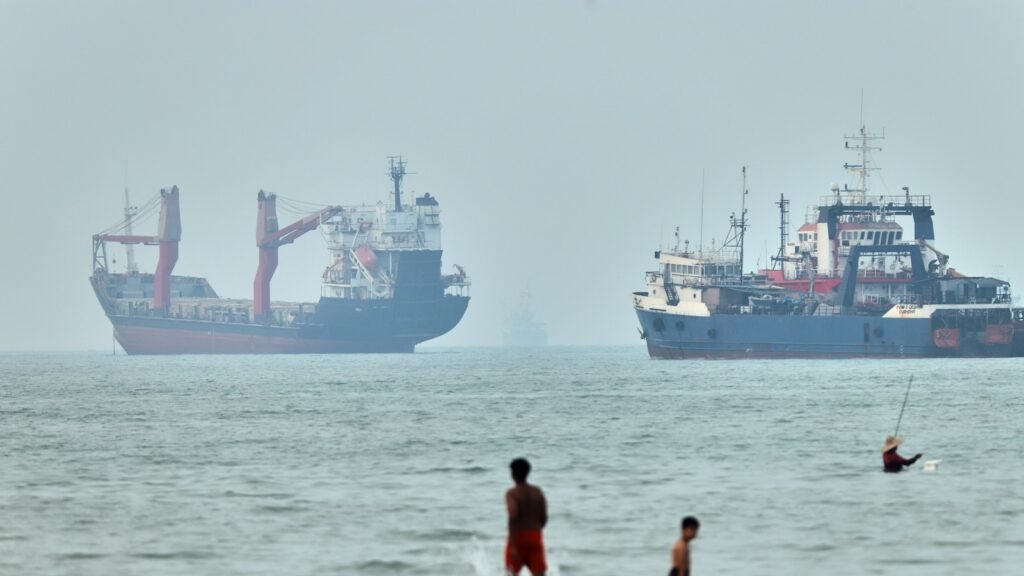
NEW YORK — Oil prices fell in early trading on Sunday, falling further from a two-month high hit last week, after the United States and Iran refrained from launching military strikes in the Persian Gulf for the second day in a row. The price of a barrel of Brent crude oil to be delivered in
NEW YORK — Oil prices fell in early trading on Sunday, falling further from a two-month high hit last week, after the United States and Iran refrained from launching military strikes in the Persian Gulf for the second day in a row.
The price of a barrel of Brent crude oil to be delivered in September fell 4.9% to $92.02 shortly after trading resumed. The drop followed a 3.9% drop on Friday.
Brent crude, the international standard, briefly hit $102 a barrel last week. That was $30 more than the most traded contract on the Brent market was trading at the beginning of the month, and the highest since May.
Oil prices rose this month due to increased fighting in the Middle East and concerns that a return to all-out war would further slow the global flow of crude oil.
The ability of oil tankers to safely pass through the Strait of Hormuz has been the main concern for the oil market since the United States and Israel attacked Iran in late February. The narrow strip of water off the coast of Iran is the route by which a fifth of the world’s oil normally leaves the Persian Gulf and heads to customers around the world, and the conflict has largely halted shipping traffic.
Oil producers have since sought alternative routes, but these too are under pressure. Last week, attacks hit Saudi oil tankers using the Red Sea to leave the region. When there is less oil available for customers to buy, the price goes up and so do fuel prices.
In the United States, the average price of a gallon of regular gasoline on Sunday was $4.11, up from $3.90 a month ago and $3.15 a year ago, according to motor club AAA.
If oil prices remain high, it could lead to higher prices for every product shipped, trucked or airlifted around the world, including groceries. Although the US economy continues to grow, the current conflict with Iran has reduced consumer confidence in that country.
The reacceleration in oil prices this month came just as inflation had begun to slow more than economists expected. Now, traders believe inflation pressures have risen enough to bet on a 36% chance that the Federal Reserve will raise its main interest rate at an upcoming meeting, according to data from CME Group.
Higher interest rates would help control inflation, but they could also slow the economy by making borrowing more expensive for all types of Americans and businesses.
Long-term mortgage rates in the United States have already reached their highest levels in almost a year, for example, cooling the real estate industry. And more expensive borrowing could slow the construction boom of artificial intelligence data centers, which have become a big driver of growth in the U.S. economy.
While oil prices have given up some of their big July gains, a lot of uncertainty still remains.
The price of a barrel of benchmark US oil to be delivered in September fell 5.6% to $84.34 on Sunday. It fell 3.1% on Friday.
In the oil market, traders buy and sell contracts for barrels of oil that will be delivered many months in the future. The price of a barrel of Brent crude for delivery in October, which is now the most traded part of the market, fell 4.6% to $87.48.
Keep following us for the latest insights.