I’m a child of the 2000s (and specifically San Diego), which is to say that Will Ferrell’s work (and specifically “Anchorman”) is deeply important to me. Star vehicles like “Step Brothers” and “Talladega Nights”; Also, did I mention “Anchorman”? – epitomized the bravado and blissful ignorance of Bush-era masculinity, in some ways even more so
I’m a child of the 2000s (and specifically San Diego), which is to say that Will Ferrell’s work (and specifically “Anchorman”) is deeply important to me. Star vehicles like “Step Brothers” and “Talladega Nights”; Also, did I mention “Anchorman”? – epitomized the bravado and blissful ignorance of Bush-era masculinity, in some ways even more so than Ferrell’s impressions of the president on “Saturday Night Live.” I have a deep and abiding love for Ferrell’s classic work, and I’ve carried that affection into more recent efforts like a small role in “Barbie” or the delightful “Eurovision Song Contest,” a film inspired by Ferrell’s personal passion for the annual spectacle.
I hope this throat-clearing gives me some credibility when I say this: “The Hawk,” Ferrell’s first time topping the call sheet for a scripted TV comedy, is a huge disappointment, especially for this longtime resident of a whale’s vagina.
From the beginning, “The Hawk” is obsessed by its own potential. Set in the world of professional golf, the show’s tagline instantly evokes “Talladega Nights,” another story of the rise, fall and rise of a star in a conservatively codified sport. Ferrell fans have also had years to build anticipation for this project specifically: A version of “The Hawk” was first reported in 2023 as a thinly veiled version of the ascendant LIV golf circuit, backed by Saudi Arabia, a controversial rival to the PGA. Comedian Ramy Youssef joined the show in 2024, only to leave months later due to alleged “creative differences.” Perhaps relatedly, the final version of “The Hawk” makes only cursory mention of LIV and the geopolitics that accompany it, focusing on Ferrell’s golfer Lonnie “The Hawk” Hawkins, his attempt to return to the PGA tour, and his relationship with his son Lance (Jimmy Tatro), now a PGA professional.
“The Hawk” took so long to air, in fact, it was surpassed by other A half-hour of streaming-native father-son golf directed by a 2000s movie star. Owen Wilson’s “Stick,” which premiered last summer on Apple TV, isn’t exactly a masterpiece, but I thought about it often and fondly as I made my way through the 10 episodes of “The Hawk.” Maybe it’s because the two shows feature identical iconography, such as a tour bus driven by a irascible older caddy, and characters, such as an archenemy whose business savvy and composure contrasts with our antihero’s disarray. (Here, Luke Wilson replaces Timothy Olyphant.) Maybe it’s because “Stick,” which has been renewed for Season 2, does a much better job of explaining the fundamentals, appeal and dynamics of professional golf to neophytes, information without which I’d be lost watching “The Hawk,” which barely bothers with such exposition. Or maybe it’s because “Stick” makes use of Wilson’s star persona but feels far less beholden to him at the expense of the story than “The Hawk,” which is committed to glorifying Lonnie and, by extension, Ferrell, above all else.
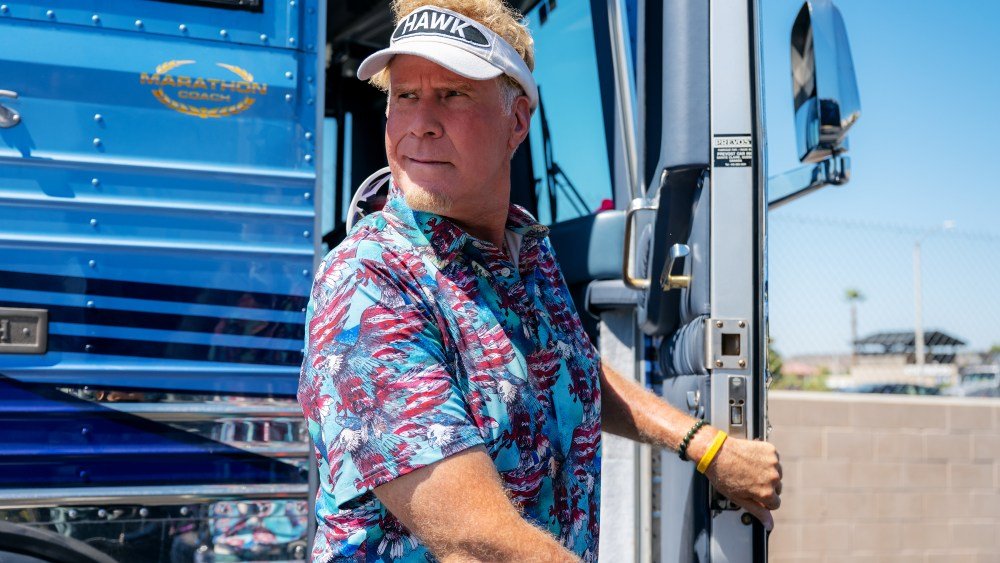
Lonnie is, of course, a textbook Ferrell: selfish, shameless, and oblivious to the knock-on effects of these qualities on the people around him. (Hawk’s way of clearing his mind before a swing is to imagine himself smashing an air guitar on a golf club to the tune of Steely Dan’s “Reelin’ in the Years.”) It also comes to life with the help of two former Ferrell associates who stepped in after Youssef left: Harper Steele, an “SNL” alum and co-star of the sweet road-trip documentary “Will & Harper,” and Chris Henchy, co-founder of Funny Or Die with Ferrell and his former producing partner Adam McKay, a director whose interest in social issues hasn’t always served him well but who is sorely missed here.
Without the rise of a disruptive force like LIV and with a creative team whose perspective is so closely tied to Ferrell’s, “The Hawk” mostly floats around, losing both the touch of satire and the driving force of narrative momentum. To the extent that “The Hawk” has an inciting incident, it is the death of Hawk’s former caddy, Old Henry (Keith David), and his replacement by Sam (Fortune Feimster), a drifter who knows nothing about irons or birdies but shares Hawk’s experience. joy of living. (His first purchase with the tournament winnings is an all-leather tracksuit, which pairs nicely with Hawk’s boldly printed pants. Costume designer Christie Wittenborn makes her mark!) A buddy comedy about two ne’er-do-wells shaking up the staid, starchy world of country club jocks is a fun idea, but Sam seems to prompt Lonnie’s return with a single pep talk before disappearing for much of the middle stretch of the season. “The Hawk” seems cautious about attributing Lonnie’s sudden rebirth to anyone other than Lonnie himself, which also makes it feel somewhat random because Lonnie is also immune to introspection or change.
Once Lonnie returns to the PGA Tour, he competes directly with his own son, whose traumatic response to his absent father’s hedonism is rigorous, self-sacrificing discipline that begins to evaporate under stress. Lance has a more interesting, or at least more clearly defined, arc than Hawk’s stubborn stasis, played entertainingly by “American Vandal” star Tatro, although he is surrounded by female characters who suffer from a lack of dimension. Lance’s fiancée Natalie (Katelyn Taver), an “aspiring fitness influencer,” is a largely ignored voice of reason rather than a comedic creation in her own right, despite how much there is to parody about her chosen profession; Stacy, Lonnie’s ex-wife and Lance’s mother, is an absolutely criminal abuse of Ferrell’s frequent on-screen partner, Molly Shannon. Stacy has little to do besides pour a canned cocktail and shout non-joke lines about how much she hates her ex, although at least Lonnie notes admiringly (and accurately) how sexy she is.
But there is no bigger problem with “The Hawk” than Lonnie himself. The show makes him irritating enough to be boring, but fails to give the character any real edge, leaving Lonnie stranded in an uncanny valley between the two poles. When Lonnie tells Lance that he wouldn’t let him play with Legos because he didn’t want his son to end up “half a faggot,” I gasped at the flash of something truly ugly. (Most of Lonnie’s antics are silly, like having a mid-ride fight with a colleague.) However, minutes later, we are told that a traumatic memory from Lance’s childhood was a fabrication; He doesn’t have to forgive his father for it, because there is nothing to forgive. We’re told Lonnie was a bad father, but he wasn’t. that bad, because “The Falcon” can’t bear to leave him alone.
Overall, Lonnie seems like a watered down, half-baked version of Danny McBride’s protagonist; perhaps not a coincidence, given that McBride collaborator David Gordon Green is the producing director of “The Hawk.” Arguably, McBride is to Trump’s America what Ferrell was to Bush’s: an artist with a fine ear for the messages a disordered culture sends to men searching for identity, with results that only grow uglier over time as the underlying illness goes untreated. But “The Hawk” doesn’t seem to especially reflect a time or place. In theory, the show’s interests are in gradually bringing a nuclear family back together, though even that topic is half-heartedly addressed. Once Lonnie’s mojo returns, he discovers that legions of fans of his prime have been waiting to see him play once again. As a long-time Ferrell enthusiast, I can’t say that “The Hawk” inspires the same emotion.
All 10 episodes of “The Hawk” are now streaming on Netflix.
Keep following us for the latest insights.