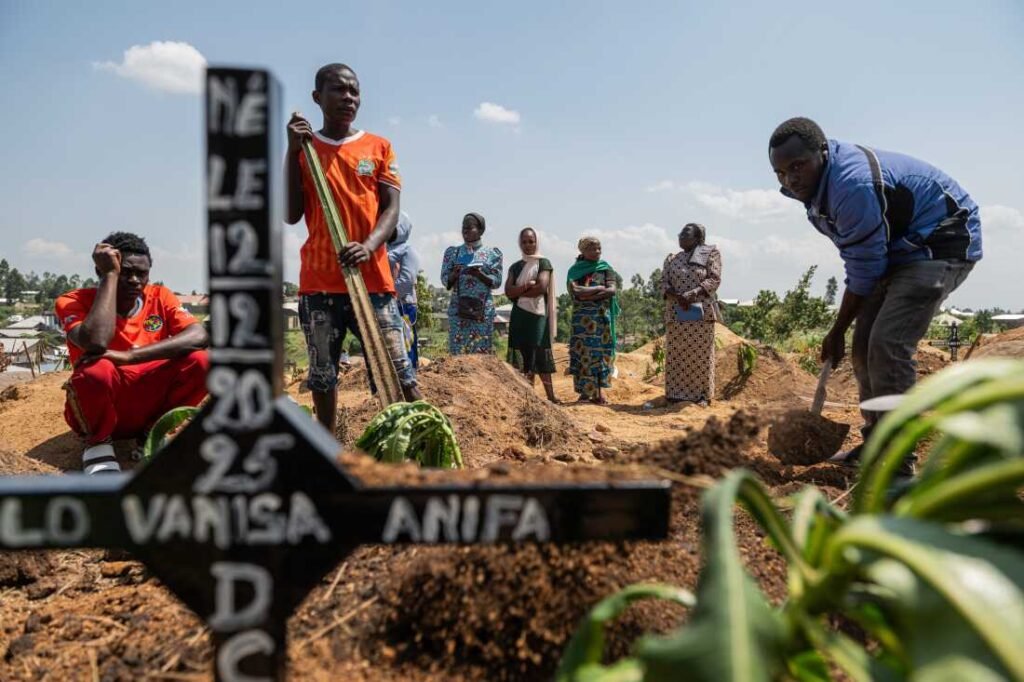
Relatives of Vanisa Anifa, a 6-month-old orphan girl who died of Ebola, attend her funeral in Bunia, Congo, on Friday, June 19, 2026. Moisés Sawasawa/AP hide title toggle title Moisés Sawasawa/AP KINSHASA, Democratic Republic of Congo—More than 1,000 people have died from Ebola in eastern Democratic Republic of Congo, according to official figures released Thursday,
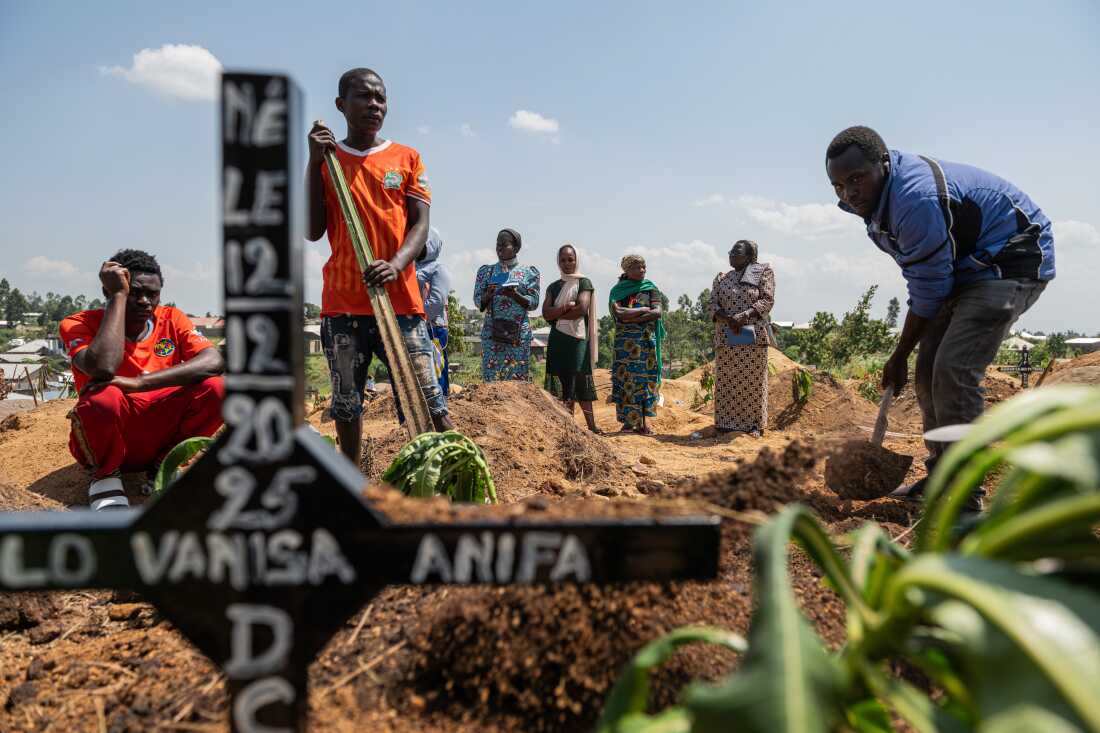
Relatives of Vanisa Anifa, a 6-month-old orphan girl who died of Ebola, attend her funeral in Bunia, Congo, on Friday, June 19, 2026.
Moisés Sawasawa/AP
hide title
toggle title
Moisés Sawasawa/AP
KINSHASA, Democratic Republic of Congo—More than 1,000 people have died from Ebola in eastern Democratic Republic of Congo, according to official figures released Thursday, and the outbreak shows no signs of slowing.
Health workers have recorded 2,536 Ebola cases, as well as 1,033 deaths, since the conflict-torn Central African nation declared an epidemic on May 15.
Congolese Prime Minister Judith Suminwa will travel to Ebola hotspots in the country’s east on Thursday to “assess the realities on the ground,” the government said, accompanied by U.S. and United Nations officials.
Health services say conditions on the ground are dire, with fragile hospitals overwhelmed and health services struggling to catch up with the scale of the epidemic.
The situation is “getting worse by the day,” Amadou Bocoum, director of the aid organization CARE International in Congo, told NPR. It pointed to shortcomings in contact tracing, funding and rapid geographic spread of the disease.
Aid workers are in a race against time to try to bring the situation under control before it gets even worse.
Ebola is now spreading in eastern Congo at the fastest rate ever recorded. According to the World Health Organization (WHO), it took 10 months to reach 2,000 confirmed cases during the 2018-2019 outbreak in Congo, compared to just two months for the current epidemic.
Other complications abound. Armed conflict has ravaged the epicenter of the outbreak, Ituri province, for more than 30 years, and more than 900,000 people live there in displaced persons camps.
One of the pillars of the local economy is also artisanal gold mining, which attracts informal workers who are highly mobile and therefore likely to spread Ebola quickly if infected.
Funding is also an issue, as the severely degraded local health system in eastern Congo, as well as NGOs, struggle to address the spread of Ebola in remote rural areas. In mid-July, the WHO said its joint $518 million plan to combat the disease, with the African Centers for Disease Control, faced a funding gap of more than $400 million.
On the ground, many doctors say they, too, work without pay. Health workers in Ituri went on a brief strike this month, for example, walking out of Ebola wards and, in some cases, burning tires outside health centres, to protest alleged lack of pay and poor working conditions.
“We cannot continue responding to the epidemic with the same limited resources while it continues to overtake us,” said Trish Newport, director of the emergency program of Doctors Without Borders (MSF) in a statement this week.
MSF, as well as other aid organizations involved in the response, also warned that many Ebola treatment centers are operating at full capacity. One consequence is that people with Ebola must often wait at home until a bed becomes available, risking infecting others.
To further complicate the answer, Ebola has also spread further away from Ituri in recent weeks.
The Congolese government confirmed this month that Ebola had reached the provinces of Tshopo and Haut-Uele. Tshopo is a particular concern. According to official figures, four people have died from Ebola in its capital, Kisangani, a major commercial center of more than a million people, with direct links to the Congolese capital, Kinshasa.
Bocoum, director of CARE International, said there was a need to increase funding. “If nothing is done, it is unlikely that the situation will be brought under control,” he said.
{For more tech updates, stay tuned to our blog.|Keep following us for the latest insights.|Check back often for more exciting news!}