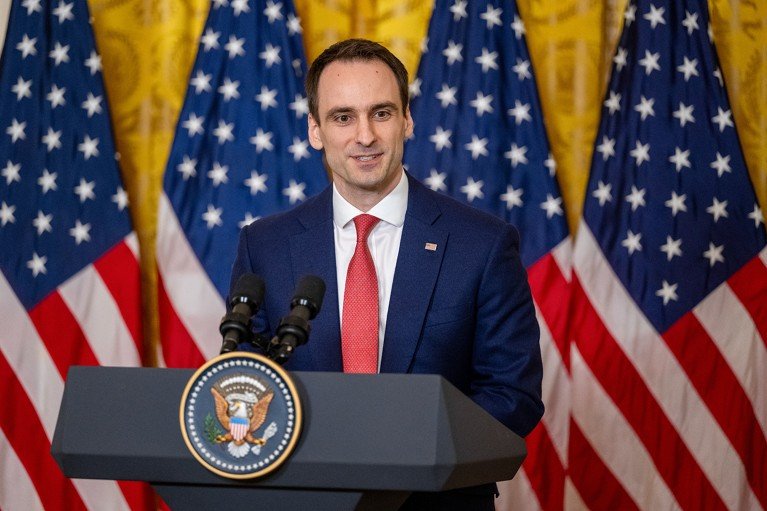
Michael Kratsios, US President Donald Trump’s chief science adviser, released a report this week that reinvents how science is funded in the country. Credit: Daniel Heuer/Bloomberg via Getty Washington D.C. It was a big week for science in US President Donald Trump’s administration. On Tuesday, the president’s chief scientific adviser, Michael Kratsios, released a report
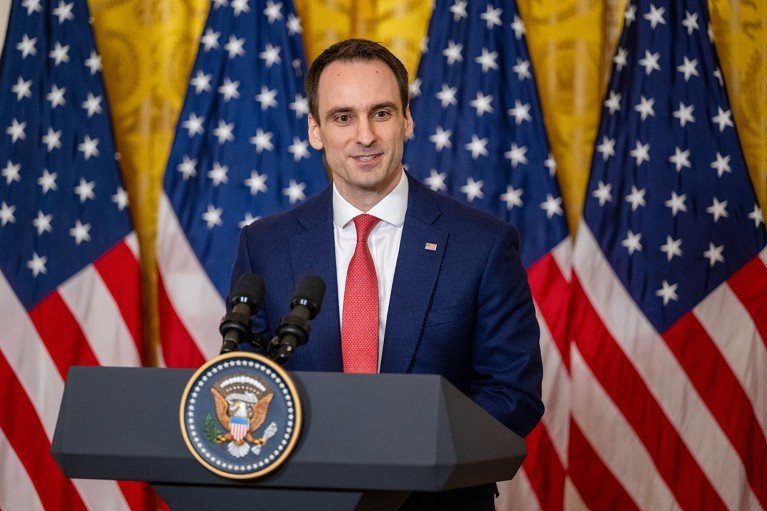
Michael Kratsios, US President Donald Trump’s chief science adviser, released a report this week that reinvents how science is funded in the country. Credit: Daniel Heuer/Bloomberg via Getty
Washington D.C.
It was a big week for science in US President Donald Trump’s administration. On Tuesday, the president’s chief scientific adviser, Michael Kratsios, released a report called Science: a new golden age which proposes substantial changes to federally funded research. The next day, he helped reveal some of the first research grant winners from the Genesis Mission, the administration’s flagship artificial intelligence initiative.
Over the past year and a half, the Republican-led administration has made headlines for attempting to cut funding for American science it disfavors. This week’s events are notable because they advance the science it does favor, particularly AI.
Trump has big ambitions in AI and quantum: this scientist’s job is to make them come true
About 5,000 teams applied for funding from the Genesis Mission, which the administration billed as a program “comparable in urgency and ambition to the Manhattan Project” to accelerate American science with AI. At a summit on July 22, officials announced around 280 winning projects in a first phase of the program. The teams will apply AI to problems such as upgrading the US power grid and automating laboratories, and will receive a nine-month grant of between $500,000 and $750,000. Researchers on these teams can also submit applications for a second phase: a three-year program that involves millions in annual funding.
“I was very, very, very happy” to be chosen “because it was incredibly competitive,” said winner Jeremy Zucker. Nature at the summit. Zucker, a computational scientist at the Pacific Northwest National Laboratory in Richland, Washington, leads a project that will model the growth of algae in ponds to maximize biofuel production.
Kratsios’s report met with a more mixed reception at a hearing in Washington DC he attended the same day. In the report, he calls for American science funding to be diverted from “legacy institutions” such as universities. “Much of our research activity has come to serve itself and not the scientists within it,” he wrote. Under this new vision, individual scientists would be supported by programs such as ‘golden tickets’, which give grant reviewers the ability to override their colleagues’ decisions to fund high-risk proposals. “We should try other ways to make progress other than what we have been doing for so many years,” he said at the hearing of the US House of Representatives Committee on Science, Space and Technology. He argued that American science is stagnant and needs to be rethought.
Members of the US Congress, who decide what science to fund, had mixed reactions. Republicans on the committee broadly expressed support for Kratsios’ vision for American science; Democrats, however, criticized the Trump administration’s cuts to scientific budgets and agencies, as well as its attempt to seize political control of grants. “They’re not throwing us into ‘the golden age of innovation.’ They’re sending us back to the Stone Age,” said Gabe Amo, a Democrat who represents Rhode Island.
Some scientists were quick to criticize the report. Carl Bergstrom, an evolutionary biologist at the University of Washington in Seattle, wrote on the social media platform Bluesky that the administration appears determined to “destroy” American universities. (Trump and his Republican allies have accused American research institutions of being discriminatory toward conservative views, and the administration has withheld funding from some universities, citing anti-Semitism.)
Grant Challenges
Lawmakers also questioned Kratsios about media reports, including one from Naturethat the US National Science Foundation (NSF) plans to recover about $500 million from its grant-making divisions and funnel the money into a new White House initiative. Democrat Zoe Lofgren of California asked the chief scientific advisor about this. He responded, “I’m not familiar with those details. I would refer it to NSF,” but stated that the United States should “be more deliberative and specific in trying to address big challenges.”
NSF plans cuts to basic science programs to fund White House initiative
Nature has learned that the NSF has withdrawn $300 million from two of its divisions: mathematics and physical sciences, and computer and information sciences and engineering. Program officials, who handle grant proposals at NSF, have withdrawn 150 proposals that already passed peer review to free up money that the U.S. Congress appropriated to the agency. Some proposals have been rescinded, others have had funding cuts, and others have been carried over into the next fiscal year.
NSF staff members, who spoke with Nature On condition of anonymity for fear of retaliation, they say the money will likely go to a program called Grand Research Challenges, organized by the White House Office of Science and Technology Policy, which Kratsios runs. A preliminary document shown to Nature which appears to outline the challenges lists four areas: the future of intelligence, the frontier of quantum phenomena, advanced materials and matter, and the foundations of biological design.
An NSF spokesperson said the agency would not comment on internal budget deliberations. They said funding for research activities in fiscal year 2026 could be awarded that year or the following year, and that “NSF reviews budgets and manages portfolios as necessary.”
For more tech updates, stay tuned to our blog.