Ten years ago, the virus that causes polio seemed to be on its way to extinction. In August 2016, Nigeria experienced its last two cases of the wild virus, leaving it circulating only in Afghanistan and Pakistan. Amid global enthusiasm, Hamid Jafari, who at the time was leading polio operations and research at the World
Ten years ago, the virus that causes polio seemed to be on its way to extinction. In August 2016, Nigeria experienced its last two cases of the wild virus, leaving it circulating only in Afghanistan and Pakistan. Amid global enthusiasm, Hamid Jafari, who at the time was leading polio operations and research at the World Health Organization (WHO), predicted of Pakistan: “It may be months, months, not years, before we eradicate polio in this country.”
Polio is on the brink of eradication. Here’s how to prevent it from coming back
However, since then, eradication targets have come and gone: 2019, 2023, 2025. Last month was the last missed target to stop transmission. Over the past decade, more than $3 billion has been spent fighting the virus in Afghanistan and Pakistan, where billions of doses of oral vaccine have been administered. Campaign leaders hoped polio would finally disappear during last winter’s low transmission season. But that didn’t happen; So far this year, 14 new cases have been reported.
New challenges now threaten the endgame, including an unprecedented funding shortfall and, from New York to rural Pakistan, growing vaccine hesitancy.
Although the WHO stated last January that eradication was “within reach,” the majority of researchers interviewed by Nature For this article we are very concerned about the chances of success. “In theory, eradication is possible, but in practice it is not,” says Kimberly Thompson, who studies health economics at Kid Risk, a nonprofit consultancy in Orlando, Florida, that models polio transmission and eradication.
So will we ever rid the world of polio or is it time to implement plan B?
Ambitious effort
The polio eradication effort relies on the oral polio vaccine (OPV), a drop of liquid containing live, attenuated poliovirus. Giving it to children protects them from disease and prevents the virus from spreading by blocking its replication in the intestine. A population immunity level of around 90% is needed in vulnerable areas for the virus to disappear. A different vaccine, inactivated polio vaccine (IPV), contains killed strains and is administered by injection. It is administered globally, in both vulnerable and polio-free areas, and protects against disease but does not stop transmission.
In rare cases, the attenuated OPV virus can mutate to regain virulence, meaning it can cause vaccine-induced cases of polio and paralysis. When immunity is poor, vaccine-derived polio can spread in communities. Ultimately, the strategy is to eradicate wild poliovirus with oral vaccine and then carefully withdraw that vaccine without triggering vaccine-derived polio, while using IPV to protect against such outbreaks.
At first glance, the approach is working well. When the Global Polio Eradication Initiative (GPIE) began almost 40 years ago, there were 350,000 cases of wild polio each year in 125 countries. By 2025, the GPEI, a partnership of national governments and international organizations, had reduced wild polio to just 52 new cases, a drop of 99.98%. What’s more, modelers estimate that their work has prevented between 2.5 million and 6 million cases of paralysis1.
And leaders still say they are optimistic. Today, says Arshad Quddus, acting director of the GPEI, we are still moving towards zero: polio is transmitted less frequently and in smaller areas. Some places previously considered “core reservoirs” have not seen cases in more than a year, he adds.
But the data tells a different story: Polio cases rise and fall. For example, the number of wild cases dropped to 22 in 2017, but rose to 176 in 2019, fell to 6 in 2021, but recovered to 99 in 2024 (see ‘Ups and downs’). The pattern is similar for the detection of the virus in the environment. It is enough for Thompson to conclude: “We are not going towards success.”
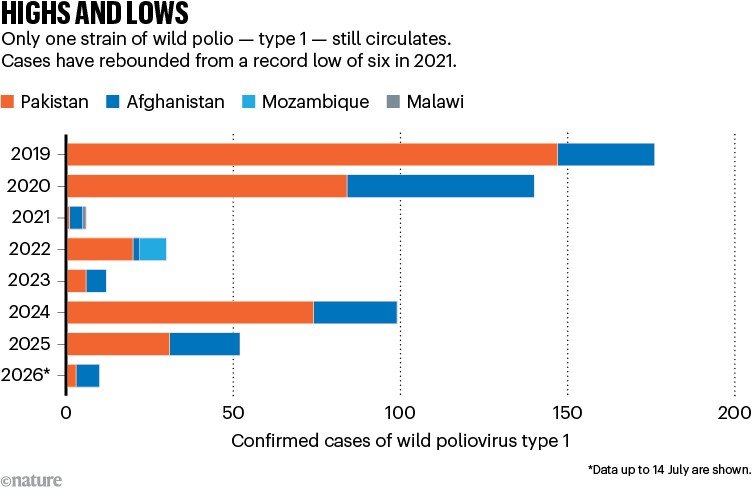
Source: World Health Organization
The key to polio eradication is high population immunity, particularly intestinal immunity, which blocks transmission. It has been achieved in the most difficult geographies: now, of the three types of wild polio that circulated, only type 1 remains.
If the rest of the world has managed to stop transmission, why isn’t that happening in the two remaining hiding places? Is there something about type 1 that makes it harder to nullify than the others? “I think the answer to this has to be no,” says David Salisbury, chair of GPEI’s Global Commission for the Certification of Polio Eradication, citing its successful eradication elsewhere. Some researchers have suggested that the oral vaccine fails to generate the level of immunity in Afghanistan and Pakistan that it achieved elsewhere.2but most say the problem is not scientific.
“We know the tools, we know the key reservoir areas,” says Isobel Blake, who models polio epidemiology at Imperial College London. The challenges, he says, are “operational.”
Despite Herculean efforts, there are still 100,000 unvaccinated children in inaccessible districts of the two countries, and average immunization rates in some districts are below 50%, says Zulfiqar Bhutta, a pediatrician at Aga Khan University in Karachi, Pakistan. And yet, much of what they face has been addressed elsewhere in the world, Salisbury says.
Violence broke out between Pakistan and Afghanistan this year, and conflict-torn areas in southern Pakistan have become inaccessible, Quddus says; Many people continually cross the border between Pakistan and Afghanistan, replenishing viral stocks, and distrust of vaccinators has increased. At least four police guards have been killed while accompanying vaccinators just this year in Pakistan, and in southern Afghanistan, female and house-to-house vaccinations, which have been crucial to global success, are banned.
However, in northeastern Nigeria, Salisbury says, polio was eradicated even though the rebel group Boko Haram actively resisted anti-polio campaigns between 2009 and 2016, killing vaccinators and destroying health facilities. And the war in Gaza did not prevent the negotiation in 2024 of a humanitarian pause to allow emergency vaccination against polio for 640,000 children. Religious opposition has also been overcome elsewhere, he says.
Polio is on the brink of eradication. Here’s how to prevent it from coming back
But Quddus maintains that some problems in Afghanistan and Pakistan are unique. In Gaza, it is clear who is in conflict and from whom to seek approval for a campaign. But in the southern part of Khyber Pakhtunkhwa province in northwestern Pakistan, “the situation is complicated. There is no very specific group or groups” to negotiate with. And in southern Afghanistan, Salisbury admits, the ban on house-to-house vaccinations and of women is “a fundamental difficulty.”
Polio workers are constantly innovating in these regions, Quddus says. “What’s very clear,” says Kathleen O’Reilly, an epidemiologist at the London School of Hygiene and Tropical Medicine and WHO polio advisor, “is that they will try anything.”
There are some challenges that make today’s campaign even more difficult. The novelty of this global mission has diminished; Polio cases are rarer than other health problems, eroding communities’ enthusiasm for vaccination. Polio funds flow to Afghan authorities “no matter how poorly the program is run,” the GPEI Independent Monitoring Board noted last year. “For the first time in the history of polio eradication, it does not appear that Afghanistan is or wants to be [involved].”
Falling funds
The other major problem is that the campaign has had to deal with a 30% budget cut this year. The upheaval in the United States’ commitment to global health is partly responsible. There continues to be support for polio eradication in the United States, both among the public and in Congress, and the disease was one of the few to be included in the country’s new global health strategy, released last year.
But changes over the past year — including the U.S. withdrawal from the WHO and the dismantling of the U.S. Agency for International Development under President Donald Trump’s administration — have altered the infrastructure and technical expertise the U.S. contributed to eradication.
Instead, the United States has negotiated bilateral health agreements with 34 countries that receive global health assistance from the United States, but it is unclear how much support these will provide to anti-polio campaigns.
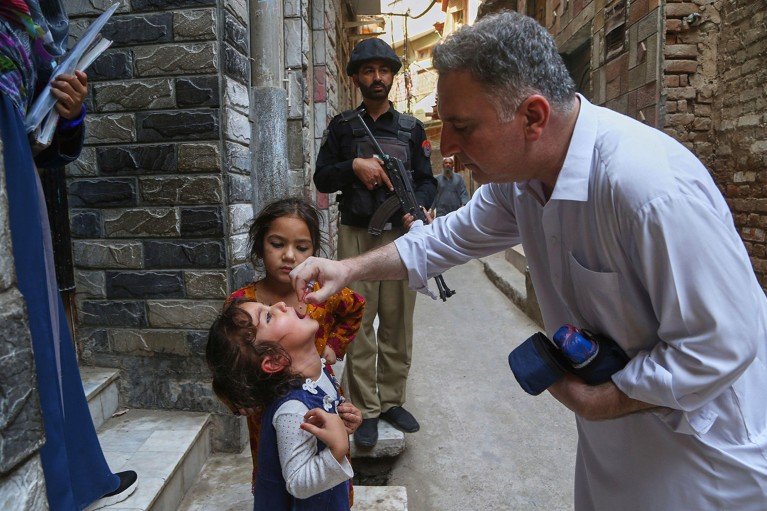
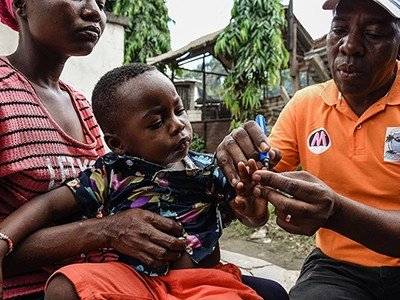
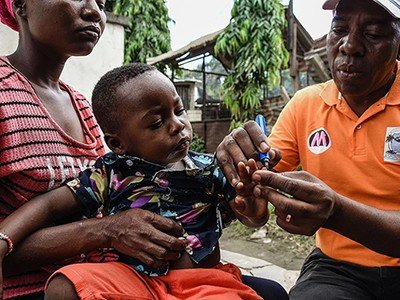
A health worker administers a polio vaccine to a child in Pakistan, one of two countries where cases of wild poliovirus persist.Credit: Muhammad Sajjad/AP via Alamy
Other nations, such as the United Kingdom, have stopped contributing to the GPEI, although the Gates Foundation, a nonprofit in Seattle, Washington, and other donors pledged $1.2 billion last December, reducing the deficit in the coming years.
Due to its reduced budget, the GPEI has cut back some of its activities, particularly OPV immunization in areas that are not currently experiencing outbreaks. Modelers say this is risky for areas vulnerable to wild or vaccine-derived polio.
Cases of vaccine-derived polio have been declining year over year since 2022, when there were 882 cases, most in sub-Saharan Africa. The number of cases increased as a result of a botched disruption of the global vaccine program in 2016, when the oral type 2 vaccine was discontinued after that strain was eradicated.3. Quddus says the recent drop is due to the rapid increase in vaccination in areas affected by outbreaks.
But both Blake’s and Thompson’s models show that to successfully eradicate outbreaks, it is essential to preventively vaccinate vulnerable populations that are currently polio-free, the same activity that has declined this year.
Uncertain future
Nobody Nature Those interviewed for this article said eradication is impossible, in theory. But most didn’t think it was imminent, and many thought it couldn’t be achieved with standard approaches.
“If the program did everything right and resources weren’t an issue, then it could be done,” Thompson says. But after so many years of missed targets, and in the current funding climate, he says, “I think it’s already failed.”
Check back often for more exciting news!