
My dad is one of the smartest people I have ever met. He was known as a talented poet and speaker at the Universidad Mayor de San Andrés in La Paz, Bolivia. But during this time, Colonel Hugo Banzer established a military dictatorship and, in the midst of political repression against students, left for Madrid
My dad is one of the smartest people I have ever met.
He was known as a talented poet and speaker at the Universidad Mayor de San Andrés in La Paz, Bolivia. But during this time, Colonel Hugo Banzer established a military dictatorship and, in the midst of political repression against students, left for Madrid in 1971.

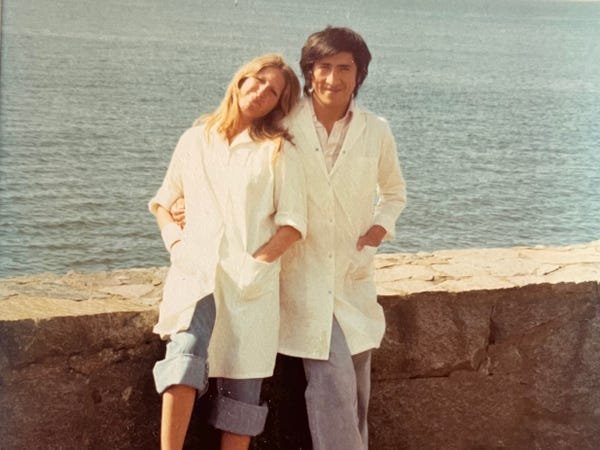
Freddy and his wife, Adela, newlyweds in Stockholm, Sweden, in the 1970s. Courtesy of the author
Fate took him to Pontevedra, where he met my mother, a local dressmaker with a store in the city. They married in 1975. As newlyweds, they spent time in Stockholm before settling in my mother’s hometown, where my brother and I were born.
I always thought of my dad as an undiscovered genius.
He was an unpublished writer with a gift for explaining complex ideas in a simple way. He taught himself classical guitar and piano, was excellent at mathematics, could draw well, spoke English, and became a local chess champion in the early 1980s.
We were a slightly eccentric family. Not rich, but culturally rich and surrounded by our beloved stray dogs. My dad loved philosophy and literature and believed that the mind should remain active. As a teenager, when I wanted a computer, he gave me his copy of Goethe’s “Faust” and, with his usual wit, told me, “Your brain is your best computer!”
His brain is the reason I write about him. He is now one of millions living with Alzheimer’s, a form of dementia, but to me, he is one in a million: my brilliant father.
He was diagnosed with Alzheimer’s at age 71 and is now 77.
For a while he became suspicious and accused my mother of stealing his things. She became overwhelmed and we tried daycare, but it didn’t work out. The place was good, but my dad is independent and stubborn, so he wanted to leave, questioning what he was doing among “older people.”

Living in a small, walkable town has made it possible for the author’s father to be independent. Courtesy of the author
The big turning point for us was when he spent a week in the hospital for a medical issue unrelated to Alzheimer’s. Being bedridden in the hospital made him depressed and the nurses found it difficult to treat him. He was sedated periodically to keep him calm and prevent him from trying to leave. It was heartbreaking. Once sedated, he lost the spirit that kept him active. That experience made us sure that a nursing home was not for him. We feared that he would spend much of his time medicated so the staff could care for him.
He never accepted his diagnosis.
At every appointment with the neurologist, he would ask me why I was there and call me a hypochondriac.
But he is a lucky man. He has my mother. Without it he couldn’t enjoy the life he has. She has an admirable work ethic and by 11 a.m. she has already cleaned the house, done laundry, bought food, and is making lunch. Their marriage is far from perfect, but after 51 years, they have their own understanding. She is practical and speaks in Galician proverbs and proverbs, and he is the one who philosophises everything. When they argue, as they do every day, he can say a Nietzsche quote while she responds with a saying.

Alzheimer’s has affected the author’s father’s short-term memory, but many of the skills and interests he developed earlier in life remain intact. Courtesy of the author
But let’s not idealize it. It can be infuriating. He wakes up regularly during the night, disrupting his sleep, hides things, and may become cautious and distressed, believing that his IDs or watch have been taken. He refuses to cut his hair and wears many layers of clothing. He had pneumonia when he was 20 and remembers it, which is why he dresses up all year round.
Even so, being in your family environment is more comforting than any institution.
We want you to have independence.
Living in a small city like Pontevedra has helped. People often see him walking, a bit like “Where’s Waldo?”, always on the move and familiar to many. When I run into him, he says, “I’ve been looking for you all afternoon!”
This independence comes with concerns. He insists on going for a walk even when told not to. You may fall, become disoriented, or tell the cafe staff that you have paid when you haven’t. Once, someone brought him home after finding him missing. You may lose your flip phone, rarely answer it, or return with someone else’s umbrella.
My dad can’t remember what he did two hours ago, but he can solve math questions, help my son with homework, or play chess.
In this family, caring means involving him in daily life rather than placing him in an unfamiliar environment. This independence is dignity, much more than keeping him calm or under control. He is a loving grandfather who still enjoys his steak and chips and a coffee with milk in the city and who believes that life goes on as always. And for now it’s for him.