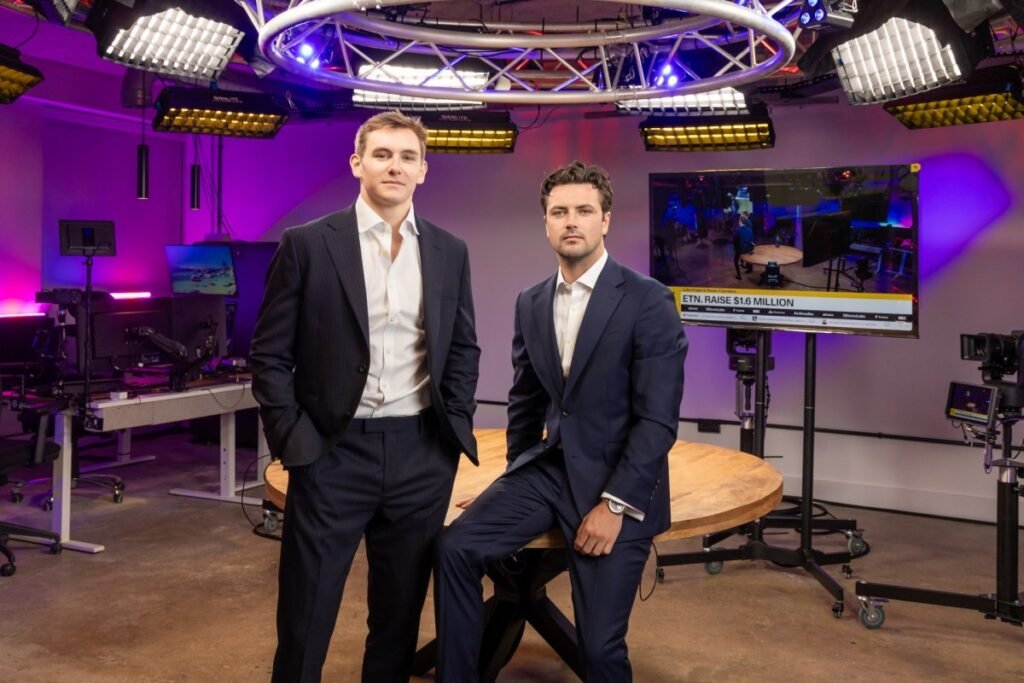
The European response to TBPN is here and ready to go live five days a week, starting June 27. Luke Knight and Ronan Chambers first launched the London-based European Technology Network (ETN) last October, analyzing tech trends and news during a livestream two days a week. The show is currently streaming live on X and
The European response to TBPN is here and ready to go live five days a week, starting June 27.
Luke Knight and Ronan Chambers first launched the London-based European Technology Network (ETN) last October, analyzing tech trends and news during a livestream two days a week. The show is currently streaming live on X and YouTube and has garnered over 5 million views.
On Monday, the network announced a $1.6 million seed round from major players in the media ecosystem, including Powerhouse Capital, Axel Springer SE (owner of Business Insider and Politico), popular media publication LadBible, and angel investors from OpenAI and DeepMind. With this new capital, the network announces its largest expansion yet.
It’s now moving into a large studio in Kings Cross (where all of London’s AI startups are based), expanding the team (currently just eight), launching a newsletter and, starting today, moving to a five-day-a-week live show schedule, which will soon see Knight and Chambers interviewing the likes of George Robson (a partner at Sequoia) and Rishi Sunak (former UK Prime Minister and senior advisor at Anthropic and Microsoft).
Speaking to TechCrunch, Knight and Chambers said ETN has already become an important stop on the press tour for European startups: they spoke with the founder of Synthesia, the CFO of Legora, the founder of Granola, and Kanishka Narayan, the UK’s first AI minister. They’ve even invited American investors to visit the show when they’re in town, including one from Andreessen Horowitz.
“ETN was born out of a big hole in the industry,” Chambers told TechCrunch. “It focuses on rhythm.” He said the current media ecosystem in the UK cannot keep up with how quickly the tech scene is moving. For example, so far this year, London startups have raised $14.7 billion according to Dealroom. Six companies have raised more than $500 million: Wayve, Superintelligence, ElevenLabs, Recursive, Ineffable Intelligence and Isomorphic Labs, the last three founded by DeepMind alumni.
“These are things that have never happened before in Europe,” Chambers continued, referring to the speed at which capital flows through the ecosystem. As the show became more popular, Chambers said they received about 70 submissions a week from guests who wanted to come on the show. They tried to do 12 interviews in two hours, twice a week, but in the end it was too much. “We needed an outlet that could move at the pace of that,” he said of the interest in the show and how quickly Europe’s tech ecosystem is moving, “which is why we’re going from two days a week to five days a week.”
The five-day format will be quite similar to the two-day format. There will be a live show from 12pm UK time until 3pm breaking down the most popular stories, and then for two hours they will have guests on the show talking about whatever they want. Chambers said they also want to start hosting debates, roundtables and a Shark Tank-style pitch session on the show.
“We want to make it as useful to the ecosystem as possible,” Chambers said. “There needs to be more discourse about AI in Europe. There needs to be more discourse about venture capital and cash flow into the ecosystem. There needs to be more discourse about the wonderful things that are happening in the tech ecosystem, and our role is to be the stage where people can shout about all the wonderful things they are doing.”
The show makes money from advertising dollars, like most media publications, and big-name sponsors already include prediction marketplace Polymarket, blockchain company Base, and AI audio favorite ElevenLabs.
When asked about the influence TBPN has had on them, Knight and Chambers said they do indeed consider John Coogan and Jordi Hays, founders of TBPN (which recently sold to OpenAI for what some say was a nine-figure sum), as pioneers of this new tech media ecosystem. The show became a place for tech guests to appear and chat with friendly faces, announcing new product launches, hiring or funding news. “My thought was, if we can have an ITV and a BBC, why wouldn’t we have a regional version of this?” Chambers continued.
However, Europe is a big place, with over 40 different countries and over 200 languages spoken (24 of which are recognized by the European Union). Chambers said that although ETN will report from London, he and Knight are making an effort to attract guests from across the continent. In addition to bringing guests to the studio, they also travel to the most important technology conferences in Europe. For example, they broadcast from the Panathenaea Conference in Athens and from inside the Louvre in Paris for the RAISE AI Summit.
“You have all these different cultures, these different minds coming together and creating different products,” Chambers said. “You can try what it does [Europe] a superpower.”
With all this, they said they would never turn down an American founder if they wanted to appear on the show. “It is a European technological network, but we believe that there are enormous [global] opportunities,” Chambers said. Knight added to that, noting how often conversations pit the European tech ecosystem against the US.
“We are globally optimistic,” Knight said. “We are driving global prosperity from Europe. Wherever you want to go and build your company, wherever is the best place to go and build that company, go and do it, and we will shout at you to go and do it.”
He and Chambers don’t necessarily see themselves as journalists either; rather, they consider themselves tech-savvy and curious to know what is happening and why. They also do not see themselves as replacing traditional media and instead intend to work in conjunction with those publications. “We rely on traditional media,” Chambers said, adding that’s how they find a lot of the news they talk about on ETN.
Overall, the duo hopes to help document the stories coming from the new wave of European success, from ElevenLabs in London to Lovable in Stockholm, to help the next generation understand that technology is a way to propel a nation forward.
Discussing the impact of European success stories, Chambers said: “It irritates the next generation to the point where it’s no longer cool to finish university and go into banking or consulting. People want to leave university and go straight to starting a new company, and I think that’s a surprising thing.”
When you buy through links in our articles, we may earn a small commission. This does not affect our editorial independence.
For more tech updates, stay tuned to our blog.