
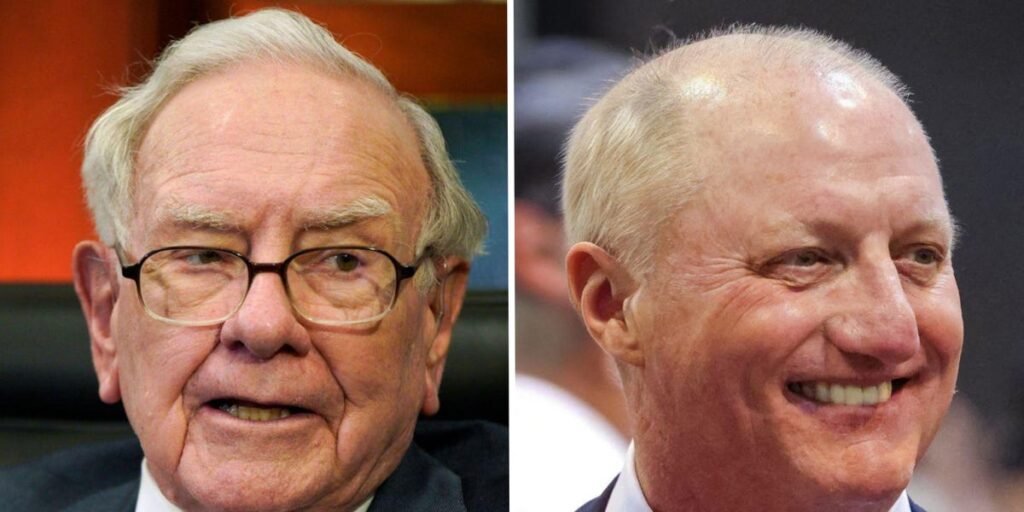
Warren Buffett’s successor, Greg Abel, just completed his first acquisition as CEO of Berkshire Hathaway. It’s the latest sign that he’s ready and willing to build on what Buffett built. In a press release on Friday, Berkshire said it had officially acquired Taylor Morrison for $8.5 billion in cash, a deal it first announced in
Warren Buffett’s successor, Greg Abel, just completed his first acquisition as CEO of Berkshire Hathaway. It’s the latest sign that he’s ready and willing to build on what Buffett built.
In a press release on Friday, Berkshire said it had officially acquired Taylor Morrison for $8.5 billion in cash, a deal it first announced in late May.
Taylor Morrison is one of the country’s largest real estate developers and homebuilders; It made about $1 billion in pretax profits on about $8 billion of revenue last year, its latest annual report shows.
The homebuilder has now joined Berkshire’s group of housing-related subsidiaries, which includes its real estate brokerage network, Berkshire Hathaway HomeServices, and its building products businesses, such as Clayton Homes, MiTek and Acme Brick.
“Berkshire is acquiring a premier national homebuilder, led by an exceptional team and backed by a trusted reputation for customer experience,” Abel said in the May press release, echoing Buffett’s appreciation for market power, quality management and a strong brand.
Abel said he hopes to “unify our site-built home construction operations into a combined platform that allows us to make the dream of homeownership a reality for more Americans.”
He shared a nearly identical vision in Friday’s press release, noting that he plans to marshal Berkshire’s homebuilding power to try to help address the affordability crisis that has prevented many Americans from becoming homeowners.
The news release states that Taylor Morrison’s brands, including Esplanade, Yardly and Taylor Morrison Home Funding, will be combined with the site-built home construction operations of Berkshire, a collection of 15 regional and local homebuilders that make up Clayton Properties Group.
Taylor Morrison CEO Sheryl Palmer similarly said the united operations will be “transformative” in scale and scope.
Forging your own path
Abel replaced Buffett on New Year’s Day, marking the end of a nearly six-decade career for the legendary investor that saw him transform a failing New England textile mill into a trillion-dollar conglomerate. Buffett remains chairman, and both men have said he provides input into every major company decision.
Regarding the deal with Taylor Morrison, Buffett told CNBC’s Becky Quick in May: “Greg did it faster than I could have done it, more easily than I could have done it, and I never spoke to the CEO. He launched it.”
Buffett’s defining struggle for years has been finding smart ways to use Berkshire’s cash hoard, which doubled in size to $380 billion in the two years ended March 31. That sum exceeds the market capitalization of many of the most valuable companies in the United States, including General Electric, Coca-Cola and Procter & Gamble.
The bargain hunter has refused to buy shares at record highs, make acquisitions when private market valuations are high and private equity firms are fiercely competitive, and even buy back Berkshire shares when they rose to record levels.
The situation may finally be improving. Buffett recently told CNBC that he made the decision to invest in Alphabet last year. During the nine months ended March 31, Berkshire built up a stake in Google’s parent company valued today at $18.5 billion.
It bought another $10 billion in shares in a private placement in June, giving it a stake of about $28 billion today, assuming it hasn’t altered the size of its stake in recent months.
That means Berkshire, which rarely makes big changes to its stock portfolio, took Alphabet from zero to a top-five position in less than a year.
Berkshire also reached a deal to acquire OxyChem in October for nearly $10 billion from Occidental Petroleum, one of the largest holdings in its stock portfolio in recent years.
In addition to his efforts to allocate Berkshire’s capital, Abel has also begun putting his top lieutenants to work. Michael O’Sullivan, Berkshire’s first general counsel, and Charles Chang, who is set to take over as Marc Hamburg’s chief financial officer next year, briefly served as acting directors of the acquisition vehicle that bought Taylor Morrison, along with Hamburg, an SEC filing shows.
It’s not entirely clear how much influence Buffett has had on Abel’s early decisions. But it seems that between turning an AI giant into one of Berkshire’s largest holdings, acquiring a leading homebuilder, and bringing O’Sullivan and Chang into the merger process, Abel is starting to make his mark.