
Sign up to receive products 🛍️ Product news, reviews and must-see deals. By registering, you confirm that you are over 16 years of age, will receive newsletters and promotional content, agree to our Terms of Use, and acknowledge the data practices in our Privacy Policy. You can unsubscribe at any time. The screech of your
The screech of your hair dryer’s jet engine is a sound that most people run away from. But listen to the right frequencies, says Alexandra Fierra, and something else emerges: movement, rhythms that change and repeat, musical textures that undulate like waves on the ocean. “There’s a movement of energy there that, if you could hear it, can actually be very elegant,” he says.
Most of us never hear it, because the sound is actually no sound at all. It is the electromagnetic field emitted by the motor, invisible and restless, that radiates almost everything electrical in your home, which we would normally find as interference. Fierra built an instrument to play it.
Eternal Research Demon Box
See it
That instrument is the Demon Box, a $999 desktop device from Eternal Research, Fierra’s Brooklyn-born and now Los Angeles-based company, which launched this year after a Kickstarter campaign raised more than $111,000. It captures the electromagnetic fields radiated by everyday electronic devices and converts them into sound, along with control signals that can control synthesizers, modular equipment and stage lights.
Demon Box’s name and marketing lean toward the occult (“part science and seance”), but Fierra’s actual tone is closer to the opposite of mysticism. The magic, he maintains, is that all of this is really there and you can learn to listen to it.
The idea of listening to EMF is older than the Demon Box. Since the late 1970s, German artist Christina Kubisch has used induction coils to convert the fields around us into sound, and her Electrical Walks series provides participants with headphones that make audible the invisible electrical activity of a city. Since then, affordable wearable devices such as the open-source Elektrosluch have helped bring electromagnetic listening to a wider audience. Fierra sees the Demon Box as the next evolution of that idea, going beyond simple field monitoring to become a spatial listening device and expressive instrument in its own right.

Meet the Demon Box: the instrument that channels the unknown
Deconstructing guitars years ago, Fierra built his own powerful version of the same idea and then moved on. When people told her that someone had already done it, she took that as an indication. “What does 30 steps beyond that look like?” remember thinking. “One of the Achilles heels of capitalism is that sometimes, when you get a product that sells, you stop innovating.”
Here’s the simple version of how the Demon Box works: Inside its triangular enclosure are 33 small inductors, arranged in three channels, which act as antennas for the electromagnetic fields around them. Bring a magnetic object close to it and the box will detect the field; The signal can be output as audio, as a control voltage for a modular synthesizer, or as MIDI to trigger other instruments and visuals. The movement that makes it an instrument more than a meter is the phase.
“If you put several of these together and everything is out of date, you create this third thing,” Fierra says. These are new rhythms and changing amplitudes that are born from the interference between pickups.
Instead, a guitar pickup aims to capture one string cleanly and treats everything else as a problem. “We didn’t invent any of the pieces,” he says. “We just organized them in a way that was completely unique.”
The fun lies in where you point the Demon Box. Obvious targets have motors: electric drills, electric toothbrushes, anything that hums. Then Fierra realized that she didn’t need any power. A permanent magnet has a field that the box can read, just like the coil in a Bluetooth speaker or the buried inductor coil in a cell phone, which sings when you pass it over the sensors. Two magnets together form a third pattern when their fields collide.

Each magnet has a different shape and therefore a different voice, and Fierra likes to hold a sheet of magnetic field observation film over them to see the fields directly. Her instinct is a kind of investment, not so much about transforming the noise but, as she puts it, “becoming a better listener of details.”
Hold a fluorescent light over the box, he says, run it through the effects, and “it turns into a big, beautiful drone.” A violin is difficult, he points out, because everyone wants to play it as if it were a violin. Nobody expects anything from a hair dryer and that is exactly freedom.
Fierra came to all of this sideways. He grew up in a Pennsylvania Dutch community where, he says, “if you can’t do it yourself, you can’t do it.” And she describes herself as a former Luddite, disdainful of technology that seemed “adversely inhumane.” He wrote on a typewriter and refused to buy an iPhone, until he recast the entire category. “A synthesizer is like a new kind of hammer or a new kind of saw,” he says.
Fierra started playing piano at age 30, and at 42 he sees that late start as a license rather than a limit: He emerged outside the world of traditional music, without an inherited sense of how things are supposed to be arranged.
The invention runs in Fierra’s family and hides in plain sight. His great-grandfather, JI Rodale, founded an electrical connector company with his brother in 1923 and later used the profits to build the publishing company behind magazines such as Organic Gardening and Prevention. His daughter Ruth married Joel Spira, who invented the first solid-state dimmer, and brought him into Lutron, the Pennsylvania lighting company that Rodale himself helped seed, giving the couple room to establish themselves.
The dimmer is the object that Fierra keeps coming back to, precisely because you forget it’s there. “To me, that’s how good the design is,” he says. “It’s just there.” It’s also a fair description of what you want from Demon Box: quiet, nuanced work on a signal most people never think about.
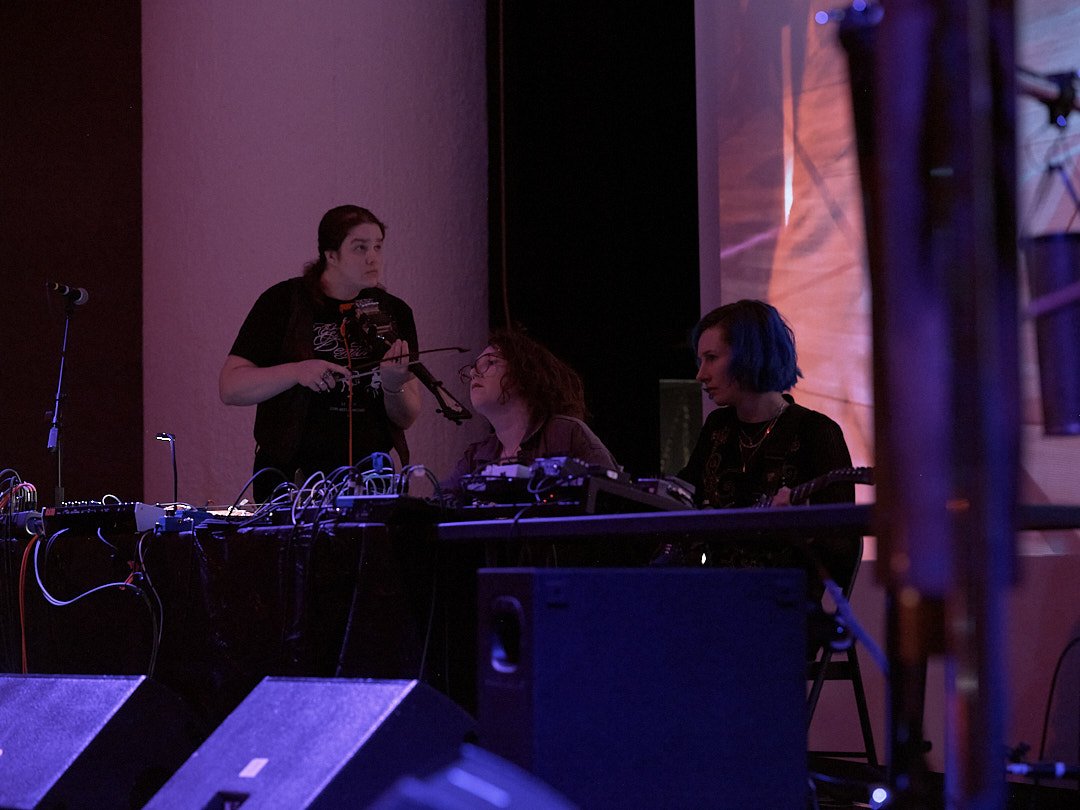

Fierra Ex Machina is featured in Rite of the Demon: Summer in San Francisco, Eternal Research’s synesthetic retelling of the Oracle of Delphi through live music, dance and film, alongside electronic music pioneer Suzanne Ciani.
That instinct, to rearrange familiar parts rather than invent new ones, is why Fierra moves from electronics to orchestra in search of his true lineage. She points to Stravinsky’s work. He Rite of springwhich pushed the violin front and center, spreading the colorful spotlight throughout the orchestra.
“The Demon Box is in a way a legacy of The rite of spring” says Fierra. “It just changed the orientation of things.” Even the strange count of 33 inductors, arrived at around prototype 17, follows a rule she repeats like a mantra: “There is a hint of arbitrariness in any worthy endeavor.”
So what about the demon? Fierra is content to let people enjoy the hidden flavor, but says that’s not its true meaning. His is the oldest sense of the word: the demon, a muse and guide more than anything to do with good and evil. It is, he says, “the inspirational demon that comes to you in a dream and says: I will go further, there is more out there.”
That’s the whole project, really. If you are in a forest, says Fierra, everything is alive, all energy, principle and movement, and that is already surprising without adding anything supernatural. “Even reality is magical.”
The Demon Box just gives you a way to listen a little more. Which means that the next time your hair dryer whines, the fluorescent light vibrates, or your phone hums against the table, you can argue that your ordinary, irritating, electrified world has been singing the entire time. You just had to listen.

Awards for the House of the Future of Popular Science 2026
For more tech updates, stay tuned to our blog.