Three weeks after Apple filed a landmark case accusing OpenAI of stealing trade secrets, OpenAI is hitting back. In a new blog post, the ChatGPT-maker said Apple’s lawsuit is “careless, aggressive and oddly personal.” Apple alleged in its initial complaint that two former Apple employees, software engineer Chang Liu and 24-year Apple veteran Tang Tan,
Three weeks after Apple filed a landmark case accusing OpenAI of stealing trade secrets, OpenAI is hitting back. In a new blog post, the ChatGPT-maker said Apple’s lawsuit is “careless, aggressive and oddly personal.”
Apple alleged in its initial complaint that two former Apple employees, software engineer Chang Liu and 24-year Apple veteran Tang Tan, improperly accessed Apple’s proprietary tech after they left for OpenAI. But OpenAI claims that Apple’s own security lapses allowed Tan and Liu to access Apple’s systems, and that this was a previously known issue.
This all comes as Apple asked the US District Court for the Northern District of California this week to speed up the case and order OpenAI to “collect and return” all Apple info it has. The case could have big ramifications for OpenAI, which is gearing up to launch its first AI hardware device. OpenAI is arguing that because the initial filing was based on false claims, the case shouldn’t continue. (Disclosure: Ziff Davis, CNET’s parent company, in 2025 filed a lawsuit against OpenAI, alleging it infringed Ziff Davis copyrights in training and operating its AI systems.)
To aid its point, OpenAI released some selected text and email exchanges between the two companies and their lawyers. These, combined with the documents filed with a California federal court on Tuesday, paint a picture of two heavily lawyered companies: one that can’t figure out how to use its email, and another that is aggressively defensive.
The text and email exchanges OpenAI released are heavily redacted. But the messages seem to support OpenAI’s claim that Apple made mistakes in the lead-up to filing its lawsuit. Apple’s outside counsel leading the case, Gabriel Gross, seemed to have emailed the wrong person at OpenAI in February about Apple’s concerns. Che Chang, OpenAI’s general counsel, emailed Apple’s in-house lawyers, saying Gross claims to represent Apple and says Gross had spoken with Chang, despite the fact that Chang has never heard of him.
“I don’t know what the point of [Gross’s] lie is, but could you please confirm if he is actually representing you, and if so, whether you have other counsel you can use. I don’t think interacting through him is appropriate given this behavior,” Che emailed Apple’s in-house lawyers on Feb. 23, according to an email OpenAI released.
Apple’s lawyers confirmed Gross is representing the iPhone-maker and that Gross initially contacted the wrong person at OpenAI. (Chang’s email is not included in court filings, but Gross’s emails straightening out the miscommunication are.)
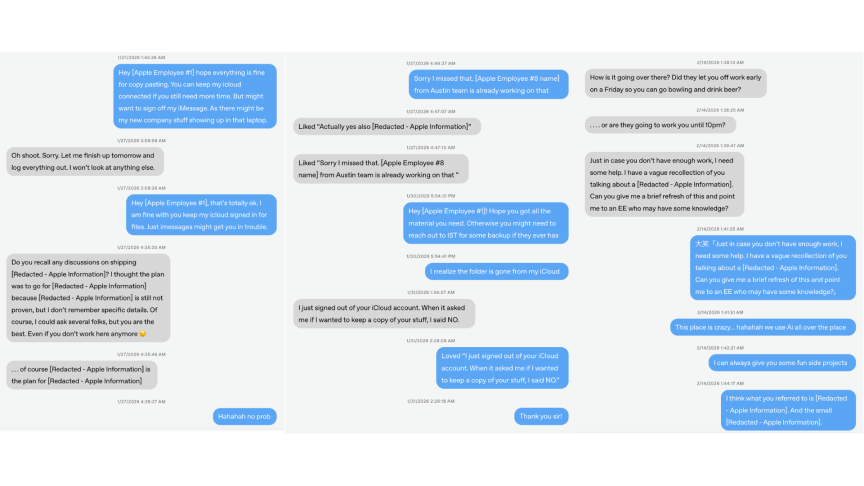
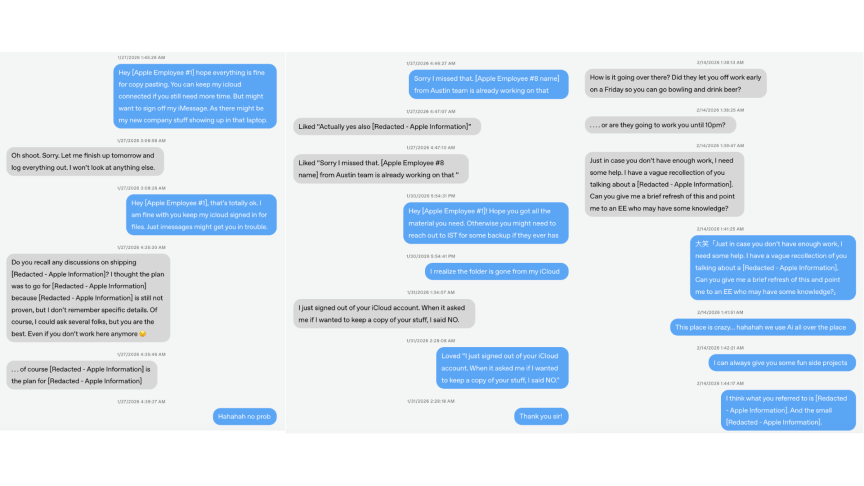
OpenAI also released what it says are text messages between Liu and Apple employees after he left Apple. The messages show Liu’s correspondence with an unknown Apple employee on his last day at Apple, arranging file transfers. The texts continue after that day, addressing file transfer issues and seeking Liu’s advice on redacted Apple projects despite Liu no longer working there. OpenAI says that Apple’s “residual access” issues let Tan, Liu and other former Apple employees improperly access company files.
“Of course, I could ask several folks, but you are the best. Even if you don’t work here anymore,” an unknown Apple employee texted Liu on Jan. 27, five days after Liu left Apple for OpenAI.
Apple said in its request for a preliminary injunction, filed Monday night, that “these interactions and exchanges cannot explain the repeated, unauthorized downloading of voluminous technical files from Apple’s cloud-based storage discussed below, which Mr. Liu performed on multiple occasions from February to April 2026 while employed by OpenAI.”
Apple also referred to Liu’s text messages, which it included in its preliminary injunction filing, where Liu said he found a way to access the company’s third-party cloud storage system without authorization, to which he said: “LOL.” Apple claims he coached other Apple-to-OpenAI job hoppers on how to access Apple files in that way “to avoid trouble with the security team,” the filing says.
It’ll be up to the court to sort out which multibillion-dollar tech company is telling the truth. OpenAI certainly has a strong motive to prove Apple wrong – the lawsuit could do a lot of damage, financially and reputationally. OpenAI has now made its position clear: “We do not have, nor want, any of their trade secrets.”

See full bio
Keep following us for the latest insights.