Back in the 1950s when Dr. Kelly Brownell was a young boy, snacking didn’t really exist. “Children ate three meals and maybe one snack,” he says. And typically that snack occurred in one place: at home. “Nobody ate in their automobile. Maybe if you took a long trip, your parents would make sandwiches to bring

Back in the 1950s when Dr. Kelly Brownell was a young boy, snacking didn’t really exist.
“Children ate three meals and maybe one snack,” he says. And typically that snack occurred in one place: at home. “Nobody ate in their automobile. Maybe if you took a long trip, your parents would make sandwiches to bring along, but that would be about it,” says Brownell, who’s an emeritus professor of psychology at Duke University
Today kids’ eating patterns look strikingly different. Children eat, on average, about three snacks a day today, eight nationally representative surveys found. Children eat nearly everywhere they go, and a large portion of their snacks are ultraprocessed foods.
Many parts of kids’ lives have shifted since the mid 20th century. But, Brownell says, there’s a major driver that’s systematically reshaping families’ eating habits.
Earlier this year, he and his colleagues at Harvard University and the University of Michigan published extensive evidence in The Milbank Quarterly that the ultraprocessed food industry intentionally shifted the social norms around families’ eating habits. “So norm after norm after norm has been changed, and it doesn’t mean that things have changed in a positive way,” he says.
Many pediatricians, including the American Academy of Pediatricians, recommend toddlers to tweens eat about five times a day: three meals and about two snacks.
Want the latest stories on the science of healthy living? Subscribe to NPR’s Health newsletter.
But this advice doesn’t take into account the rise of ultraprocessed foods, says pediatrician Tamara Hannon at the Indiana University School of Medicine, who chairs the nutrition committee at the AAP. “The problem is what we know about child nutrition comes from studies with feeding kids no processed foods but fruits, vegetables, and whole foods. So foods that our grandmothers made,” she says. “So the ‘snacks’ in these studies are really not what we, in our culture, consider snacks,” Hannon adds.
It’s time, Brownell and Hannon say, for pediatricians and parents to push back against these industry practices.
A world designed to trigger continual snacking
Throughout the 20th century, the ultraprocessed food industry used a series of tactics to make snacking throughout the day not only acceptable but even expected, says Ashley Gearhardt, who’s a professor of psychology at the University of Michigan and contributed to the new study.

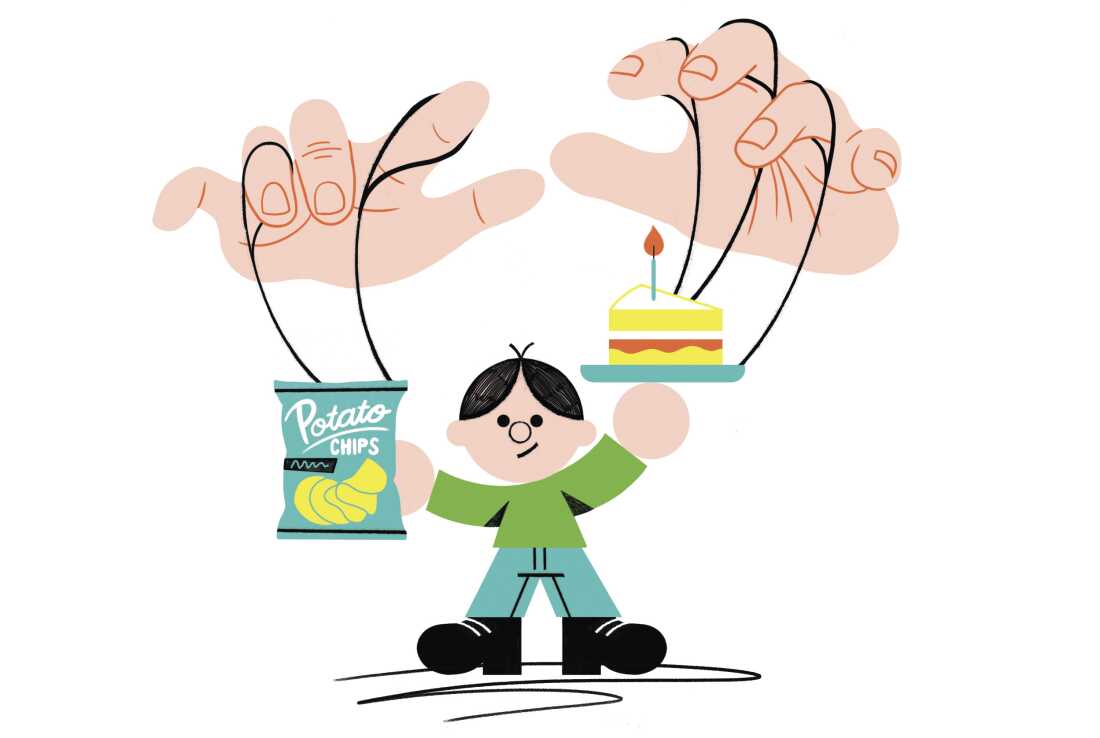
First off, the industry launched marketing campaigns, often targeted to children, to turn all contexts in which parents used to say, “No,” to eating into snacking zones. They sprinkled vending machines around communities – at schools, pools, parks and sporting events. They made ultraprocessed snacks available at gas stations, train stations and airports. “So now it’s not just cake at birthday parties anymore. It’s cake for breakfast; it’s cake in the car after you go to the gas station. It’s 24-7,” she says.
Second, big food companies added preservatives to snacks so they don’t spoil in your purse or in the car. They designed special packaging so snacks are convenient to carry around and quick to consume on-the-go. “That means you can have a purse full of snacks all the time that isn’t going to go bad,” Gearhardt says.
The result? “It has become so normal for children to constantly be snacking, snacking, snacking,” she says. “This new normal is certainly a huge benefit to the food industry.”
But it’s probably not beneficial for many children. Studies have found that large, high-calorie snacks are associated with obesity in children ages 2 to 5, as is the consumption of ultraprocessed foods, in general. These snacks account for about half of the added sugar children consume. They also boost children’s intake of saturated fat and sodium.
How to reset your child’s snacking habits
To fight back – and ensure your child receives the nutrients they need – researchers suggest these four new rules for the modern food world:
1. Cut out ultraprocessed snacks with high “total carbohydrate,” including crackers, pretzels, puffs and pea snacks
The problematic snacks aren’t just the ones with added sugar, Gearhardt says. Parents should also avoid packaged snacks with a high level of “total carbohydrate.” These foods often contain large amounts of refined starches from white flour, corn, peas and potatoes. In your body, these carbs act similar to the way sugar behaves.
“These carbs also spike your blood sugar, too,” she says. So two hours later, when their blood sugar crashes, kids want another high-carb snack. “These foods actually set kids up to be in this kind of craving and crashing cycle, as sugary foods do,” she says. “If the snack is delivering a high level of carbohydrate, be very skeptical,” Gearhardt adds.
Most of these snacks also have high levels of sodium, she adds. “In our research, we see that salt combined with a carbohydrate is one of the key ingredient combinations that makes you want to eat more and more and more.”
2. Realize that just because a child wants – or demands – a snack doesn’t mean they’re actually hungry
Big food companies have engineered ultraprocessed snacks to coax kids into eating even when they’re not truly hungry, Duke’s Kelly Brownell has found. “With these foods, their brains and guts don’t behave as they should,” he says. “Cues created by the food industry start to drive their eating instead of a biological need for food.”
“Then it’s very hard to distinguish whether kids are snacking because they’re physiologically hungry, or because the processed foods have set up biological cravings,” he adds. And these cravings can cause meltdowns and tantrums if they’re not addressed.
The solution? Wean kids off the processed snacks and onto whole foods. “So give them 75% of the processed snack and 25% slices of fruit at first,” Brownell explains. Then slowly over time, move to 50% fruit slices, then 25% and then zero. If the child turns down the whole food, then they’re not physiologically hungry, he says.
3. Focus on what kids are eating instead of how frequently they snack
In a recent study, the number of daily snacks didn’t correlate with a child’s risk for obesity or their diet quality, says Jennifer Orlet Fisher, who’s a behavioral nutritionist at Temple University. But something did matter: what caretakers offered children.
Orlet Fisher recommends sticking to whole and minimally processed foods for snacks, like produce, nuts, beans and dairy. When kids nibble on these foods, then snacking actually improves their diet. It increases their intake of often-missing vitamins and fibers, and it also helps kids develop a desire for and love of vegetables, Orlet Fisher says.
But just keep the portion size small, adds Dr. Tamara Hannon at the Indiana University School of Medicine. “Snacks are really a piece of fruit or a vegetable, maybe with some cheese, or a banana with some nuts,” she says. “They are a very small amount of food.”.
4. Stop carrying around ultraprocessed snacks
Children don’t need to eat everywhere they go, Gearhardt says. With food available in many locations, it trains children neurologically to crave and expect snacks throughout their daily routine. If you stop carrying around ultraprocessed snacks in your purse or backpack – and the snacks are truly not available – children will stop associating eating with your purse or backpack. Eventually they’re bodies and brains will adjust and stop expecting them.
Michaeleen Doucleff has a Ph.D. in chemistry and is a longtime science journalist (including previously for NPR). She is the author of the parenting book Dopamine Kids.
{For more tech updates, stay tuned to our blog.|Keep following us for the latest insights.|Check back often for more exciting news!}