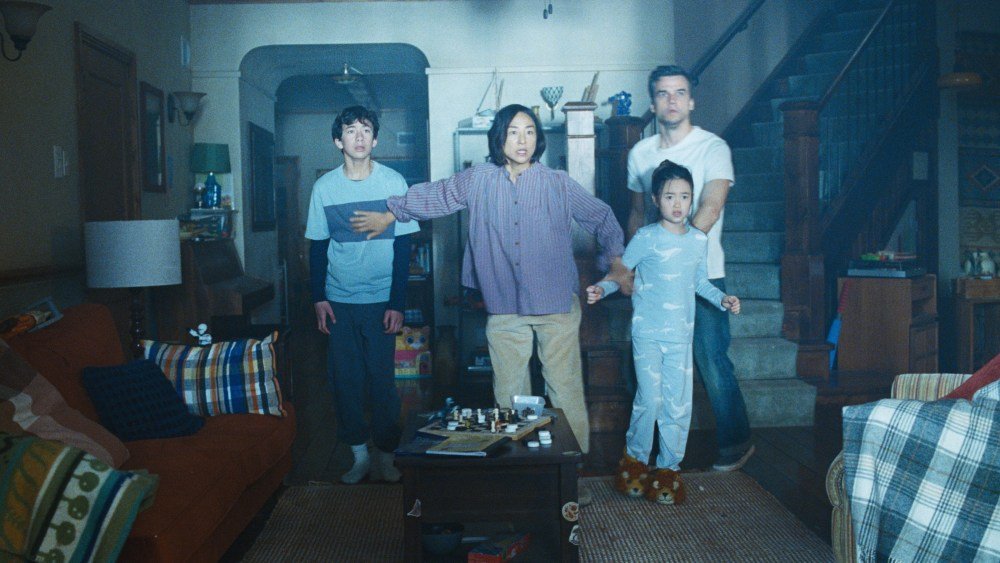
A decade or so ago, the premise of apocalyptic thriller “The Last House” might have sounded a little more out there than it does now: A middle-class Seattle family wakes up one morning to find themselves sealed inside their house with no means of escape, a mysterious enforced house arrest that turns out to be
A decade or so ago, the premise of apocalyptic thriller “The Last House” might have sounded a little more out there than it does now: A middle-class Seattle family wakes up one morning to find themselves sealed inside their house with no means of escape, a mysterious enforced house arrest that turns out to be indefinite. Post-Covid, of course, this instead plays as a fantastical spin on an experience still fresh in everyone’s mind — a familiarity that Louis Leterrier‘s film, all too aptly premiering on Netflix, uses to its claustrophobic advantage. The lockdown imposed on these four people and their immediate neighbors — and who knows how many others — may be of a more extreme and uncanny variety than the mandate that kept most of us home in 2020, but this high-concept chamber piece returns viewers to that mindset of protective panic and uncertainty.
The hows and whys of “The Last House” take it into science-fiction territory — lightly and allusively so at first, but eventually with more concrete, effects-heavy world-building (and unbuilding). But the film is most compelling throughout as a straightforward domestic drama, with increasingly fraught family dynamics lending proceedings a baseline of credibility even as whatever’s happening outside the house remains largely inscrutable. Grounded, empathetic performances by Wagner Moura and Greta Lee, as parents hanging onto their adult authority by a thread, deserve much of the credit for that, as does the intricately detailed, changeable design and conception of the house that, in a short time, becomes the characters’ entire world.
“The Last House” mostly works as a tensely enjoyable ride for times of environmental anxiety, though whether there’s any substantial meaning or resonance to the what-if scenario devised by screenwriter Matthew Robinson (“Good Luck, Have Fun, Don’t Die”) is open to question. The film touches on ideas of climate change and ecosystemic adaptation, as well as to both the virtues and limitations of community spirit, but they’re not very deeply or provocatively probed — settling for loose platitudes doled out by an unidentified female narrator. “We lived closer to each other then,” she says at the outset, describing the world before the great shut-in. “But it was easy to feel alone.”
Not that there’s much room for loneliness in the close-knit Delgado family, who are introduced making early Christmas plans as winter sets in: They live comfortably, even if engineer dad Jason (Moura) is currently out of work, and happily, even if pre-teen siblings Graham (Noah Alexander Sosnowski) and Ruth (Riley Chung) squabble on the regular. Mom Ann (Lee) frets about signs of structural damage in their roomy midcentury home, but overall, they have it better than most — especially when, with a heavy November rainstorm raging outside, they find they literally can’t leave the house. Doors and windows are rendered unopenable by some outside force; attempts to break the glass prove likewise futile.
Others in their street, they discover, are similarly trapped; with the internet down and phone signals cut, they can only guess at how widespread the crisis is. At least early on, a spirit of plucky resilience prevails: Neighbors communicate by signboards, food is lightly rationed, and family movie nights alternate the only two DVDs in the house. (“Annie” and “Air Force One,” hilariously.) But as days turn to weeks, and a spartan Christmas gives way to a very unhappy new year, the family must consider the possibility that this is a grim new normal.
If Robinson’s script is fuzzy on the logistics of who or what is keeping them inside — the explanation, when it does arrive, doesn’t exactly hold water, though Leterrier builds up to the reveal with eerie flashes of life outside the living-room window — it’s stronger on the tensions playing out indoors. As the situation grows increasingly dire, Jason and Ann are caught between their gentler duties as parents and more harshly pragmatic survival instincts; Graham and Ruth, both drawn and played with unusual nuance, must grow up fast without any wider society to show them the way. Notwithstanding the absurdly particular conditions of its drama, “The Last House” should resonate with anyone attempting to raise children in a world physically changing before our eyes — if it raises some glum existential questions, at least Jason’s ingenious MacGyver-style apocalypse hacks offer comparative light relief.
A French genre journeyman whose credits range from “The Incredible Hulk” to “Fast X,” Leterrier keeps it all ticking with the requisite balance of itchy cabin-fever atmospherics and more expansive action setpieces — though given its sometimes chintzy digital effects, the film is most effective when it plays on what you cannot see. Kevin Jenkins’ production design is the most consistent technical asset here, attentive to the detailed wear and tear of the Delgados’ house as it literally cracks and molders under pressure, as well as the ways in which it’s modified to protect and sustain its inhabitants. But there’s still everyday mess and clutter in evidence, at every stage of its evolution: “The Last House” may be silly in some respects, but it has some stabilizing sense of how life actually goes on when everything ends.
Check back often for more exciting news!