When I was first given the opportunity to test an outdoor TV, I must admit, I was quite skeptical. In fact, my initial reaction was, “I really don’t want a TV in my backyard.” I spend most of the summer at our family’s 100-year-old beach cottage at the Jersey Shore, a place that’s always been
When I was first given the opportunity to test an outdoor TV, I must admit, I was quite skeptical. In fact, my initial reaction was, “I really don’t want a TV in my backyard.”
I spend most of the summer at our family’s 100-year-old beach cottage at the Jersey Shore, a place that’s always been an escape from technology. We have one small TV inside, and the idea of putting another one outdoors felt like it would interrupt the unplugged pace we’ve always loved there. It also just didn’t seem to fit the charming aesthetic of our yard.
Surprisingly, my tech-loving kids felt the same way. They groaned when they first saw the big box arrive. But when the Knicks’ playoff run started, followed by the World Cup, our curiosity was piqued. So, with the help of my son Jack, the Sylvox Cinema Pro outdoor TV was set up in our backyard. After just one afternoon of watching TV outside, the skeptics in my family — myself included — had changed their minds.
Over the next several weeks, I tested the outdoor TV through rain, heat, humidity, and even a hailstorm. Here’s what I learned, and what impressed me most.
Outdoor TVs are a splurge, but their unique features and design justify the cost

Colleen Sullivan/Business Insider
Outdoor TVs don’t come cheap, and Sylvox’s offerings are no exception. I tested the brand’s Cinema Pro model, which is one of its top-tier TVs, built for full sunlight and extreme weather. It’s available in 65-, 75-, 85-, and 110-inch models with prices starting at $5,499.
For most backyards, the 65-inch model I tested is the best fit, while the larger models are better suited to expansive outdoor living areas. If you have a smaller patio or deck, Sylvox offers more affordable 43- and 55-inch outdoor TVs in its other product lines that are better suited to more compact spaces and areas with less light. For instance, the 43-inch partial-sun Deck Pro 3.0 Series begins at $1,149, while the 43-inch full-sun Pool Pro Series 3.0 starts at $1,649.
But while pricey compared to the best TVs designed for indoor use, outdoor TVs have good reasons to command such a premium. Chris Wang, the electronics engineer for Sylvox, explained, “One of the biggest cost drivers is brightness itself. Producing several times the brightness of a typical indoor TV requires significantly more advanced backlighting components. Then add in the weather-resistant enclosure, corrosion-resistant materials, and specialized engineering needed to protect the electronics from heat, moisture, and UV exposure, and you’ll better understand the manufacturing costs.”
Setup is mostly straightforward, but a stand is extra

Colleen Sullivan/Business Insider
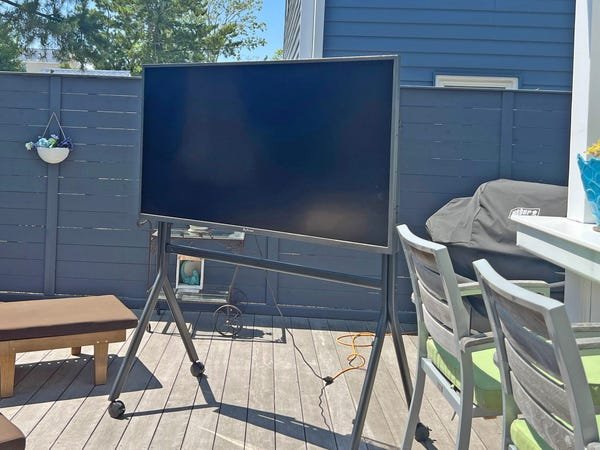
The Cinema Pro TV doesn’t come with a stand or bracket, but Sylvox sells optional wall mounts, ceiling mounts, TV lift cabinets, and rolling stands. Because my outside wall space is limited, I opted for the rolling stand ($499), which lets me tuck the TV out of sight when it’s not in use and reposition it around the yard.
The rolling stand comes with all the necessary hardware, including a wrench, and the screws and nuts are sealed in plastic bags. The assembly process wasn’t especially difficult, but we found the instructions a little confusing. Jack was convinced we had the wrong instruction manual because it seemed to include a bunch of unnecessary steps and referenced parts that weren’t even included. Things went more smoothly once we discovered Sylvox’s online assembly videos. Lifting the TV onto the rolling stand required two people, but once it was in place, securing it with the included hardware wasn’t difficult.
Getting the TV up and running was easy. The Cinema Pro comes with Google TV built in, so logging into YouTube TV, Netflix, Hulu, and other streaming services took only a few minutes. It also has three HDMI ports, so you can connect a separate streaming device or a traditional cable box.
The TV’s weather-resistant design held up against rain, wind, and heat

Colleen Sullivan/Business Insider
Every time a heavy storm rolled through, I expected to walk outside the next day and discover the TV had stopped working. Instead, the TV survived torrential rain, strong coastal winds, and even summer hail without missing a beat.
Wang explained that the TV’s reinforced aluminum-alloy enclosure is designed to resist corrosion, while the internal electronics receive specialized protective coatings that help guard against moisture, mold, and even salt spray (something that immediately caught my attention, considering I tested the TV just a few blocks from the ocean). And all that without a fabric screen cover. Wang shared, “While a cover isn’t required, it provides an extra layer of protection that can help extend the television’s lifespan.” Of note, covers are now included with all Sylvox TVs, so you can add that extra layer of protection when the TV isn’t in use.
I was convinced the multiple 90-plus-degree days we’ve experienced would eventually damage the TV — but so far, so good. Wang said the Cinema Pro is engineered to operate in temperatures ranging from -22°F to 122°F, making it suitable for year-round outdoor use. He also explained that the current models now carry an upgraded IP56 weather-resistance rating, meaning they’re designed to withstand dust and driving rain.

Colleen Sullivan/Business Insider
The only durability-related issue I encountered involved the remote. At the end of each day, I would drop the remote into the convenient plastic storage holder on the back of the TV. After about a month outdoors, I noticed the tiny screws on the battery compartment had begun to rust. Wang explained that while the remote is designed to withstand splashes and rain, it doesn’t have an official IP (Ingress Protection) rating for water resistance. Had I known that from the beginning, I would have brought it inside at night.
The ultra-bright, anti-glare screen looks great, even in direct sunlight

Colleen Sullivan/Business Insider
The biggest surprise wasn’t just that the Cinema Pro TV survived harsh weather, but also how great the picture looked. I’m told it all has to do with things like Helio QLED and 3,500 nits — a mouthful of tech to someone who’s still figuring out all the features on her YouTube TV.
Fortunately, Wang broke it all down for me. Helio QLED is Sylvox’s name for its display technology. It combines a QLED panel with Mini LED backlighting to produce a bright, colorful picture that’s easy to see outdoors. Wang explained that a “nit” is simply a unit of measurement for screen brightness. “A TV installed under a covered patio typically only needs about 500 to 700 nits, while one in a partially shaded location generally requires 700 to 1,000 nits,” he said. “If the screen sits in direct sunlight, however, it needs substantially more brightness to remain easy to see.”
The Cinema Pro produces up to 3,500 nits on the 65-, 75-, and 85-inch models and up to 5,000 nits on the 110-inch version. The result? Even on bright summer afternoons, the picture remained crisp, colorful, and easy to see without squinting or searching for shade.
The Cinema Pro also features an anti-reflective screen that scatters incoming light, reducing glare. We never had to change our viewing angle to escape reflections, something I’ve found myself doing with our indoor TV in our sunroom. The TV also features a 120Hz refresh rate, meaning the screen refreshes 120 times per second, helping fast-moving action scenes, sports, and video games appear smoother with less motion blur.
While all those specifications sound highly technical, what mattered most to my family was much simpler: the picture stayed bright, sharp, and vibrant whether we turned it on in the middle of the afternoon or after sunset.
The TV has changed the way my family spends time together

Colleen Sullivan/Business Insider
Having that clear, bright screen changed the dynamic of our summer days and nights. Instead of everyone disappearing into different rooms of our house, we’ve found ourselves gathering outside to watch games and movies. I joke that it’s like having our own drive-in movie theater. It’s also become our go-to spot for music. With Google TV built in, it’s easy to stream playlists from YouTube Music and other music apps.
You can also cast music, photos, and videos from a compatible phone, tablet, or laptop using Chromecast or Apple AirPlay. We’ve found ourselves leaving music on while we’re grilling, floating in the plunge pool, or entertaining friends.
When I first agreed to test an outdoor TV, I was convinced it would ruin the laid-back feel of our backyard. A few months later, it has become one of our favorite places to spend time together. In the past, when it rained at the shore, we were disappointed because we couldn’t go to the beach. Now we’re just as disappointed because we can’t spend the day outside watching a movie or a game under the stars.
What about the warranty and lifespan?
Outdoor TVs are built to withstand far harsher conditions than indoor models, but they won’t last forever. Wang says outdoor TVs typically last five to seven years, depending on the environment, usage, and maintenance. Weekly cleaning can also help extend the TV’s lifespan. Wang recommends turning off and unplugging the TV and allowing the screen to cool completely before using a soft, dry microfiber cloth on both the screen and the metal housing. “Avoid alcohol- or ammonia-based cleaners, household glass cleaners, paper towels, and abrasive scrubbers, all of which can damage the anti-reflective screen coating or the finish on the metal housing,” he said.
The Cinema Pro Series is backed by a two-year limited warranty, which covers defects in materials and workmanship under normal use (customers can also purchase an extended warranty for additional protection). If a problem arises, Wang said customers should contact Sylvox customer support, and depending on the situation, the company may repair or replace the TV. I read through Sylvox’s customer reviews and was encouraged to see that the company appeared responsive to customer concerns and that many reviewers praised the company’s customer service.
Cons to consider

Colleen Sullivan/Business Insider
Normally, this is the section where I list everything I didn’t like about a product. With this TV, I had to think a little harder.
- One minor quirk I noticed during testing was that the TV occasionally went black and needed to be unplugged and restarted. I’m chalking it up to our spotty WiFi on the island.
- Another drawback is that the Cinema Pro doesn’t include any mounting hardware. Everything is sold separately, so you’ll need to factor those costs into your budget. The most common options include a wall mount starting at $149, a motorized ceiling mount starting at $499, a dual-pole ceiling mount starting at $399, and a rolling TV cart starting at $399 (or $499 for larger models). Lift cabinets are also available if you want to conceal the TV when it’s not in use, starting at $3,999 for the 65-inch model and a whopping $5,999 for the 75-inch version, making them more of a luxury upgrade than a necessity.
- Storing a large TV is another consideration. While the Cinema Pro is designed to withstand extreme cold, I’m still not convinced I’ll leave it outside through a New Jersey winter. Between the high winds and falling tree limbs that often accompany Nor’easters, I suspect I’ll end up storing it indoors during the offseason, which will take up space in my already packed garage. Given its price, I’d also have a hard time leaving it outside unattended, knowing it could be stolen.
What are your alternatives?
Other brands offer similar outdoor TV options, including Sunbrite, Furrion, and Samsung. SunBrite is one of the pioneers in the outdoor TV category. The Veranda 4 series is a good choice for covered patios, screened porches, and other fully shaded outdoor living areas where you need a screen engineered to withstand rain, humidity, heat, and cold without paying a premium for extreme brightness. It’s available in 49-, 55-, 65-, and 75-inch sizes, with prices starting at about $2,200.
Furrion has long been a respected name in the RV and outdoor markets, and its premium Partial-Sun series is built specifically for areas that receive a mix of light and shade, such as an exposed deck or open patio. To protect against stray backyard debris or a rogue football, the screen is manufactured with specialized impact-resistant tempered glass. Available in 43-, 55-, 65-, and 75-inch models, the line starts at about $3,100.
Samsung’s The Terrace is built for buyers prioritizing top-tier, cinematic performance, combining the company’s SmartThings platform with upgraded Neo QLED display technology for vibrant color that can cut through daytime glare. This premium option is built for year-round exposure in both partial-sun and full-sun layouts, with the 55-inch partial-sun base model starting at about $3,500.
The bottom line

Colleen Sullivan/Business Insider
In researching this story, I learned that you can buy an outdoor TV designed for partial or full sun, and that it’s important to choose one that matches your environment, not just your budget. If your patio is covered for most of the day, a partial-sun model may be all you need. But if the screen will spend hours in direct sunlight, as ours does, investing in a full-sun model like the Sylvox Cinema Pro will make a noticeable difference in picture quality.
Though I was very skeptical about whether I’d enjoy using a TV outdoors, testing the Cinema Pro has completely changed my mind. It’s become one of my family’s favorite ways to spend time together, and it’s genuinely cool to have our own mini drive-in theater. There are important cost and logistical considerations, but if you have the space and budget, an outdoor TV could be the ideal upgrade for your backyard.
{For more tech updates, stay tuned to our blog.|Keep following us for the latest insights.|Check back often for more exciting news!}