PHOENIX — Hundreds of Navajos were recruited by the Marine Corps during World War II to create a code based on their native language. Their efforts frustrated the Japanese force and ended up playing a vital role in U.S. victories in the Pacific War. The program remained secret for decades and in 1982, President Ronald
PHOENIX — Hundreds of Navajos were recruited by the Marine Corps during World War II to create a code based on their native language. Their efforts frustrated the Japanese force and ended up playing a vital role in U.S. victories in the Pacific War.
The program remained secret for decades and in 1982, President Ronald Reagan signed a proclamation designating Aug. 14 as the official day to honor the Navajo Code Talkers and all Native Americans who served in the war.
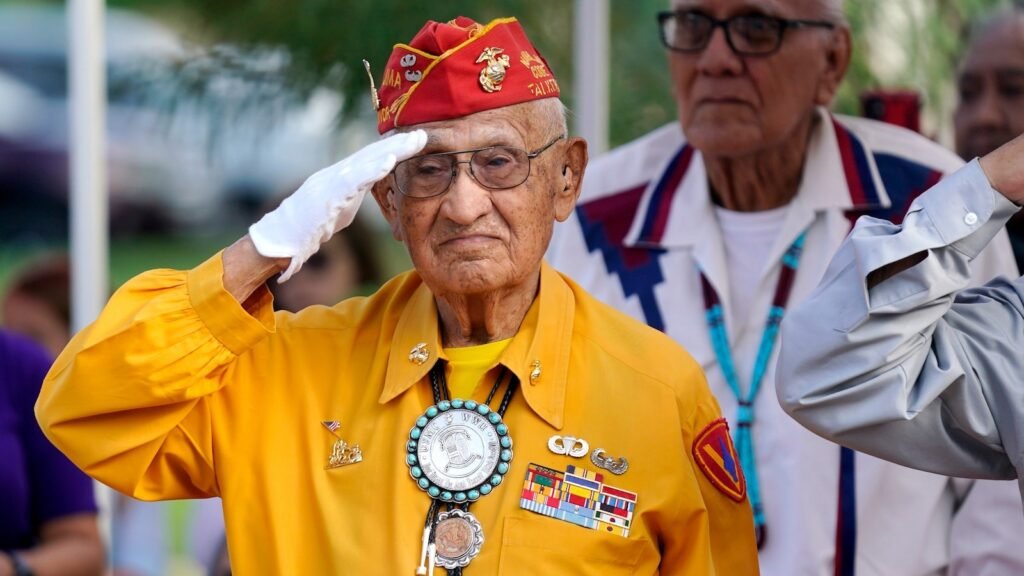
A crowd is expected to gather in Phoenix to mark the day. Among them will be Thomas H. Begay, 101, who is among the last two remaining Code Talkers.
In all, the military recruited and trained more than 400 Navajo men to communicate confidential information using their then-unwritten language. It became the largest code-talking program in the military at the time.
Between 1942 and 1945, they sent thousands of secret messages on battle tactics and enemy troop movements and ultimately helped save the lives of thousands of Allied soldiers.
“The U.S. was being defeated. Without that code, that war could have been different,” said Dawn Manuelito, a granddaughter of one of the first 29 Navajo Code Talkers. “Our language saved this country.”
When the Code Talkers were discharged after the war, they couldn’t tell anyone — even family members — about their secret mission. The program remained classified until 1968 and then efforts began to formally recognize the soldiers for their contributions.
In 1971, President Richard Nixon sent a letter of appreciation to the Navajo Tribal Council. Code Talker veterans participated in the bicentennial parade in Washington, D.C., in 1976 and then Begay and other Code Talkers made a written request for recognition that resulted in a 1982 joint congressional resolution and Reagan’s proclamation.
In the proclamation, Reagan also acknowledged that members of the Choctaw, Chippewa, Creek, Sioux, and other tribes used their tribal languages as effective battlefield codes in the two world wars.
At least 20 tribes have had members participate in the code talking programs, according to the National Museum of the American Indian.
During World War II, over 40,000 Native American men and women enlisted in the U.S. armed force. Of the hundreds of Code Talkers deployed, the Comanches participated in operations in Europe, including the D-Day invasion of Nazi-occupied France.
Following President Donald Trump’s executive order to end federal diversity and equity programs, the Defense Department deleted thousands of pages honoring contributions by women and minority groups, including the Navajo Code Talkers and other Native American veterans.
Tribes condemned the action. The Pentagon restored some webpages, saying the Navajo Code Talker material was erroneously removed.
Laura Tohe, the Arizona Poet Laureate and daughter of a Navajo Code Talker, said her father went to a boarding school where students were punished for using their native languages. But when he joined the Army, Tohe said, he and other men were told that the military would use their language to devise a code.
“It’s a huge contradiction,” Tohe said. “Despite the complicated and dark history and relationship that we have with the U.S., these men were willing to step up because many of them felt like it was their responsibility to serve.”
There’s no dedicated museum to honor the group. Attempts to build one on the Navajo Nation haven’t come to fruition, but plans were announced last week to establish one in Farmington, New Mexico.
Begay grew up speaking only the Navajo language with his parents. At 13, like many Native American Code Talkers, he first learned English when he was sent to boarding school.
Begay left the Marines in 1946 but joined the U.S. Army a year later. He worked as a communication specialist and was a paratrooper during the Korean War. The experience in Korea convinced him to leave the military in 1953.
The other surviving Navajo Code Talker is Peter MacDonald. He joined the Marine Corps at 15. He was two years too young, so he lied about his age.
After the war, MacDonald worked as an engineer at a defense contractor company and eventually became a powerful and controversial politician on the Navajo Nation. In November 2017, MacDonald, along with other World War II veterans, met Trump in the Oval Office and shared the history of the Navajo Code Talkers.
——
Associated Press writer Savannah Peters contributed from Albuquerque, New Mexico.
For more tech updates, stay tuned to our blog.