Hello Nature readers, would you like to get this Briefing in your inbox free every day? Sign up here. Physicians test narcolepsy treatments by checking whether the drugs help people to fall asleep and stay asleep throughout the night.Credit: Lucia Graphus/Alamy The US Food and Drug Administration has approved a first-of-its-kind drug to treat the
Hello Nature readers, would you like to get this Briefing in your inbox free every day? Sign up here.

Physicians test narcolepsy treatments by checking whether the drugs help people to fall asleep and stay asleep throughout the night.Credit: Lucia Graphus/Alamy
The US Food and Drug Administration has approved a first-of-its-kind drug to treat the sleep disorder narcolepsy type 1. Oveporexton, sold as Orzeyful, targets a root cause of narcolepsy by activating receptors that respond to the peptide orexin, which helps the brain regulate many pathways in the body, including the sleep–wake cycle. It’s one of a slate of emerging treatments known as orexin agonists, which researchers hope will do for the brain what GLP-1 receptor agonists such as Ozempic and Wegovy are doing for the body. GLP-1s were originally used to treat diabetes and obesity, but are being assessed for their efficacy against a wide range of health issues.
Nature | 6 min read
Postdoctoral fellows held protests in Argentina last week after nearly 400 were left in career limbo by delays linked to cuts made by the government of President Javier Milei. The country’s main science agency, CONICET, says it won’t know until next August whose applications for a permanent career track are successful. In the meantime, most postdocs whose fellowships have come to an end won’t get paid. This year’s budget on science and technology is projected to fall to about 0.14% of gross domestic product, the lowest level in decades.
Science | 6 min read
Researchers exploring the capacity of artificial intelligence systems to do open-ended research say that we are not there yet. Computer scientist Sayash Kapoor (who co-wrote the book AI Snake Oil) and his colleagues asked an AI tool to do research and write up its findings based on a research question from two papers, and asked the original authors to scrutinize the tool’s output. There were some successes — such as running experiments without getting stuck — but the humans deemed that the AI allowed itself to follow fruitless paths, didn’t fully follow instructions and produced poorly written papers.
Nature | 7 min read
Reference: arXiv preprint (not peer reviewed)
Image of the week
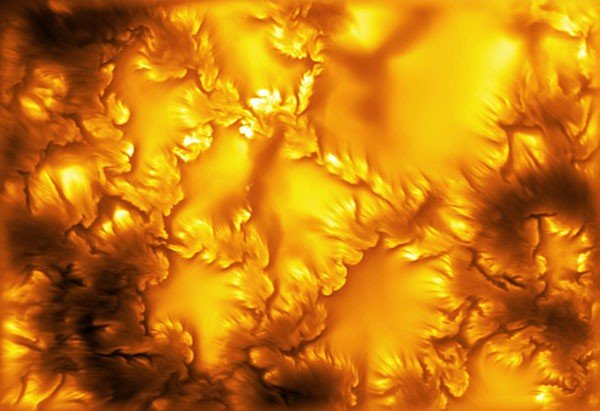
The highest-resolution image ever of the Sun’s photosphere could help to solve mysteries such as how the star dissipates its magnetic flux so quickly and why its corona is so darned hot. The feathered patterns are associated with Kelvin–Helmholtz instabilities, in which parallel streams of fluids interact at different velocities. “The interface can become unstable and develop wave-like vortices that grow in size until they break apart, not unlike waves out on a lake or out on the ocean in windy conditions,” says astronomer and study co-author Friedrich Wöger. (Reuters | 7 min read)
Reference: Nature paper (NSF/NSO/AURA/MPS)
Features & opinion
In Earth & Life, palaeontologist Andrew Knoll explores how physical, chemical and biological processes have interacted over time to enable life to flourish on our planet. Through a catalogue of Earth’s biogeochemical cycles, Knoll explains how life-supporting factors such as atmospheric oxygen arose and changed throughout history, how lifeforms began to influence the Earth in return and how our knowledge of the past informs our perspective of modern climate change. “The best historians recognize that they are storytellers,” writes geobiologist Dianne Newman in her review. “Knoll is one of them.”
Nature | 7 min read
“Fifteen years ago, an astro-tourism experience would scarcely have been a consideration in this part of the Karoo [region of South Africa],” writes science communicator Anton Binneman. “These are remote communities where, beyond sheep farming, little exists that might attract tourism.” But the construction of the MeerKAT and SKA telescopes changed all that. Now, the Carnarvon Astro Guides initiative connects these large-scale observatories to local people. “Astronomy infrastructure provides the scientific anchor, local guides provide the interpretive interface, and the night sky becomes a shared space where science, place, culture, and livelihood intersect,” Binneman writes.
Nature Astronomy | 15 min read
In the 1980s, the late neurologist Francisco Lopera led breakthrough work in his native Colombia that gathered a vast family tree of people who seemed to carry a mutated gene that raised their risk of early-onset dementia — and, in a few family members, rare protective gene variants that can delay the symptoms by decades. But high-profile research into protective mutations, which builds on his work, might be flawed, reports a Science investigation. The GNA research group involved has defended its work, but critics worry that the field is being undermined. “It’s fostered this whole little cottage industry based on incredibly unstable foundations,” says neurologist Michael Greicius.
Science | 33 min read
On Friday, Leif Penguinson was wandering the atmospheric forests of La Gomera, one of the Canary Islands, Spain. Did you find the penguin? When you’re ready, here’s the answer.
I’ve also been hiding in the woods for a little while, but now it’s great to be back in your inbox. Let me know what I missed — plus any feedback on this newsletter — at briefing@nature.com.
Thanks for reading,
Flora Graham, chief editor, Nature Briefing
With contributions by Jacob Smith
• Nature Briefing: Careers — insights, advice and award-winning journalism to help you optimize your working life
• Nature Briefing: Microbiology — the most abundant living entities on our planet — microorganisms — and the role they play in health, the environment and food systems
• Nature Briefing: Anthropocene — climate change, biodiversity, sustainability and geoengineering
• Nature Briefing: AI & Robotics — 100% written by humans, of course
• Nature Briefing: Cancer — a weekly newsletter written with cancer researchers in mind
• Nature Briefing: Translational Research — covers biotechnology, drug discovery and pharma
Check back often for more exciting news!