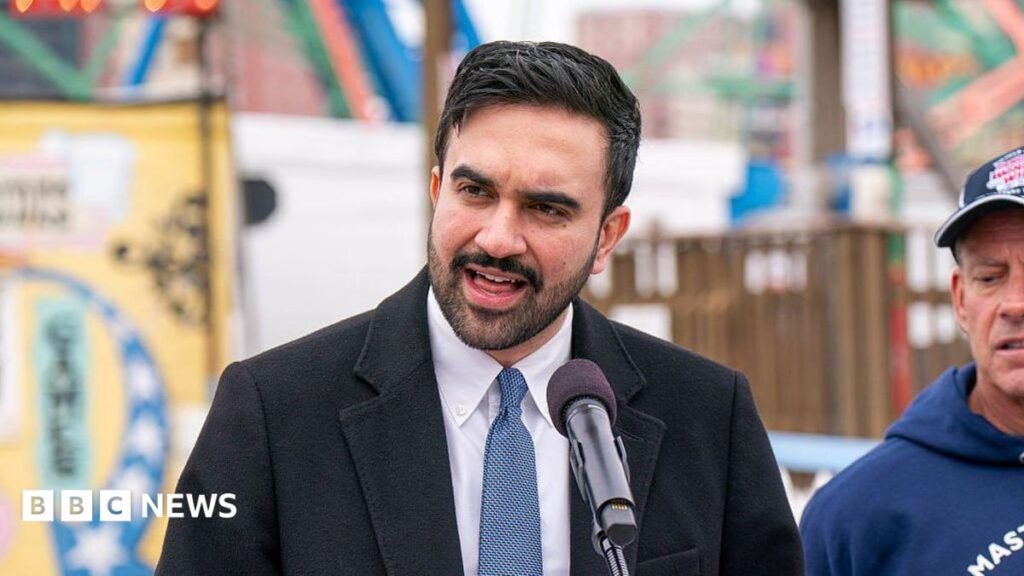
Jason Haber, who runs the American Real Estate Association, said the list of names and addresses threatens people’s safety. “Imagine the gift this is to scammers, to fraudsters, to anyone with ill will,” he said. He said a foreign actor could download the list and send an email to residents posing as the city asking
Jason Haber, who runs the American Real Estate Association, said the list of names and addresses threatens people’s safety.
“Imagine the gift this is to scammers, to fraudsters, to anyone with ill will,” he said. He said a foreign actor could download the list and send an email to residents posing as the city asking for tax money.
Haber told the BBC he has seen some buyers pause searches for expensive properties in New York because of the new tax.
“It’s the surprise of this and the confusion of this that’s really pushing everyone over the edge,” he said. Haber said he believes the loss of tax revenue from fewer people purchasing pricey homes in New York would offset the effects of the pied-à-terre tax.
But Morris Pearl, a former managing director at investment firm BlackRock, said the idea that people were choosing not to invest in the city because of the tax was “absurd”.
“The whole point of being rich is you can live wherever you want,” said Pearl, a chair of Patriotic Millionaires, a group of wealthy Americans who advocate for taxing the rich.
“Someone who owns a residence that is not their primary residence that’s worth more than $5m has the ability to pay more than most New Yorkers do.”
Across the world, some countries and cities already experiment with similar secondary home taxes.
In France, homes are subject to an additional charge that varies across the country, with a 60% local tax surcharge for homes in Paris. The tax has generated billions of euros in revenue.
The city of Vancouver in Canada has an Empty Homes Tax on residences that are vacant or under-used for more than six months of a calendar year. The tax – 3% of the property’s value – began in 2017 to help improve housing affordability.
Research from Canadian think tank C. D. Howe Institute found the tax has raised as much as $194m in revenue in eight years, and has reduced housing vacancies by as much as 21%, but has done little to bring down the average cost of rent.
In San Francisco, California, residents in 2022 voted for an Empty Homes Tax, which required owners to pay between $2,500 to $20,000 for apartments that are vacant for six months or more.
But like in New York, the tax faced fierce opposition from real estate and landlord groups in the technology hub, and after a group sued, a judge found the tax unconstitutional. It remains in limbo as the city appeals.
Pearl said the New York City administration’s decision to launch the tax with a list of wealthy residents may not have been the most diplomatic choice.
“I do think that the mayor himself – I have suggested that he sort of unnecessarily antagonises people occasionally,” Pearl said.
But, he added, “I’m with him on the policy.”
For more tech updates, stay tuned to our blog.