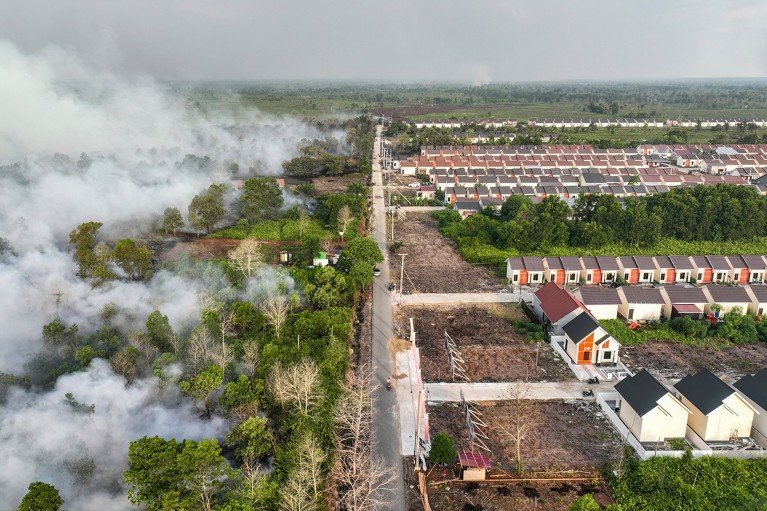
Wildfires in Indonesia this year, including this one next to a housing complex in Kubu Raya, might been intensified by the strong El Niño. Credit: DITO/AFP via Getty For Julia Cole, a palaeoclimatologist who uses corals to study Earth’s past climate, the powerful El Niño event now gaining strength in the Pacific Ocean comes as
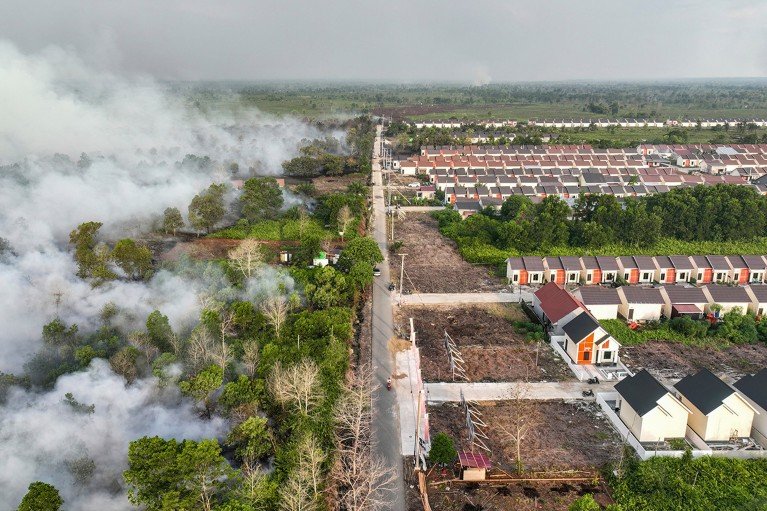
Wildfires in Indonesia this year, including this one next to a housing complex in Kubu Raya, might been intensified by the strong El Niño. Credit: DITO/AFP via Getty
For Julia Cole, a palaeoclimatologist who uses corals to study Earth’s past climate, the powerful El Niño event now gaining strength in the Pacific Ocean comes as no surprise. It looks like part of a century-long pattern of strong El Niño events happening more often as the planet heats up because of human-caused climate change. “It doesn’t look like a fluke,” she says.
That observation is based on a reconstruction by Cole and her colleagues of sea surface temperatures in the eastern Pacific Ocean in the millennium before the industrial revolution, published today in Science1. According to the analysis of coral skeletons from the Galápagos islands, the past century has seen strong El Niño events happening more frequently than in the 1,000 years before human-generated greenhouse-gas emissions began to warm the planet.
Many climate models project that this trend towards more-frequent strong El Niños will continue with climate change this century. These events lead to a temporary surge in global average temperatures, and influence the weather in particular places around the globe with consequences for ecosystems and economies. “We need to think about how to prepare better so that these aren’t as catastrophic for us,” says Cole, who is at the University of Michigan in Ann Arbor.
However, the interactions between the ocean and the atmosphere that drive El Niño events are complex, so there is still uncertainty about how cycles of Pacific temperature will change this century. “Corals give us a time machine to look into the past,” says Cole. “They don’t give us a time machine to look into the future.”
Pacific swings
El Niño is the warm phase of the natural swing between warm and cool temperatures in the tropical Pacific Ocean known as the El Niño–Southern Oscillation (ENSO). This June, El Niño conditions emerged in the Pacific, and forecasts suggest that it is shaping up to be a record-breaking event by a wide margin, and the third strong El Niño in just 11 years — something never observed before.
That has reinvigorated a long-standing debate about whether human-caused climate change has boosted the intensity and frequency of El Niño events.
The question has been challenging to answer for a few reasons. Computer models have trouble fully capturing the intricate feedback between winds and water that drive ENSO. And reliable temperature measurements in remote parts of the tropical Pacific are rare before the twentieth century, creating uncertainty about how ENSO behaved without the influence of human-caused warming.
The heart of El Niño
Palaeoclimatologists use proxy measurements of Pacific Ocean temperatures, including tree rings and marine fossils, to extend the ENSO record further back in time. Corals are particularly useful because their growth captures the month-to-month changes needed to identify fleeting events such as El Niños.
Coral records from the central Pacific indicate a trend over the past several decades towards more-frequent strong El Niños. But, until now, this record didn’t capture where El Niños are strongest in the eastern Pacific, leaving an ambiguous view of the changes overall. Julien Emile-Geay, a palaeoclimatologist at the University of Southern California in Los Angeles, compares the situation to a doctor trying to measure someone’s heartbeat by placing a stethoscope on their ankle.
The Galapagos islands in the eastern Pacific are ideally located to measure “the heart of El Niño”, Cole says. But few corals grow there because of the extreme conditions in that part of the ocean.
Keep following us for the latest insights.