At the G20 Innovation Ministerial summit on Wednesday, US Commerce Secretary Howard Lutnick, on stage with Anthropic co-founder and chief compute officer Tom Brown, made a controversial argument: If the world wants to grow AI, we need data centers. On the surface, this is logical. Data centers are a crucial piece of infrastructure that tech
At the G20 Innovation Ministerial summit on Wednesday, US Commerce Secretary Howard Lutnick, on stage with Anthropic co-founder and chief compute officer Tom Brown, made a controversial argument: If the world wants to grow AI, we need data centers.
On the surface, this is logical. Data centers are a crucial piece of infrastructure that tech companies need to power their training of new AI models. But the first part of that “if-then” statement is questionable. These massive AI server farms are wildly unpopular, in large part because of serious environmental concerns, energy costs and resource guzzling.
Over the past few years, data center construction projects have been sprouting across the US, with about 3,400 sites already operational and another 2,000 planned, according to Cleanview’s data center tracker tool. The facilities are notorious for demanding massive amounts of electricity to power AI compute, clean water to cool the computer chips and, of course, acreage to build.
Tech companies are quick to claim that data centers create jobs and give back to the tax base. But local residents are footing the bill and have pushed back, saying they bring noise and air pollution and higher utility bills. And the growing opposition is bipartisan: Both Democrats and Republicans (as well as independents) are against new data centers in their area.
That’s why the US government is launching a campaign to persuade other global leaders to promote AI data centers. Will it work?
Rising anti-Big Tech protests
The backlash against AI and Big Tech came right to the G20’s doorstep on Wednesday, as the summit is being held at the University of North Carolina at Chapel Hill. About 100 students and local residents participated in a protest against the in-person and virtual appearances by OpenAI CEO Sam Altman, Elon Musk and Howard Lutnick.
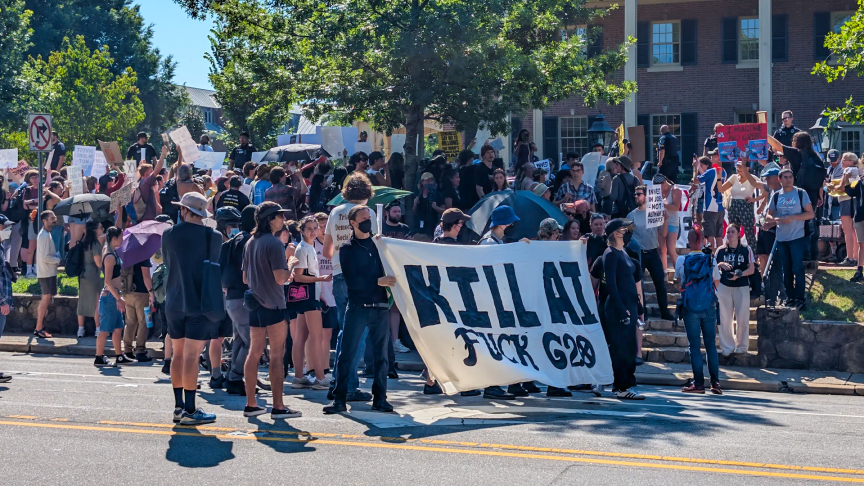
“We as students and community members are showing up because we do not think that tech billionaires should feel comfortable and have a place on our campus,” said Amy, a student and member of UNC’s Sunrise organization that advocates for social and economic justice.
Amy, who did not provide her last name, told me that students have been protesting the addition of over 20 Flock surveillance cameras across campus. Protestors chanted “Hey ho, hey ho, Sam Altman has got to go.” Some signs called out Lutnick’s ties to Jeffrey Epstein, while others advocated for tech companies to put people over profits.
Government response: No more doomerism
Pro-AI tactics often use a common message: Anyone who doesn’t get on board will be left behind. President Trump doubled down on this claim with a post on Truth Social this week, saying that communities that don’t allow data centers to move in will end up “backwards and poor.” Beyond the inflammatory rhetoric, there’s no proof this is true.
The administration’s approach during this week’s summit has been to focus on growth, unburdened by new regulation. Lutnick and other officials are adamant that existing laws and statutes are sufficient to address any issues posed by AI and that additional rules would be burdensome. But we’ve already seen how AI can perpetrate harm under current US laws.
“This is an opportunity to democratize intelligence,” Lutnick said on Wednesday, adding that he “doesn’t buy the AI doomerism at all.” AI doomers tend to believe AI poses a serious, existential risk to humanity.

In an effort to assuage concerns that data centers raise people’s electric bills, the Trump administration got the biggest tech companies to sign a ratepayer protection pledge, which says tech companies, not individuals, will absorb any rising energy costs. But as CNET reported, the pledge is voluntary, and there’s no way to enforce it.
Energy constraints on the US’s already overtaxed electrical grid, combined with community opposition to data centers, could create a new incentive for tech companies to optimize their operating systems and software to run on less energy. And tech companies say that once they have sufficient energy, the excess will be returned to communities. But that’s speaking optimistically.
Tech response: Focus on curing cancer
There’s no one better suited (or less objective) to speak about data centers than Nvidia CEO Jensen Huang.
“Every single country that we’ve worked with, the moment we created [AI] infrastructure locally, all of a sudden, the startups and researchers just really get activated,” Huang told G20 ministers on Wednesday.
Huang said the US’s regulatory environment allows for substantial build-out of AI infrastructure. Though tech companies often boast that data centers create jobs, many studies say that job growth is overstated. After construction is complete, employment opportunities tend to be minimal once the site is built and running.

In an effort to combat data centers’ growing reputation problem, tech companies have pivoted their focus to the potential scientific advances AI could help cultivate in the future. The marketing pitch goes: If AI cures cancer, isn’t the cost worth it?
“The economic scientific impacts [of AI] that we’ll see five years from now will be immense. I think that we will make a major impact in things like curing cancer,” Anthropic’s Brown said on Wednesday.
But Anthropic CEO Dario Amodei seems to discern that AI hype isn’t entirely effective. He recently said that tech companies need to win back the people’s trust, writing on X: “At this point, saying that AI will cure cancer is more a cliche than it is inspiring, and most people think it is deceptive. The thing that will work is *actually curing cancer*.”
That at least appears to read the room, even if it doesn’t prevent the harm data centers cause to communities in the meantime.

See full bio
Keep following us for the latest insights.