We have all seen it happen on our local streets. A car suddenly appears parked on the nature strip, sits untouched for days or weeks, and leaves the neighbourhood guessing whether someone has visitors over or if an offender dumped a stolen vehicle after a joyride. Until now, finding out what was actually going on
We have all seen it happen on our local streets. A car suddenly appears parked on the nature strip, sits untouched for days or weeks, and leaves the neighbourhood guessing whether someone has visitors over or if an offender dumped a stolen vehicle after a joyride.
Until now, finding out what was actually going on meant either ignoring it, posting photos to local community social media groups, or sitting on hold to the non-urgent police line just to see if a licence plate was flagged.
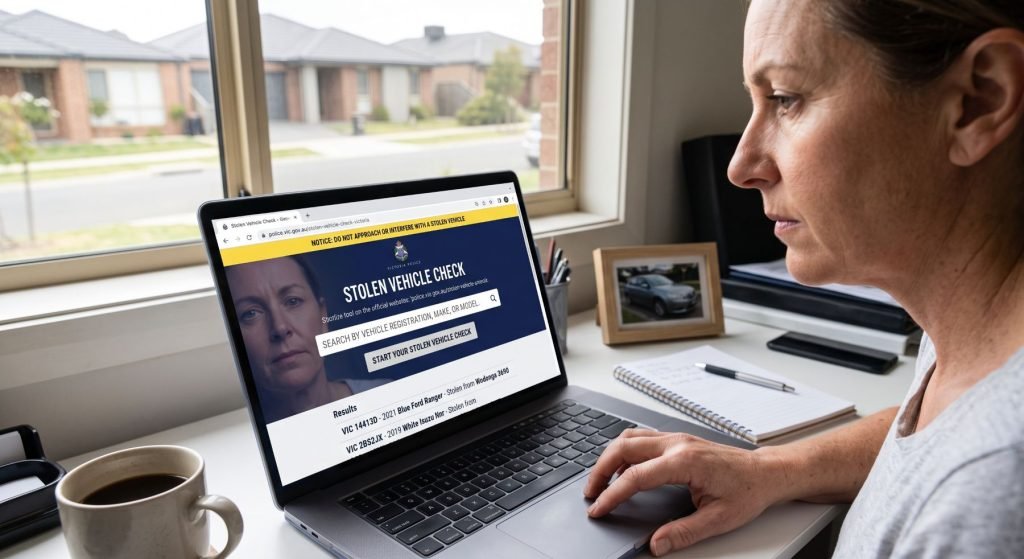
Victoria Police has officially launched a new public online tool called the Stolen Vehicle Check. The live search portal gives anyone with a smartphone or web browser the ability to check whether a suspicious car, ute, van, motorcycle, or trailer is listed as stolen across Victoria.
It is a sensible, practical deployment of open public data. By putting live records into the hands of the community, it turns everyday residents into an active recovery network without overloading police phone operators with routine plate lookups.
How the online search tool works
The interface is refreshingly straightforward and built for quick mobile use. You do not need to sign up for an account, log in via a government digital identity portal, or download a separate app. You simply visit the webpage and run a search.
The backend pulls data directly from the Victoria Police Law Enforcement Assistance Program database, alongside records from VicRoads and the National Exchange of Vehicle and Driver Information System.
The dataset refreshes in real time whenever a new theft report is lodged or when police successfully recover a vehicle and clear it from the system.
Users have two ways to look up a vehicle:
- Registration plate: Enter the licence plate number without spaces or dashes.
- Vehicle make or model: Search directly by manufacturer or model name, such as Ford Ranger, Toyota Hilux, or Volkswagen Golf.
When a query returns a match, the database displays the vehicle description including year, colour, make, and model, the body type, the suburb and postcode where it was stolen, the date reported, and the registered licence plate on file. The public tool covers vehicles reported stolen within the last 90 days, which keeps the focus squarely on active investigations where community sightings are most valuable.
Why searching by make and model is a smart feature
Allowing users to search by make and model rather than solely by licence plate is one of the most effective technical decisions in this build.
Car thieves routinely swap licence plates shortly after taking a vehicle, often targeting an identical make and model nearby to bypass automated number plate recognition cameras. If you spot a suspect car parked outside your house and check its licence plate, you might get a completely clean result if those stolen plates belong to a legitimate vehicle elsewhere.
By letting the public search by make, model, and colour, you can quickly see if an identical vehicle was reported stolen in your surrounding suburbs recently. If you see an exact match taken two suburbs away the previous night, that gives you actionable context you can immediately pass on to police.
Street parking remains the primary target for modern car theft
The launch comes as fresh Crime Statistics Agency figures reveal that one in three cars stolen in Victoria were parked on residential streets. Out of 30,985 vehicle thefts recorded in the year to March, 10,151 vehicles were taken directly from the street. That is double the 5,031 taken from residential properties and triple the 3,148 taken from single-level carparks.
The data shows Melbourne CBD recorded the highest number of street vehicle thefts with 621 offences, followed by Dandenong with 487 offences and Tarneit with 367 offences.
Police intelligence highlights that modern vehicles with push-button keyless start ignitions are primary targets. Rather than hotwiring or smashing ignitions, offenders increasingly use key-mimicking tools, signal relay hardware, and on-board diagnostic port reprogramming tools to bypass electronic immobilisers and drive away in minutes.
“Car theft isn’t just an inconvenience. It impacts someone’s sense of safety. That’s why police are working tirelessly to target car thieves and make arrests. This new tool lets people check if a car is stolen and report its location to police. All people have to do is enter the registration, make and model of the suspect vehicle.
We know cars with push start ignitions are a particular target with thieves using technology to enable their offending. Police are seeing proof of this with on-board diagnostic devices showing up more frequently during intercepts of suspicious vehicles. While the majority of stolen vehicles are recovered as a community it will take all of us working together to stop thefts happening in the first place.
A quick dash to the shops without locking your car is sometimes all it takes for thieves to seize an opportunity. Where possible we encourage people to park their vehicle off the street and in a garage if they have one available. Anti-theft devices such as a steering wheel lock and OBD port lock also help deter would-be thieves.”
Julie Macdonald, Detective Inspector, Vehicle Crime Squad, Victoria Police.
Simple steps to protect modern push-button vehicles
Police already recover around 80 percent of stolen vehicles across the state, but preventing electronic bypass thefts in the driveway or on the street requires taking a few basic physical and digital precautions:
- Install a physical OBD port lock: These inexpensive hardware locks cap your vehicle on-board diagnostic port, stopping thieves from plugging in handheld devices to program blank key fobs.
- Use a physical steering wheel lock: While low tech, physical visual deterrents often force opportunistic thieves to move on to easier targets.
- Store key fobs securely: Keep keyless entry fobs away from front doors and external walls, or store them in signal-blocking Faraday pouches to prevent relay amplifier attacks.
- Lock the vehicle every time: Even when parking inside your driveway or running a two-minute errand, always lock the doors and never leave the engine idling unattended.
Important: this is not a substitute for a PPSR check
Victoria Police explicitly notes that this public portal is designed for street-level safety and vehicle recovery, not for used car buying decisions.
If you are buying a secondhand vehicle, you should not rely on a 90-day state police check. You still need to run an official search through the national Personal Property Securities Register at ppsr.gov.au.
A formal PPSR certificate costs A$2, searches nationwide records against the permanent Vehicle Identification Number on the chassis, and confirms whether the car is flagged as stolen nationally, written off by insurance, or burdened by unpaid finance.
What to do if you spot a stolen vehicle
If you run a search on a suspicious vehicle and get a match, Victoria Police provides clear guidance on how to handle the situation:
- Do not approach the car: For your own safety, never attempt to enter, follow, or confront anyone in or near the vehicle.
- Non-urgent reports: If the car is parked, unattended, and there is no active threat, note the location and registration details, then contact the Police Assistance Line on 131 444 or report it anonymously via Crime Stoppers.
- Emergencies in progress: If you see someone actively breaking into, stripping, or driving a stolen vehicle, call Triple Zero (000) immediately.
If a vehicle on your street does not appear in the database, does not seem suspicious, but has been parked indefinitely and appears abandoned, the issue should be directed to your local municipal council for collection.
Following a soft launch that saw around 8,000 users test the tool over two weeks, the platform is now live and fully accessible to the Victorian public.
For more information, head to Victoria Police.
Keep following us for the latest insights.