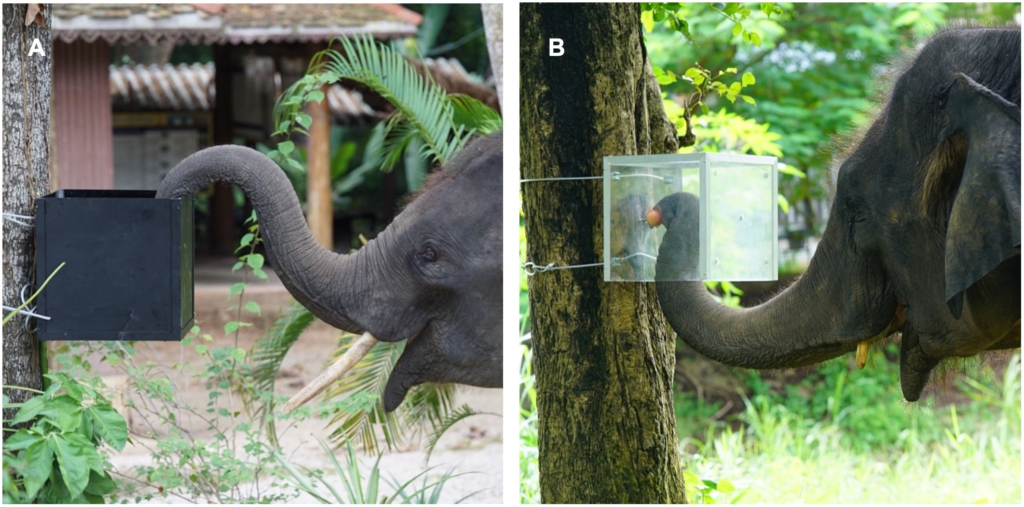
Get the Popular Science daily newsletter💡 Breakthroughs, discoveries, and DIY tips sent six days a week. By signing up, you confirm you are 16+, will receive newsletters and promotional content and agree to our Terms of Use and acknowledge the data practices in our Privacy Policy. You may unsubscribe at any time. Like humans, elephants
Like humans, elephants are famously social creatures. But unlike teenage humans, Asian elephants (Elephas maximus) can think before they act.
Scientists in Thailand discovered this after 16 Asian elephants at the country’s National Elephant Institute successfully participated in a detour test. In this sort of challenge, the animal has to resist an obvious but ineffective strategy (an impulse) to get a treat and follow an effective but indirect alternative—an ability called inhibitory control.
“Although we are beginning to understand how intelligent elephants are, we still know very little about their capacity for inhibitory control,” Sydney Hope, a postdoctoral researcher at Hunter College in New York, tells Popular Science. “Understanding elephant inhibitory control will help us understand how this aspect of cognition may have evolved across species, including humans. It will also help us understand how elephants may cope with environmental—including anthropogenic—changes.”
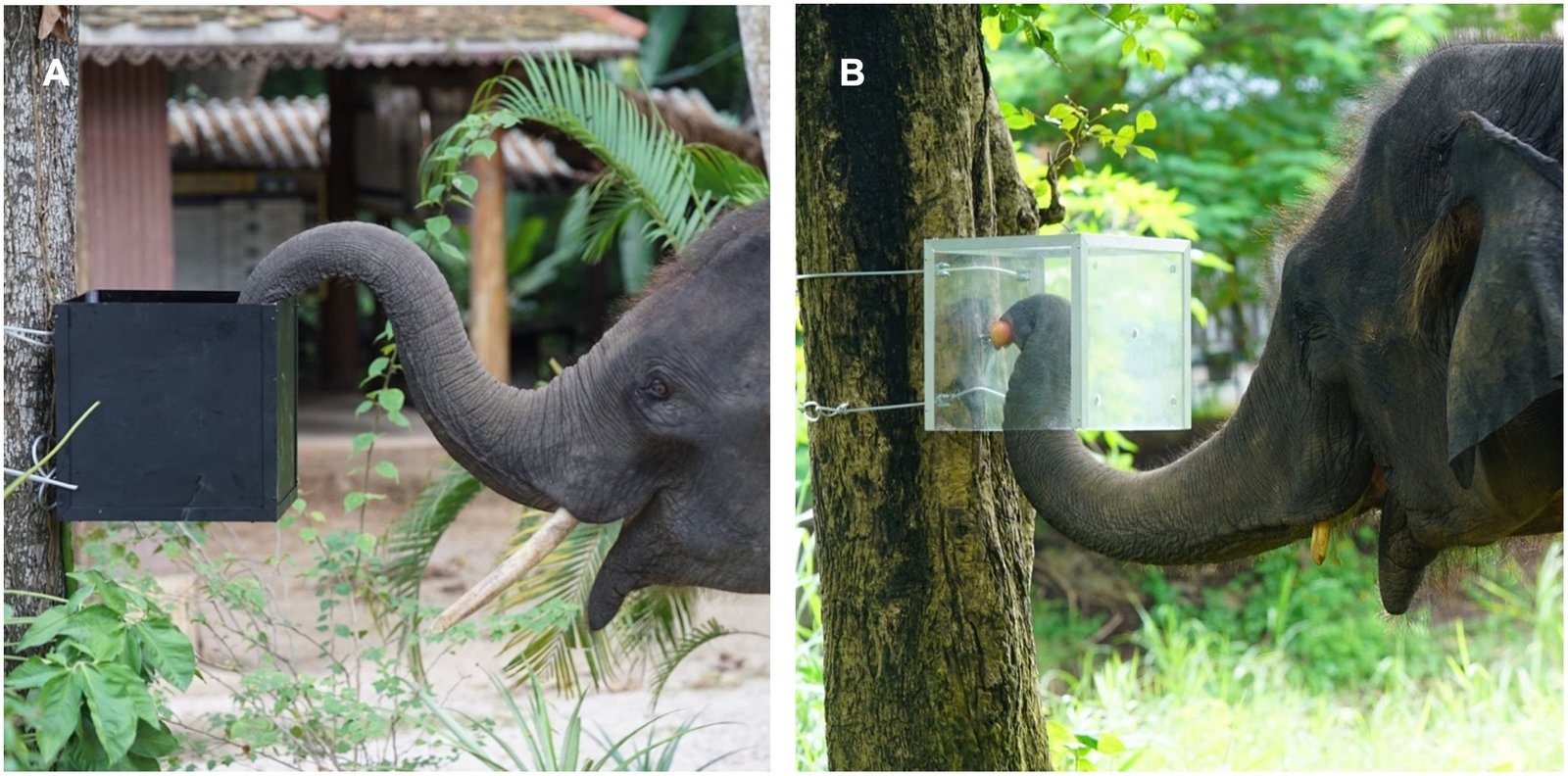
In their new study published today in the journal PLOS One, Hope and her colleagues presented Asian elephants with a transparent box filled with fruit. The box also had small holes, so that the elephants could see and smell the goodies inside. The temptation here was to reach directly through the barrier, whose holes were presumably too small for the elephants’ trunk to fit through. The elephants could consistently resist this impulse, and instead used an opening on the side of the box, as they had previously been taught to do.
In a second version of the trial, the researchers rotated the box. Initially, the elephants gave in to the urge to reach for where the opening used to be, but then rapidly amended their behavior. This fix came slower in older elephants. That’s potentially because of cognitive decline with age, though the team says that further research is necessary on this point.
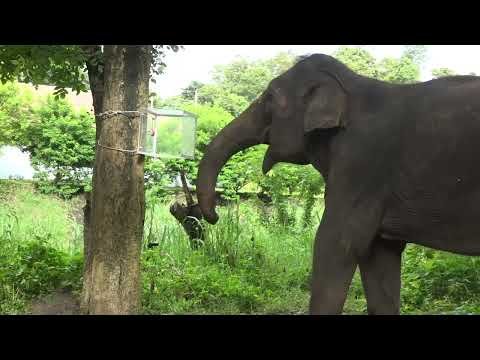
Testing inhibition of an elephant’s previously learned behavior
More broadly, the study shows that elephants are able to resist an impulsive, ineffective action (like reaching through a perforated, transparent barrier or continuing a no longer successful approach) in favor of e indirect effective behaviors, even if they must change a previously effective strategy. And they’re in good company—inhibitory control is important for humans’ and other animals’ decision-making and cognitive flexibility. For elephants, it might play a significant role in their famous problem-solving and socializing capabilities, according to the researchers.
“These results may also help conservation efforts,” Hope points out. “One major threat to Asian elephants is human-elephant conflict, often occurring when elephants navigate around barriers (e.g., electric fences) to enter agricultural lands. Understanding how elephants detour around barriers in controlled experiments may help with developing new techniques to mitigate conflict.”

2026 Popular Science Home of the Future Awards
Keep following us for the latest insights.