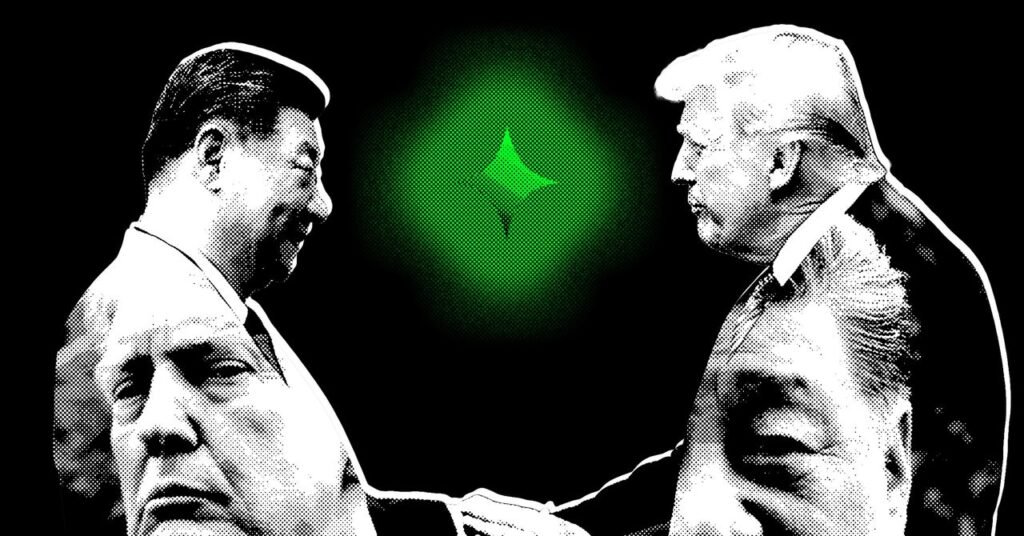
As US president Donald Trump and Chinese president Xi Jinping prepare to meet in Washington for a state dinner at the White House on Thursday, AI has become a top priority. Tech executives from OpenAI and Nvidia have confirmed their attendance at the dinner, as a number of key agenda items are on the table.
As US president Donald Trump and Chinese president Xi Jinping prepare to meet in Washington for a state dinner at the White House on Thursday, AI has become a top priority. Tech executives from OpenAI and Nvidia have confirmed their attendance at the dinner, as a number of key agenda items are on the table.
Chief among them is a US proposal to establish an AI notification system with China, akin to the Cold War hotline with Moscow, which would allow each country to alert the other about national security issues related to AI. Treasury secretary Scott Bessent first announced the notification system on Sunday with Chinese vice premier He Lifeng.
But for all the high-level progress, Trump administration officials tell Inner Loop they expect it to still take a number of weeks to finalize an agreement, even if they are optimistic that the hotline could be in place before the year’s end.
There are several parts that need to be formalized in more detail, including establishing benchmarks on what kind of incident rises to the level of a national security issue, which remains unclear, as well as explicit sign-on from China, which has been noncommittal.
Trump officials tell Inner Loop they are essentially targeting a framework for the system to be functional—and, crucially, agreed to by Trump—by the time Bessent next meets with Lifeng in follow-up talks in two months’ time in Shenzhen, China.
The discussions around such a mechanism underscore the growing concern around the rapidly developing capabilities of frontier AI models as the US and China race to become the dominant power in the industry.
Trump officials have internally discussed putting together a framework that lays out criteria for when each country is obligated to alert the other and enforcement measures to ensure it doesn’t only become the US alerting the Chinese.
But with the US expected to extend a trade truce and Trump reluctant to stop exports of cutting-edge Nvidia chips to China, developing a framework that has enforcement measures with teeth could take time to get White House approval, sources say.
The administration has granted a limited number of licenses this year for Nvidia to sell its H200 chip to China, a critical component for AI labs to increase compute power to train their models. Nvidia’s supporters have argued that not selling the chips incentivizes Chinese companies like Huawei to develop their own chip technology, though according to recent reports, the company has already achieved that milestone with its commercially available AI chips.
Some Trump officials have also suggested the notification system may also be delayed while Trump decides on who to appoint as his next “AI czar” to lead a so-called “AI Force,” which is being envisioned as a role in charge of interagency coordination.
Bessent has been one of the names floated as the AI czar, but it is not clear if he’s the standout. Commerce secretary Howard Lutnick and White House AI officials Michael Kratsios and Sean Cairncross are also in the mix, two sources tell Inner Loop.
It remains unclear if Trump will choose someone who will be wearing two hats or is departing their current role to take the position. The previous AI czar, David Sacks, was in the position as a special government employee. Sacks is not considered to be in the mix to return, the sources say.
The push for Bessent has come in part because the AI notification system is seen as something akin to the US-China dialogue between former Treasury secretary Hank Paulson and former Chinese vice premier of finance Wang Qishan. During the 2008 financial crisis, Paulson credited the hotline as helping to stave off China from dumping a large portion of US government sponsored debt issued by Freddie Mac and Fannie Mae.
Meanwhile, while some Trump officials have chafed at the idea of giving more AI power to Lutnick, he remains in contention insofar as he oversees the Center for AI Standards and Innovation, which successfully navigated crises with frontier AI model companies this summer.
This is an edition of Hugo Lowell’s Inner Loop newsletter. Read previous newsletters here.
For more tech updates, stay tuned to our blog.