I never got the chance to see Steve Jobs speak in person at an Apple event. I’ve been covering the company and its products for decades now (it feels a little weird to type that), but always from afar—at least in those days. Even before announcement events were livestreamed, Jobs and Apple knew how to
I never got the chance to see Steve Jobs speak in person at an Apple event. I’ve been covering the company and its products for decades now (it feels a little weird to type that), but always from afar—at least in those days. Even before announcement events were livestreamed, Jobs and Apple knew how to put on a show. Looking back at a nearly 40-year-old Popular Science article makes me wish I could have been there for his return. Unfortunately, I was six.
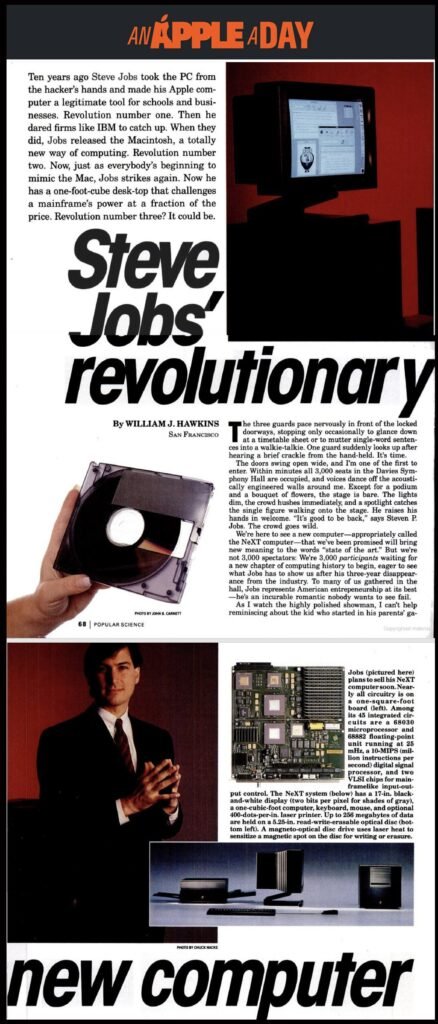
Popular Science sent William J. Hawkins to Davies Symphony Hall in San Francisco for the October 12, 1988, debut of the NeXT Computer, and his story in the January 1989 issue opens with the guards. They paced outside locked doors with walkie-talkies until the doors swung open; by Hawkins’ count, all 3,000 seats filled within minutes. Jobs walked onto a bare stage with a lectern and a bouquet of flowers, raised his hands, and said, “I think I speak for everybody at NeXT saying it’s great to be back.” It was his first major product presentation in the three years since his contentious departure from Apple, and the crowd went wild.
Hawkins had met Jobs 11 years earlier at a computer flea market in Atlantic City, when Jobs was a 22-year-old in sneakers and jeans. The version onstage in 1988 was 33, wearing what Hawkins guessed was an expensive, hand-tailored Italian suit. This Jobs also knew how to work a room. He pulled a one-foot-square circuit board from under the lectern, called it the most beautiful board he’d ever seen, and explained that robots in a Fremont, California, factory built each one in about 20 minutes, untouched by human hands.
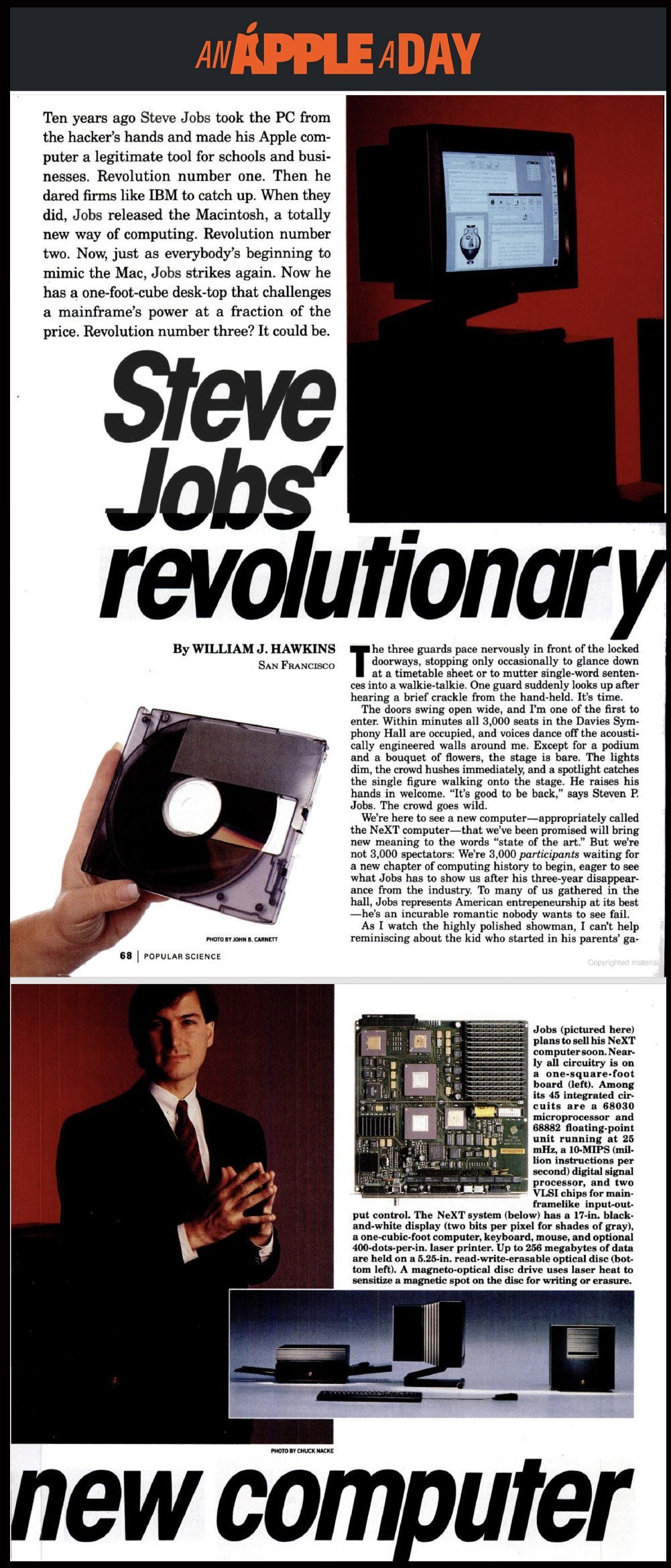
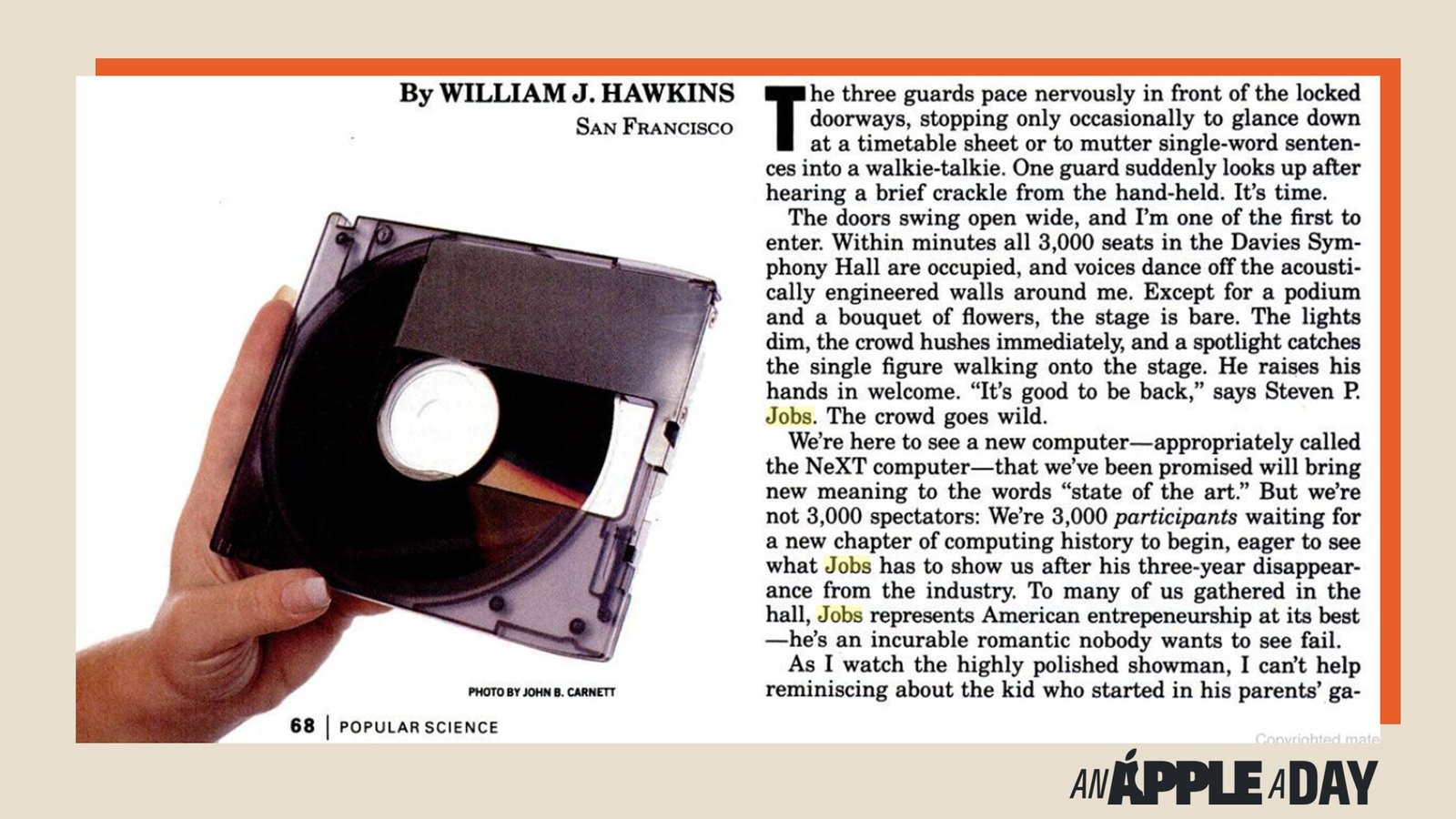
Jobs saved the system’s big storage reveal for the end of the first act, right before a 20-minute intermission. It was an early version of the “one more thing” flourish that would later become a meme. He held up a 5.25-inch plastic cartridge and said the NeXT would be the first computer in the world to ship with read-write, erasable optical storage, good for about 250MB. A standard high-density 3.5-inch floppy held 1.44MB. The hall went silent. Then one person let out a shriek that Hawkins compared to a game-show contestant learning they’d won the car. Jobs added that each cartridge cost $50.
The rest of the demo reads like a preview of the next 30 years of Apple. The black magnesium cube held a 25MHz Motorola 68030 and a dedicated digital signal processor for audio, and it drove a 17-inch grayscale MegaPixel display. It ran a Unix-based operating system Jobs promised would be “usable by mere mortals.” Files went into a black hole instead of a trash can. A tool called Interface Builder let him drag buttons and sliders into a window and connect them to a gas-molecule simulation in minutes. The optical disc came loaded with Webster’s dictionary, a thesaurus, and the complete works of Shakespeare. Jobs looked up “mercurial” onstage, a word reporters often used to describe him, and decided he didn’t think it was so bad. Then he announced that IBM had licensed NeXTSTEP.
Hawkins still made room for critics near the end of his piece: many of the parts were off the shelf and would soon be available to competitors including Sun, DEC, and Apple; NeXT planned to sell only to colleges; and studies showed consumer interest fell off quickly above $3,500. The NeXT cost $6,500, and its laser printer was another $2,000.
The critics had the hardware right. By March 1989, NeXT said it had shipped about 1,000 computers, mostly to more than 60 universities, with some going to software developers. That month, it announced a deal to sell the system at Businessland stores for $9,995 starting in May. The finished operating system, NeXTSTEP 1.0, didn’t arrive until September 18, 1989. That optical drive turned out to be too slow to serve as the only drive, so in September 1990 NeXT announced the NeXTstation, built around a conventional hard drive. IBM offered a NeXTSTEP environment for its AIX workstations but never followed it with a 2.0 release. NeXT ultimately sold only about 50,000 computers. In February 1993, it stopped making hardware and laid off 280 of its roughly 530 employees.
The software aged much better. At CERN, Tim Berners-Lee wrote the first web browser-editor and web server on a NeXT computer, and both were running by the end of 1990. The machine bore a handwritten label that read, “This machine is a server. DO NOT POWER IT DOWN!!” A few years later in Texas, id Software developed Doom on NeXT workstations.
By 1996, Apple was the company in trouble. It had canceled its own next-generation operating system, Copland, and was shopping for a replacement. On December 20, it announced that it would buy NeXT and bring Jobs back as an adviser. The deal was announced at about $400 million, and Apple’s 1997 annual report later put the total purchase price, including NeXT’s liabilities, at $427 million. A J.P. Morgan analyst told CNET that the companies hadn’t explained exactly how Apple would use the software. NeXT’s technology became the foundation of Mac OS X, whose descendants include today’s macOS and iOS. Write code for an iPhone today and you’ll still run into class names like NSObject and NSString. That NS prefix is a holdover from NeXTSTEP.
Hawkins asked whether the cube would be revolution number three. The box on the table never got cheap enough for the students it was designed for, so by his own definition, it didn’t qualify. The software inside it is another story, and most people have used its descendants without knowing it. Hawkins ended with Jobs raising his hands after three hours and asking, “Well? What do you think?” The room gave him a standing ovation. And while I’m a big fan of Apple’s current live stream setup and announcement format, I would have loved to be in that room full of 3,000 nerds clapping for a new storage disk. I would also love if I didn’t have to publish my Apple live blogs until three months after they happened like the old days.

2026 Popular Science Home of the Future Awards
Keep following us for the latest insights.