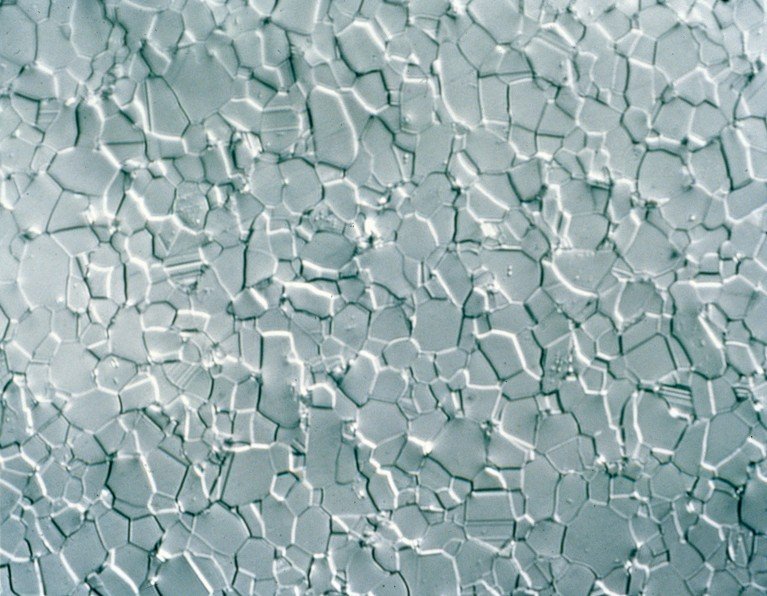
Boron carbide, also known as black diamond, is one of the hardest synthetic substances known. Credit: Science Museum Group/SPL Boron has long intrigued scientists. Its atoms are amenable to many bonding modes, and pure boron can be found in a variety of phases — some clear; some opaque; most poorly conducting; all, so far, superhard.
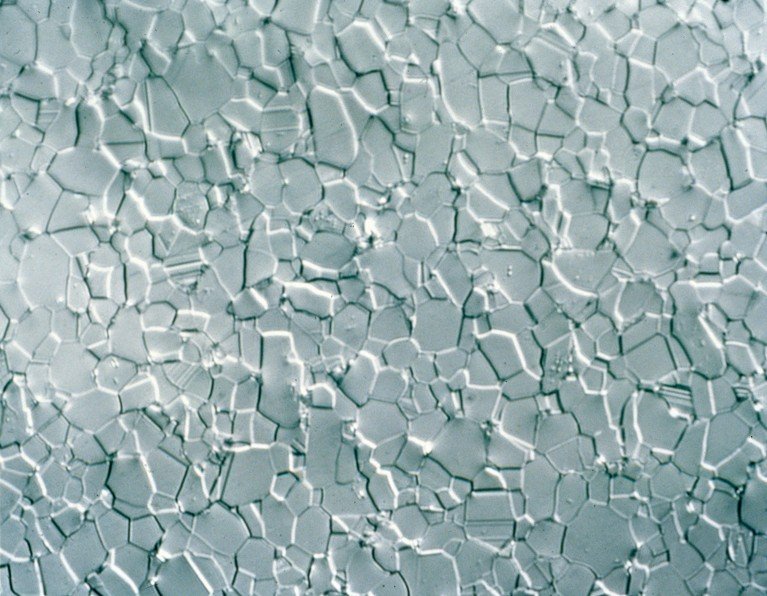
Boron carbide, also known as black diamond, is one of the hardest synthetic substances known. Credit: Science Museum Group/SPL
Boron has long intrigued scientists. Its atoms are amenable to many bonding modes, and pure boron can be found in a variety of phases — some clear; some opaque; most poorly conducting; all, so far, superhard.
Now, researchers have prepared a new, and potentially useful, phase that is deformable and has an electrical conductivity more than one million times that of typical boron materials. The structure, called Imma-B60, is reported today in Nature Chemistry1.
Synthetic success
Just like its periodic-table neighbour carbon, which can be found in arrangements such as diamond or graphite, boron can take several forms, known as allotropes, that exhibit different properties.
The last discovery of an unusual boron allotrope dates back to 20092. Artem Oganov, a materials chemist at Skolkovo Institute of Science and Technology in Moscow, who was involved in that work, says that the discovery of Imma-B60 opens up a synthesis route for an entire family of materials.
Typically, boron reacts readily with other elements to form borides rather than pure boron allotropes. And because boron atoms are light (only about ten times heavier than protons), they can be difficult to detect accurately in experiments. This twofold challenge is one reason for the 16-year period during which hardly any boron allotropes were discovered — although many have been predicted.
To prepare the Imma-B60 phase, Xiang-Feng Zhou, a materials scientist at Yanshan University in Qinhuangdao, China, and his collaborators devised a two-step process that had never before been applied to boron. First, they coaxed boron into reacting with sodium by putting both elements under high pressures. The mixture was then heated at 900 °C under vacuum to almost completely remove sodium impurities, yielding Imma-B60.
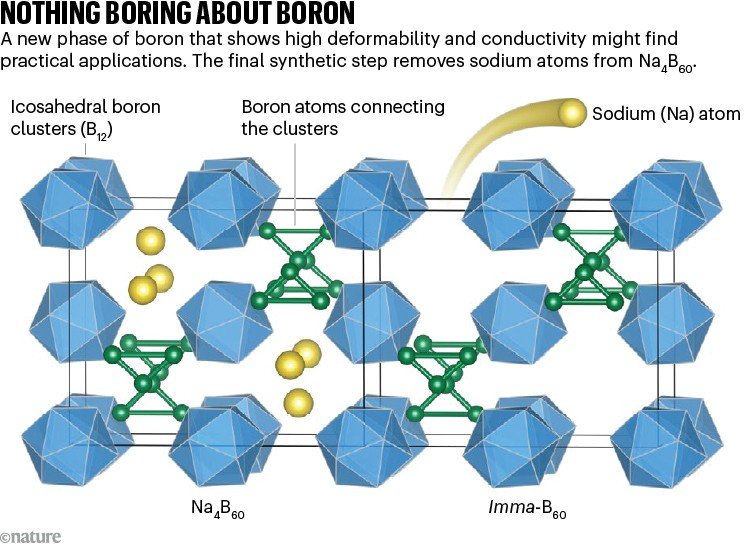
Source: ref. 1
“It’s a powerful approach — not brand new but perhaps the most elegant, most modern application of it,” says Oganov. “Its consequences can be very far-reaching.”
Unique properties
The new phase consists of a network of boron atoms, with open space where the sodium atoms used to be. This enables a movement of the atoms called dislocation slip, giving the material its deformability: the material extended to 23% of its original length before breaking. Once extended, however, it doesn’t bounce back to its original form.
Check back often for more exciting news!