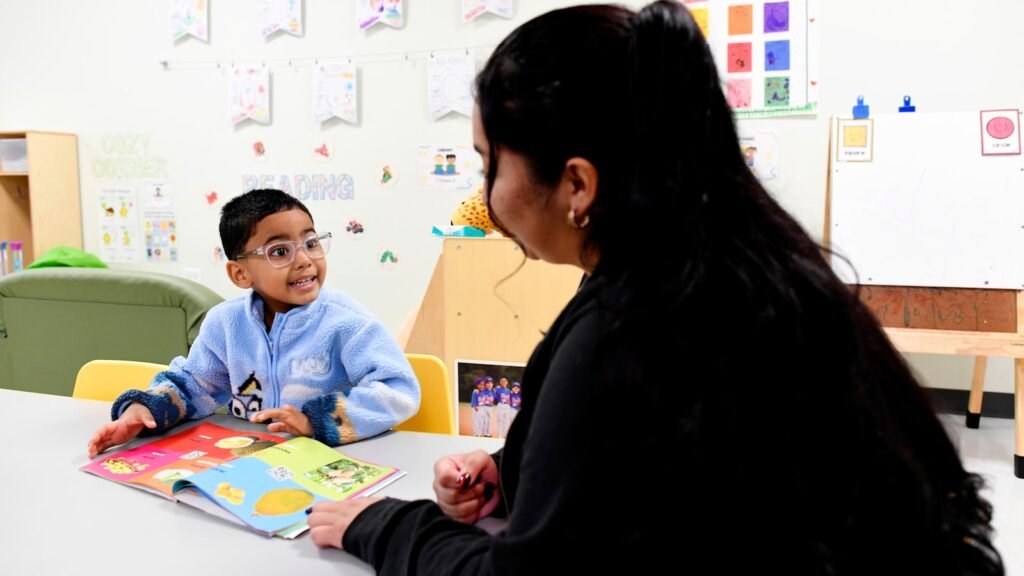
It was sometime around Xavier Rogers’ second birthday that his mom and Early Head Start teachers noticed a shift in his demeanor. Xavier, usually a happy baby, now mostly wanted to play alone and would sometimes bite and hit other kids in his class. Instead of removing Xavier from his class, his Chicago-area preschool gave
It was sometime around Xavier Rogers’ second birthday that his mom and Early Head Start teachers noticed a shift in his demeanor. Xavier, usually a happy baby, now mostly wanted to play alone and would sometimes bite and hit other kids in his class.
Instead of removing Xavier from his class, his Chicago-area preschool gave the family extra support from a social-emotional and mental healthcare team.
“With these supports in place, I feel like he has grown tremendously,” said Xavier’s mom, Joanna Isitt, a Head Start teacher herself. Now 4, “he’s become much, much more aware of himself and how he feels and how others may feel.” He’s less likely to resort to negative behaviors, and he even encourages her to join him in breathing exercises, saying, “OK, Mama, smell the flowers, blow the candles.”
The protections and support Isitt and her son received are part of longstanding Head Start regulations, but they could soon disappear under the Trump administration’s proposed rule change for the 61-year-old early childhood education program.
The proposal would eliminate federal guidelines that keep kids who exhibit behaviors like Xavier’s from being removed from Head Start programs. Instead of receiving the help he needed to self-regulate, the little boy could have been told to leave, and his mother could have been left scrambling for alternative care.
___
AP has partnered with The 74, an education-focused nonprofit news outlet, to cover the impact of the Trump administration’s proposedchanges to Head Start.
____
The family lives in Illinois, which has its own regulations against imposing exclusionary discipline such as suspensions and expulsions on preschoolers. But some other states, such as South Carolina and Florida, do not. The updated Head Start rules would ask providers to make their own discipline policies by following state and local licensing requirements.
Advocates and experts fear Head Start students and families in these places could experience a more punitive reality if the proposed changes take effect. Suspensions and expulsions are associated with negative outcomes, including lower educational achievement, decreased likelihood of graduating high school and depression.
“If the state of Florida doesn’t have standards related to suspension and expulsion, and that’s what the administration wants us to go by … I think as a country we should all be very concerned that we’re taking our most vulnerable children and families and potentially putting them in an environment where they’re going to have no protections,” said Wanda Minick, executive director of the Florida Head Start Association.
Only 14 states and Washington, D.C., have laws or policies that align with Head Start’s rules around exclusionary discipline, according to a recent analysis by the Children’s Equity Project at Arizona State University.
Of those, researchers said, only around half the laws appear to apply to all children under 5, the population served by Head Start. And in only one, Minnesota, do the regulations explicitly include Head Start programs. That means that in 70% of states, Head Start students would be left with fewer guardrails should the rule change pass.
Many of the states with flexible rules or no laws end up removing the most preschoolers from their classrooms, while states with tighter regulations suspend far fewer, according to an analysis of 2023-24 federal data by The 74 and The Associated Press. The data captures suspensions for pre-kindergartners who are enrolled in public school districts.
South Carolina reported suspending 604 public preschoolers a total of 1,181 times that year, while Minnesota reported zero students suspended. Florida reported expelling 466 public preschoolers, more than any other state.
Ultimately, the data shows, some Head Start students would remain shielded from expulsion and suspension, but some would not — simply depending on where they live. The public may comment on the rule change through Oct. 6.
The Trump administration is attempting to roll back these discipline safeguards along with many of the tools that prevent behaviors from escalating in the first place, advocates said. These include lower adult-to-child ratios, a required number of monthly mental health consultations, timely developmental screenings and staff breaks.
In this environment, “if they were to make it permissible to either reject kids or throw them out, I think a lot of teachers would, because they’re just feeling so much strain,” said Joel Ryan, executive director of the Washington State Association of Head Start. “They don’t want to — and I don’t think that would be the majority — but I think it could lead to some of those kids being excluded.”
A Department of Health and Human Services spokesperson said the proposed rule would give Head Start programs more flexibility and wouldn’t force them to change their current disciplinary practices if they work well.
For many families, Head Start is their last remaining preschool option, said Natalie Renew, executive director of Home Grown, an initiative focused on home-based childcare. It is one of the few places where kids displaying challenging behaviors are largely guaranteed support, rather than exclusion.
If the administration’s proposal takes effect, “a lot of the children who can’t be served elsewhere will have nowhere,” she said.
Expulsion is currently banned within Head Start, which serves nearly 700,000 predominantly low-income kids. Temporary suspensions can only be used in extreme circumstances and as a last resort, after programs have attempted a series of other interventions, including collaborating with parents, meeting with a mental health consultant and turning to resources such as behavior coaches or psychologists. In rare cases where kids are suspended, programs must set up home visits and explore a referral for special education services.
Preschoolers who are forced out “don’t just magically vanish or magically get cured,” said Walter Gilliam, executive director of the Buffett Early Childhood Institute at the University of Nebraska. “They just get passed around from program to program to program, and that’s not good for the children. Nor is it good for the programs.”
While limited data exists around exclusionary discipline for kids before they reach kindergarten, in 2005, Gilliam, then at the Yale University Child Study Center, found the preschool expulsion rate was three times that of K-12 schools. The highest rates were for older preschoolers and Black preschoolers. Boys were 4.5 times more likely to be expelled than girls.
A newer 2021 report released by the Office for Civil Rights found 2,822 public preschoolers received one or more out-of-school suspensions, with Black children being overrepresented, making up 18% of all students and 43% of suspensions. Those rates were also disproportionately high for American Indian and Alaska Native students. That same year, 306 preschoolers were expelled, with Black students and those with disabilities receiving the harshest punishments.
It is hard for Isitt, the Illinois mom, to imagine the impact suspension would have had on Xavier.
“He loves coming to school, he loves seeing his friends,” she said, “and if he were to get kicked out for biting, I don’t think he would understand.”
And she would have few places to turn for his childcare and education. “He would ask, ‘Mommy, why aren’t we going to school?’” ____
AP data reporter Sharon Lurye contributed.
____
The Associated Press’ education coverage receives financial support from multiple private foundations. AP is solely responsible for all content. Find AP’s standards for working with philanthropies, a list of supporters and funded coverage areas at AP.org.
For more tech updates, stay tuned to our blog.