Elon Musk promised a flying car. And the Tesla Roadster did exactly that. Tesla demonstrated its next-generation Roadster at an event in Waco, Texas, where the electric supercar drove upside down, briefly flew, and accelerated to 60mph in under a second. It was an impressive demonstration of a car that likely will come with some
Elon Musk promised a flying car. And the Tesla Roadster did exactly that.
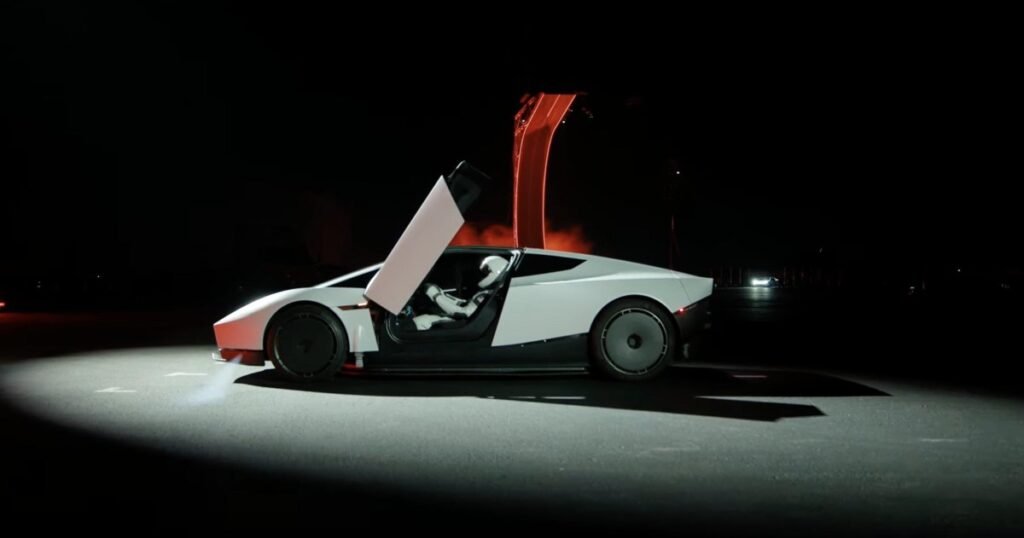
Tesla demonstrated its next-generation Roadster at an event in Waco, Texas, where the electric supercar drove upside down, briefly flew, and accelerated to 60mph in under a second. It was an impressive demonstration of a car that likely will come with some heavy caveats if it ever goes into production.
The event was less than 30 minutes and felt more like a stunt show than a product reveal. Indeed, there was no mention of price, trim levels, or other such mundane details. Who cares about that boring crap anyway? The people were here to see a car fly, and that’s what Tesla gave them.
The next-gen Roadster certainly took the scenic route in getting here. A prototype version was announced as a “one more thing” style surprise during the 2017 Tesla Semi event. The specs sounded ludicrous even back then: 0-60 mph in 1.9 seconds, a top speed over 250 mph, a 200 kWh battery delivering up to 620 miles of range, and a $200,000 starting price tag. Musk said deliveries would start in 2020, which sounded perfectly doable at the time.
Early adopters quickly threw down $50,000 deposits (or $250,000 for the limited Founders Series), effectively interest-free loans to help fund Tesla’s scaling ambitions. But then Tesla seemed to forget about the Roadster, as cementing its status as the ultimate vaporware. Production deadlines slipped as Tesla prioritized mass-market vehicles like the Model Y, while also wrestling with the overly complicated Cybertruck. Occasionally, when Musk would remember that the Roadster existed, he would up the ante about its capabilities. This culminated in the “SpaceX package” that would equip the supercar with cold-gas thrusters, bestowing hover powers and a 0-60 time under one second.
Musk has also sought to downplay the Roadster’s significance, calling it a “small potato situation” that will not “move the needle in a major way financially.” He’s framed the supercar more as a joint engineering collaboration between Tesla and SpaceX, even questioning whether it’s “even a car anymore” given its experimental nature. Some analysts theorize that the decision to re-release the Roadster is an attempt to set the stage for a rumored Tesla-SpaceX merger.
Tesla’s failure to bring the Roadster to market allowed other automakers to slip passed the company with their own hyper-powered EVs. Rimac has smashed performance records with the Nevera, Porsche has refined electric performance with the Taycan, and Chinese giants like BYD are producing track-ready supercars at a fraction of the cost. The Roadster is no longer shocking the world as an impossible prototype; it’s playing catch-up to an industry that spent nine years building what Tesla merely rendered.
Keep following us for the latest insights.