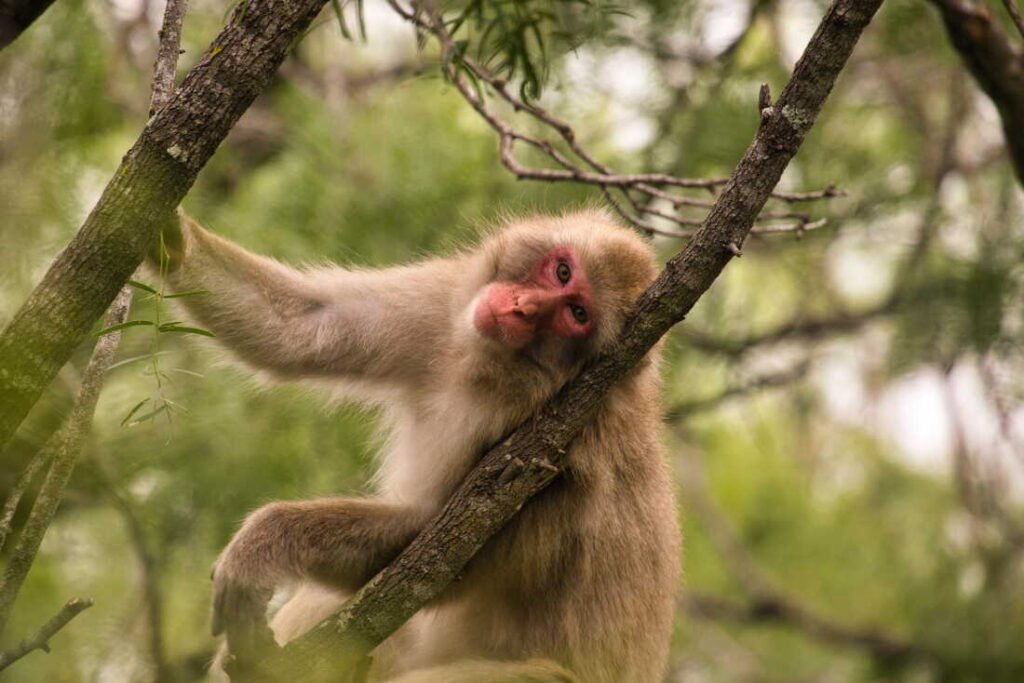
One of the macaques at a Texas sanctuary, where researchers ran tests to see if the monkeys became germaphobes after experiencing a viral outbreak. Stephan Kaufhold hide caption toggle caption i Stephan Kaufhold In the very early days of COVID-19, millions who’d rarely thought twice about germ avoidance became germophobes. Some folks wiped down groceries
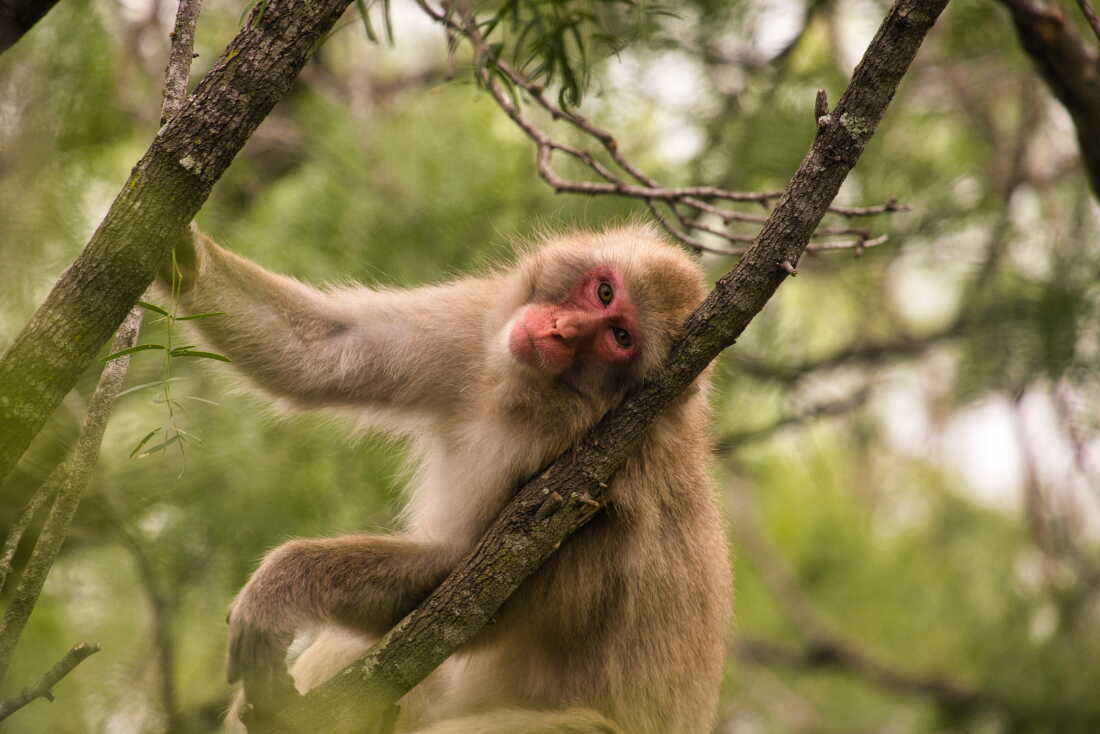
One of the macaques at a Texas sanctuary, where researchers ran tests to see if the monkeys became germaphobes after experiencing a viral outbreak.
Stephan Kaufhold
hide caption
Stephan Kaufhold
In the very early days of COVID-19, millions who’d rarely thought twice about germ avoidance became germophobes.
Some folks wiped down groceries before stuffing them into the refrigerator. Others let mail quarantine outside for days lest it harbor stray viruses. With the hindsight that SARS-CoV-2 spread primarily through the air, these sorts of precautions seem extreme. But in the moment, they were perhaps reasonable ways of avoiding an unknown pathogen.
Around this same time, a different virus hit a macaque sanctuary in Texas. New research suggests the monkeys responded in similar ways as humans did to COVID-19 — by being extra germophobic.
Humans are far from the only animals to avoid possible sources of disease. Scientists have found that critters as diverse as monkeys and nematodes (aka roundworms) can sense and steer clear of feces, for instance, which can harbor harmful bacteria.
“Something that has been less studied is the question of how flexible this avoidance is,” says Stephan Kaufhold, a cognitive scientist at UC San Diego. He wanted to see if experiencing an outbreak could make individual monkeys even more wary of picking up pathogens.
The outbreak in the Texas sanctuary, home to over 100 macaques, offered Kaufhold and his colleagues an opportunity to put that question to the test.
Grape expectations
In 2020, macaques in an enclosure at the sanctuary started getting sick with an HIV-like virus called SRV.
Once a monkey gets infected through bodily fluids, the disease “can take a rapid progression, where about three to four weeks after you initially get infected, you might die,” says Kaufhold. Many monkeys died, while others developed chronic immunodeficiency.
Sanctuary staff quickly started separating monkeys quickly, ultimately creating two groups — those who’d experienced the virus, either by getting sick themselves or witnessing others get sick, and those who hadn’t experienced the outbreak.
To see if those different histories made the monkeys more germophobic, the researchers presented individuals with two tasty treats — grapes.
“They get a fantastic diet at the sanctuary, but not grapes every day, so grapes were definitely a treat,” says Kaufhold.
One red grape was presented on a non-descript, clean-looking piece of wood. The other was on top of macaque poop, encased in epoxy. “Basically not to make the animals eat off actual feces,” says Kaufhold. “It did look quite gross, feces with a glossy wet look. Definitely worked also in triggering disgust in humans.”
From 2022 to 2024, the researchers presented monkeys with this choice in nearly 200 trials. Among monkeys who didn’t experience the outbreak, 79% ate the poop-plated grape. But only 47% of the outbreak veterans ate it, researchers report in the journal Royal Society Open Science.
Essentially, those who’d been oblivious to the outbreak were more likely to throw caution to the wind and eat the poop-plated grape than those who’d lived through it.
“I was surprised,” says Kaufhold. “I think it’s pretty clear evidence that something is going on.” Kaufhold thinks that something might be a heightened sensitivity to disgust.
“If you think about disgust, the evolutionary origins most likely are to try to protect the body from contamination because there are pathogens and parasites that we ideally would want to avoid,” he says. Becoming more easily disgusted after a devastating outbreak could pay off if it means avoiding infection, of whatever cause.
Of course, scientists can’t know whether macaques are actually experiencing disgust. “But the possibility that things like disgust are influencing the behavior of other species, and especially species like primates, it’s definitely a possibility worth considering,” says Andrew MacIntosh, a biologist at the Wilder Institute who wasn’t involved in the study but has done similar experiments with macaques.
“It seems plausible that past exposure to outbreaks could make individuals more cautious or risk averse,” he says, but he thinks more evidence is needed to show that. For example, the experiment was carried out several years after the outbreak, enough time for other factors to influence these behaviors, he says.
MacIntosh also points out that the fecal avoidance experiment bears little connection to how the initial outbreak spread, through bodily fluids transmitted through scratches or bites. “The mode of transmission of that virus has really nothing to do with fecal contamination,” he says.
Kaufhold doesn’t think that’s a problem.
“We’re not claiming that macaques had any sort of understanding of the mechanism of viruses, it just seems to be an increased caution,” he says. People didn’t initially know how SARS-CoV-2 spread either, he says, but many went to great lengths to avoid infection. Those impulses may have been shaped not by paranoia, but by evolution, as a way of staving off sickness in an uncertain world.
For stories about life in our changing world, subscribe to NPR’s Global Health newsletter.
{For more tech updates, stay tuned to our blog.|Keep following us for the latest insights.|Check back often for more exciting news!}