The Federal Aviation Administration’s ground stop, which halted flights nationwide, was lifted Friday night after stranding travelers in airports and canceling more than 6,600 flights. Even with airspace reopened, the hourslong closure on Friday promises to snarl air travel for days as airlines scramble to get airplanes and crew back in place — and thousands of delayed
The Federal Aviation Administration’s ground stop, which halted flights nationwide, was lifted Friday night after stranding travelers in airports and canceling more than 6,600 flights.
Even with airspace reopened, the hourslong closure on Friday promises to snarl air travel for days as airlines scramble to get airplanes and crew back in place — and thousands of delayed or canceled passengers back on their way.
Homeland Security Secretary Markwayne Mullin said late Friday that the “public was never in danger” during the airspace closure. He said “all your loved ones are safe,” and that the federal government was working to resolve the issue.
Department of Transportation Secretary Sean Duffy said at a press conference that the FAA system experienced “inconsistency” in its data systems that communicate with airplanes. Because of that, a ground stop was called around 3 p.m.
He said there had been 3,000 flights in the air at the time of the stop, all of which landed safely using alternative systems.
Duffy and Mullin said the nation’s air-traffic control system was outdated and blamed Friday’s issue on its age. They called for Congress to cough up $50 billion for its modernization — up from the $30 billion previously pitched in September.
“I have already replaced some of those switches with President Trump, and our new IP switches did not go down,” Duffy said. “It’s the old hardware that went down.”
The IP switches are new voice communication systems designed to replace the decades-old analog voice switches that much of the national airspace system still relies on.
Duffy and Mullin also said the fault wasn’t related to AI or cybersecurity.
Mullin said he’d seen “zero evidence” that the issue was a cyberattack or a problem with artificial intelligence, which he dubbed “SI,” for the Trump Administration’s preferred term, “superintelligence.”
Duffy said they were still “working on the details” of exactly what happened — what caused it and how it could be prevented in the future. He said he couldn’t guarantee it wouldn’t happen again when asked if the traveling public should feel safe when flying in US airspace.
That flying public was stranded in airports around the country — checking airport monitors only to see their flights delayed or canceled. Because the events of the day weren’t the airlines’ fault, passengers would have little recourse for meals or hotels.
A timeline of events during the FAA’s ground stop
After the ground stop was issued around 3 pm Eastern time, Duffy said just after 4:15 pm that the nationwide flight traffic halt came “following a communication issue impacting all Air Route Traffic Control Centers.”
People were quick to question whether SMART, a new FAA AI tool to help air traffic control that started deploying this week, was involved.
ASI, the company that makes the SMART system for the FAA, said that Friday’s issues weren’t “based on or a result of the SMART system, any product of ASI or our integration with FAA and ATC.”
Duffy also said SMART was not at fault.
Mullin said earlier Friday, when asked if the AI system might be related to the outage: “That’s what we’re looking at.”
He also said that it had “no indication” the ground stop was related to Microsoft, which had faced massive issues across its services this week.
Meanwhile, the FAA had said the ground stop was due to “extraordinary circumstances and for reasons of safety.”
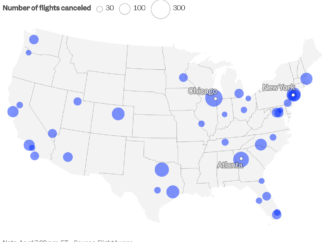
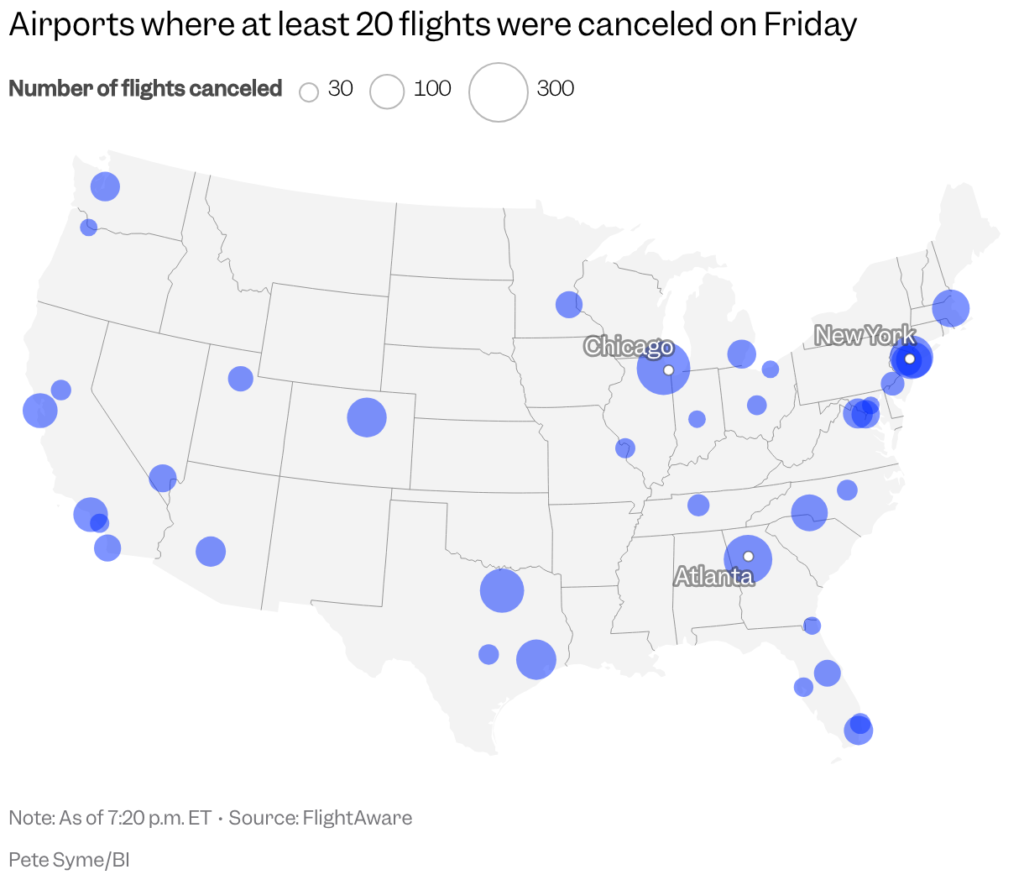
More than 6,600 flights had been canceled within the US, or in or out of the country, as of 9:45 p.m. Eastern time, according to data from FlightAware.
Chicago O’Hare topped the list with 395 cancellations, while Atlanta’s Hartsfield-Jackson — the world’s busiest airport — also saw over 350 flights canceled, as of that time.
More than 200 flights were canceled at major airports in New York, Boston, Texas, and Denver.

Homeland Security said FAA ground stop wasn’t a safety issue
Mullin said the ground stop wasn’t a safety issue. He called it a communications-related issue. He said he didn’t want people to assume this is a safety threat to the American people or “another 9/11.”
Still, many planes had to divert or turn around.
Among the flights affected was Delta Air Lines Flight 958, which was traveling from Los Angeles to New York’s JFK. Almost four hours into its journey, at 4:11 p.m., the Boeing 767 turned around and diverted to Cincinnati.
Another Delta flight, from Atlanta to JFK, changed course over the Eastern Seaboard and diverted to Baltimore.

And an LA-bound flight from Puebla, Mexico, operated by the Mexican budget airline Volaris, diverted to Tijuana — barely south of the US border.
Delta and Volaris did not immediately respond to requests for comment.

Brendan SMIALOWSKI / AFP via Getty Images
Pilots in the air have a system for these issues
Mark Stephens, a retired Delta Air Lines pilot, told Business Insider that pilots have a system for these situations to maintain safe distances from other aircraft and land within their limits.
Planes en route during a ground stop can still land; they “continue via the flight plan, and then start using backup methods.”
He said there are digital tools that can connect them with air-traffic control and their airline’s dispatch to obtain routing or other information.
Stephens said that unless someone tells the pilot to divert, the plan is “stay the course and do what you’re trained: aviation, navigate, communicate.”
The last time a nationwide ground stop occurred was in January 2023, and it lasted only about 90 minutes. Before that, it was in 2001 on 9/11.
Stephens said this could create a snowball effect into the weekend: “Long delays will turn into a crew rest nightmare,” he said. “Tomorrow is going to be a very difficult reset as pilots and flight attendants will be all over the country, and planes will be stuck in cities without crews.”
He added that “major hubs don’t have space for all these planes.”

Brendan SMIALOWSKI / AFP via Getty Images
Passengers are facing travel chaos
Some travelers were taking matters into their own hands: Amtrak said on Friday evening that its website and app were generating error messages. “We’re currently experiencing higher-than-normal call volumes due to ongoing airline issues,” the train operator said in a post on X.
At airports around the country, passengers were facing crushing delays.
A passenger at the Springfield-Branson Airport in Missouri said he was told all flights were canceled for the rest of the day, and that he should rebook — but when he tried to do so, airline systems were overloaded, and he couldn’t get through.
Airlines begin recovery, waive change fees
Late Friday, major US carriers said they were resuming operations after the FAA lifted the ground stop, but warned that delays and cancellations would continue as aircraft and crews were repositioned.
Delta said it was “safely resuming operations,” but cautioned that it would take time to reset its network. Southwest said it would resume a limited number of flights after consulting with the FAA and would also focus on repositioning its operations for Saturday morning. United said it had resumed some flights Friday night, while JetBlue expected disruptions to extend into Saturday after canceling all of its remaining Friday flights, except Europe-bound flights from JFK and Boston.
American said it was prioritizing international flights and flights to non-hub cities Friday night to position planes and crews for a recovery on Saturday.
“For the remainder of the evening, we are prioritizing flights to non-hub cities, as well as international flying, to position aircraft and crew where they are needed to help restore our operation,” the airline said in a statement to CBS News.
American, Delta, Southwest, and United issued travel waivers allowing eligible passengers to change or rebook flights under carrier-specific terms.
Noah Sheidlower and Alcynna Lloyd contributed to this report.
{For more tech updates, stay tuned to our blog.|Keep following us for the latest insights.|Check back often for more exciting news!}