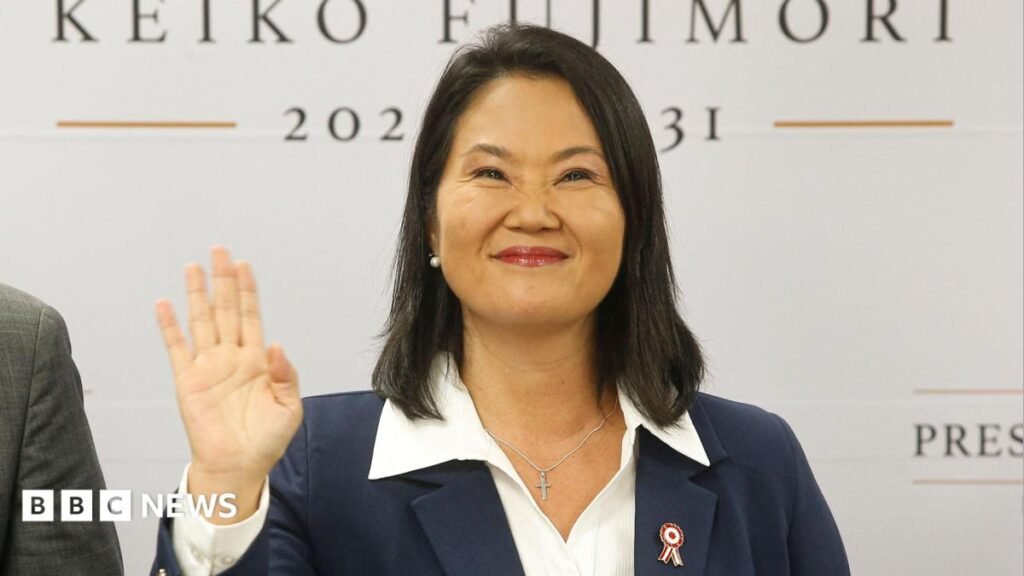
Right-wing candidate Keiko Fujimori has been declared the winner of Peru’s closely contested presidential election, almost a month after voting took place. The 51-year-old obtained 50.135% of the votes in the second round held on June 7, compared to 49.865% for leftist candidate Roberto Sánchez, a margin of less than 50,000 votes, according to figures
Right-wing candidate Keiko Fujimori has been declared the winner of Peru’s closely contested presidential election, almost a month after voting took place.
The 51-year-old obtained 50.135% of the votes in the second round held on June 7, compared to 49.865% for leftist candidate Roberto Sánchez, a margin of less than 50,000 votes, according to figures certified by Peru’s Electoral Tribunal.
It is the fourth time that the daughter of disgraced former President Alberto Fujimori has sought the presidency of the South American nation, this time promising to oversee the crackdown on organized crime.
His election, which coincides with the election of Abelardo de la Espriella in Colombia, marks a shift to the right in Latin American politics.
Fujimori said she will assume the position of president “with responsibility, humility and a deep sense of duty.”
“Each day of this transition process is an opportunity to listen, dialogue and arrive prepared at the beginning of the new government,” he added, in what seemed to be a nod to his brief mandate.
Sánchez, 57, has alleged that the second round of elections had been “seriously compromised” and threatened legal action, arguing that strong support for Fujimori among Peruvian voters abroad was a sign of irregularities.
After the result was announced on Friday, his party appealed the electoral court’s proclamation, asking for the vote to be annulled.
While Sánchez, a former foreign trade minister, championed a platform of sweeping economic reforms, Fujimori benefited from concerns about crime and political instability that dominated the race.
Throughout the campaign, he built on his father’s controversial legacy, promising a military offensive against organized crime, particularly extortion incidents that have skyrocketed in recent years.
Alberto Fujimori was eventually imprisoned for crimes against humanity for extrajudicial executions and forced sterilizations carried out during his increasingly authoritarian leadership.
Keiko also pledged to attract private investment to promote economic growth and immediately expel any undocumented immigrants found committing crimes in Peru.
He ran unsuccessfully in 2011, 2016 and 2021, losing by equally narrow margins, during a period of intense political instability in Peru. She will become the ninth president of the Andean country in a decade.
His swearing-in ceremony is expected to take place on July 28.
When he takes office, he will be the latest addition to a series of ideologically aligned right-wing leaders in Latin America who have taken power in recent years, often overthrowing left-wing governments.
Colombia’s elected president, De la Espriella, will take office a few days later, having won a similarly close election with a promise to combat organized crime.
He and others such as Nayib Bukele of El Salvador and Daniel Noboa of Ecuador have sought to align themselves with U.S. President Donald Trump, who has become more interested in Latin American political affairs in his second term.
The trend means that Brazilian Luiz Inácio Lula da Silva, who will face the son of convicted former president Jair Bolsonaro in this year’s election, is now the predominant left-wing standard bearer in the region.
For more tech updates, stay tuned to our blog.