
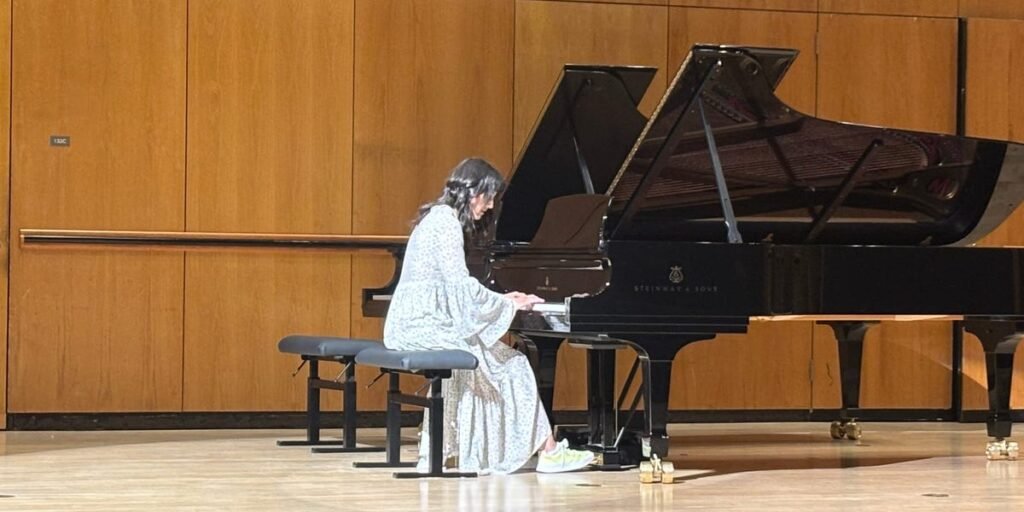
My grandmother is a pianist. As often happens, the pendulum swung the other way with my mother, who had no interest in taking piano lessons or forcing her children to do so. I vowed to swing the pendulum the other way with my kids, signing them up for piano lessons even though they showed no
My grandmother is a pianist. As often happens, the pendulum swung the other way with my mother, who had no interest in taking piano lessons or forcing her children to do so. I vowed to swing the pendulum the other way with my kids, signing them up for piano lessons even though they showed no interest.
As fate would have it, my eldest son fell in love with the instrument. Soon after, I also signed up for lessons. This fall I will begin my 10th semester as an adult piano student in our local university’s music education program.
Over the years, I learned to read notes and play chords. I arranged Billy Joel’s “Piano Man” and Burgmüller’s “L’Harmonie des Anges” for my recitals. The further I go, the more I realize that I am years away from sight-reading with the confidence needed to fulfill my original vision of being able to sit at the piano and play any pop song or Christmas carol in front of me. But that doesn’t matter so much to me.
Sure, there are many reasons why I might quit, but I find there are many more to continue. In total, I spent about $6,000 on piano lessons for our family last year, and about $2,400 of that amount went to me. The investment was worth every penny.
Music is great for my brain.
Many parents know and understand the advantages of our children learning to play an instrument. No matter our age, adults can benefit too. A 2025 study found that “playing an instrument was associated with a 35% reduction in dementia risk.”
I saw its value firsthand when I attended ‘Your Brain on Beethoven’, a public concert organized by the Music in Medicine Initiative. As the musicians performed the “Archduke Trio,” a “brain-computer interface and EEG brain dynamic data visualization” provided real-time information about how the music affected the pianist as a performer and the audience as listeners.
Even without a Ph.D. In neuroscience, I can feel the positive impact of music every time I play. My lessons often feel like a literal mental exercise.
The concentration necessary to learn is meditative.
As a father of two, it’s hard to find time, so sitting at the piano is the hardest part. That resistance quickly dissipates as soon as my fingers hit the keys, when the concentration required to play each note is so all-encompassing that I can only concentrate on the task at hand.
Walking away from a lesson, I often feel relaxed. My stress seems to melt away during the dedicated 45 minutes where I don’t check my phone or email or think about what I should do next. I get the same boost when I practice, as long as I take a minute to silence my phone.
Courage begets more courage
Learning something new is overwhelming. However, I was pleasantly surprised to find that the more I tried and failed, the more courage I had to do it again. Successes are a delight, but overcoming failures sitting in front of the piano is really exciting.
I may not be able to free a mountain alone, but surviving my heart threatening to beat out of my chest while I play a piano recital is a wonderful reminder of being alive, without any physical risk.
At my last recital, my hands were shaking so visibly that it was noticeable from the back row. I played with adrenaline, managing to hit the notes and extract some musicality despite my strong physical reaction.
I met up with the other adult students after our performance and we congratulated each other. We all point out what went well. Instead of dwelling on the mistakes, I accepted the praise. Learning as an adult is not about being the best. It’s about being the best version of yourself. It’s a lesson I learn and can pass on to my children.