
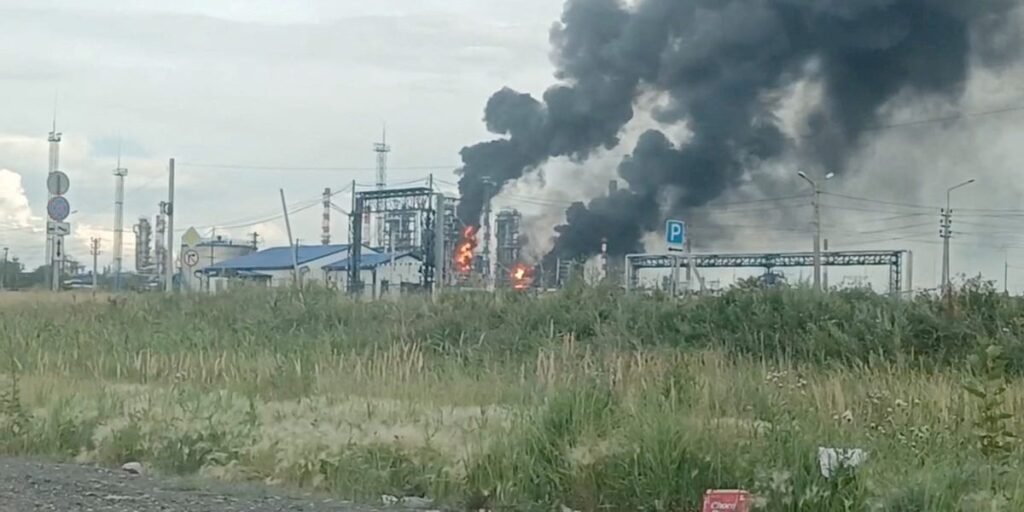
Ukraine attacked Russia’s largest oil refinery in the city of Omsk on Monday in what its forces say was its furthest-ever drone strike in the war. The Omsk facility, which processes about 21 million tons of oil a year, is located in western Siberia and about 1,700 miles from Ukrainian territory, roughly the distance between
Ukraine attacked Russia’s largest oil refinery in the city of Omsk on Monday in what its forces say was its furthest-ever drone strike in the war.
The Omsk facility, which processes about 21 million tons of oil a year, is located in western Siberia and about 1,700 miles from Ukrainian territory, roughly the distance between Los Angeles and Houston.
Omsk Governor Vitaly Khotsenko confirmed the attacks on Monday, saying that “enemy UAVs” had attacked the refinery and that no casualties had yet been reported.
Khotsenko urged the public not to “approach the debris” but did not specify the extent of the damage.
Social media images indicated that at least one major fire started at the refinery; Several columns of the refinery’s main processing unit, ELOU-AVT-11, were filmed spewing smoke.
Ukraine’s Special Operations Forces claimed responsibility for the attack on Monday, saying it was Ukraine’s first attack on the Omsk facility.
“This is the deepest long-range attack into enemy territory during the entire time of the large-scale invasion,” SOF wrote on its Telegram channel.
The military establishment wrote that ELOU-AVT-11, which it called “the most important unit of the company,” was damaged by the attacks.
Ukrainian President Volodymyr Zelenskyy highlighted the attack in his late-night speech, calling it an “important achievement” for his forces.
“The improved Firepoint drones have put Siberia within reach of Ukrainian precision,” he said.
Denys Shtilierman, chief designer at Ukrainian munitions firm Fire Point, wrote in X on Monday that a new variant of his company’s FP-1 drone was involved in the attack.
The FP-1 is one of Ukraine’s most prominent long-range unidirectional attack drones. The fixed-wing platform typically carries a payload of up to 60kg, with an initial range of 1,000 miles, which was later extended to 1,600 miles.
Shtilierman, however, said Monday that the latest version of the jet-launched drone can fly 2,110 miles, easily eclipsing the distance between Ukraine and Omsk.
Fire Point did not immediately respond to a request for comment sent outside normal business hours.
The long-range attack drone has been one of the most notable advances of the war in terms of strategic attack. Much slower but much cheaper than traditional missiles, they have formed the backbone of Ukraine’s strategy to undermine oil and gas industries critical to Russia’s economy.
The attacks have been picking up pace recently, with kyiv reporting more than 50 attacks on Russian oil infrastructure since March.
Last week, the General Staff of the Ukrainian Armed Forces said the attacks had affected about 42% of Russia’s total oil refining capacity.
About more than half of Russia’s 83 regions have introduced fuel rationing in recent weeks, as official government figures say domestic gasoline production fell 17% to 850,000 barrels per day.
Russia’s leader Vladimir Putin acknowledged earlier this month that his country was suffering from fuel shortages, but dismissed them as temporary and “non-critical.”
Putin said Moscow plans to rapidly increase production of air defense systems to protect the skies over its refineries.