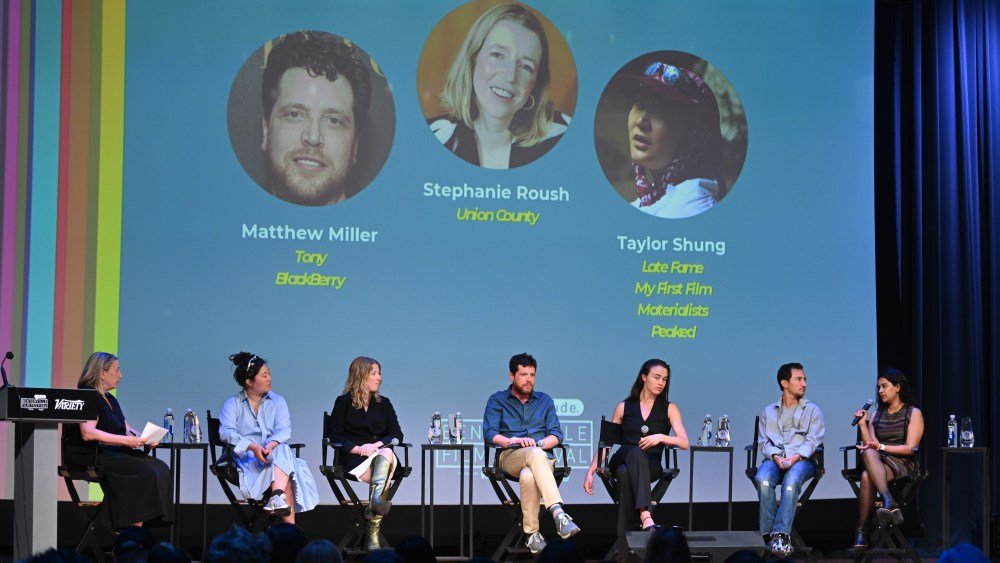
Producers recognized on Variety’s 10 Producers to Watch list offered a look at the changing film industry during a panel in association with the Bentonville Film Festival, where Variety’s Carole Horst led the discussion on the challenges of production and how independent films are evolving. Producers do not play a single role in the filmmaking
Producers recognized on Variety’s 10 Producers to Watch list offered a look at the changing film industry during a panel in association with the Bentonville Film Festival, where Variety’s Carole Horst led the discussion on the challenges of production and how independent films are evolving.
Producers do not play a single role in the filmmaking process. Apoorva Charan (“Take Me Home”) began the panel by sharing what the job entails, which includes reading scripts, scouting talent, raising financing, hiring crew, designing distribution strategies, and overseeing production and budgets.
Producers are partners with directors, said Emily Korteweg (“Splitsville,” “The Last Fix”), and they are the two who see the bigger picture of the film.
“To produce, you need to know and understand every aspect of production, from soup to nuts,” said Matthew Miller (“Tony,” “BlackBerry”). “You’re basically putting a group of people together and making something out of nothing, and you’re usually the first person to show faith in this filmmaker, in this script, in this idea.”
Overseeing the filmmaking process includes addressing several challenges and it’s important to keep an open mind, Charan said. While working on “Take Me Home,” Charan shared that they would come up with scenes and rewrite the script on the day of filming, so relying on a set routine and expectations would hinder the process.
One of the obstacles Stephanie Roush said she faced during “Union County” was gaining access to a courtroom and shooting during actual sessions. Miller shared that creating the biopic “Tony” was a challenge, as they had to review Anthony Bourdain’s estate.
All panelists shared one key struggle: finances. This challenge was especially prevalent in the case of independent films, where producers face a “fearful market.” Movies like “Obsession” do incredibly well, but people don’t fully recognize that they were made completely independently, Korteweg said.
“Now, financiers might say, ‘Well, why can’t you do it for less and get the same result?’ “That’s not how it works,” he said.
There is currently a significant difference between the funds allocated to the distribution of a project and the money allocated to independent films, which could be risky, said Luca Intili (“Maddie’s Secret”). The consequence is that many independent films are never released.
However, new financiers are emerging, but only if you know where to look. When looking for people to financially back his films, Charan looks at the film and asks himself, “What are the themes? Where can you find your advocates? Where are you going to find people who are so emotionally and financially invested in making this film?”
Actors can also create value for a film, Roush said, since having a great script can only accomplish so much if there are no great actors to bring it to life. These producers look for projects that resonate with audiences, which is also the goal of most independent films.
Independent films have become more popular in recent years, as there has been a rise in what Italy calls micro-budget cinema. “It’s like we’re all learning simultaneously that we don’t need big budgets to make something creative, interesting and well-formed,” he said.
Panelists also praised the original storytelling and finding the right filmmaker to bring it to life, which Roush said is essentially like finding the “diamond in the rough.”
“I also think Hollywood has a habit of chasing the brightest thing in front of it, and I think ‘Obsession’ [and] The conversation about ‘Backrooms’ is really appropriate for that,” Roush explained. “And the fact of the matter is, if you look at the history of independent film, chasing those things is not going to lead to the next hit or the next great filmmaker.”
Even with interest from producers, independent projects are no longer selling out festivals and smaller distributors can’t afford these films, Miller shared. The panelists agreed that film festivals are incredibly important for producers and for film in general. It is a place for filmmakers to experience the audience’s reaction to the film and engage in dialogue with viewers, allowing them to continue creating films, Charan said.
“Regional festivals serve to create a community around film, and I think they allow more people to see a certain film that they may not see because it is not distributed,” said Taylor Shung (“Late Fame,” “My First Film,” “Materialists,” “Peaked”). “It also allows regional filmmakers to push their own film production, which I think is really exciting.”
Festivals also serve as “talent incubators,” which is incredibly important for young filmmakers, Roush said. They offer some of the earliest forms of validation in their careers, and receiving community touchpoints and validation helps them have long careers.
Also at the Bentonville Film Festival, Katherine LaNasa was honored with the Variety Virtuoso Award and joined Horst on stage to talk about her decades-long career and her work on “The Pitt.”
LaNasa shared that she has been a performer for over 40 years and is lucky to work as a storyteller. “Acting has given me such a rich and beautiful life. I love doing it, creating characters and learning new things,” she said. “And some of my most profound and self-reflective moments have been while inhabiting the mind of a fictional character because, ultimately, it’s about understanding them, and therefore understanding myself and other people.”
Playing charge nurse Dana Evans on “The Pitt,” LaNasa praised the script’s writing for giving her the “elasticity” to make decisions that seem natural. LaNasa told Horst that the key to harnessing Dana’s character is finding humility.
“There’s a lot about it that has to do with service, and there’s a kind of deep sense of identity and pride that comes from doing that,” he said.
Check back often for more exciting news!