
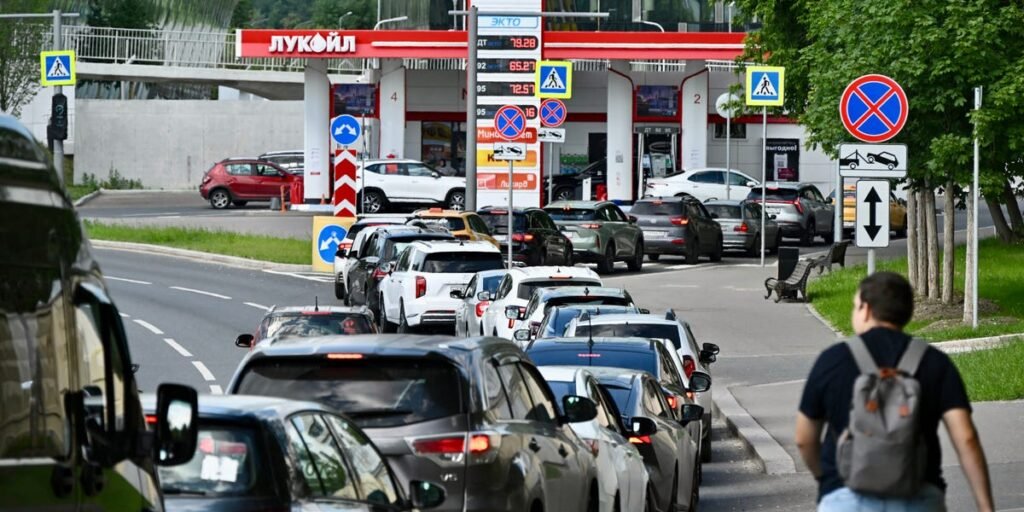
The fuel shortage, which has been increasing since the summer of 2025, is worsening into a national crisis for Russia, forcing the oil-producing nation to ban energy sales and imports. In the annexed Crimean peninsula, one of the first Russian-controlled areas hit by shortages, public gasoline sales were reduced weeks ago. “The fuel supply situation
The fuel shortage, which has been increasing since the summer of 2025, is worsening into a national crisis for Russia, forcing the oil-producing nation to ban energy sales and imports.
In the annexed Crimean peninsula, one of the first Russian-controlled areas hit by shortages, public gasoline sales were reduced weeks ago.
“The fuel supply situation remains tense and will persist for some time,” Sergey Aksyonov, the Russia-backed head of Crimea, warned again in a statement on Wednesday. “Some days there will be no fuel available for sale.”
Aksyonov’s announcement comes after Crimea said on June 22 it would temporarily cease fuel sales to all but the federal government and essential services.
Much of the crisis there stems from a Ukrainian campaign to lay siege to the peninsula through drone strikes. Crimea is connected to continental Europe and Russia by several major land bridges, all of which have come under intense attack in recent weeks.
A new class of longer-range fixed-wing drones, often equipped with artificial intelligence to improve survivability against signal jamming, has allowed kyiv’s forces to destroy these bridges, supply routes and trucks in the south for months.
A key target has been R-280, a major supply road running from Rostov-on-Don to Crimea via the western coast of the Sea of Azov. Traffic on the route fell more than 70%, Ukrainian forces said in June.
The strikes continue. On Wednesday, drone pilots from the Ukrainian Unmanned Systems Forces said they had attacked more than 360 tankers and heavy transport vehicles bound for Crimea in a single week.
“Every tanker and every heavy transport unit on this route is a legitimate military target,” the drone warfare branch said in its statement.
The fuel problem extends beyond Crimea. Ukraine has spent most of the last year repeatedly bombing Russian oil and gas infrastructure with long-range jet-launched drones.
Since then, Russian government statistics have said gasoline production fell by 17%, with about a third of local oil refining capacity damaged.
Last week, Ukrainian forces said they had destroyed 42.74% of Russia’s oil refining capacity, although this has not yet been publicly corroborated by outside sources.
Anyway, the price is starting to show. At least 78 of Russia’s 83 regions are suffering from gasoline or diesel shortages, and 48 of these areas are introducing some type of cuts or limits on purchases, according to an analysis by the Institute for the Study of War, a Washington-based think tank.
In Moscow, by far the richest city in Russia, queues of cars have been seen in front of gas stations in recent days. Social media posts in other regions show queues snaking for miles; A viral video shows a man saying he had been waiting for 36 hours in Zabaykalsky Krai in the Russian Far East.
The Kremlin responded on Wednesday by banning exports of diesel and jet fuel, saying it had begun importing gasoline and purchasing products with “lower environmental standards.”
Russian leader Vladimir Putin acknowledged the shortages last week but has so far sought to assure the nation that they will be approved, calling them “temporary matters” in a meeting with officials on Wednesday.