Colombia’s Bogotá Audiovisual Market (BAM) concluded its 17th edition on July 10 with an increase in attendance. The numbers say it all: 2,336 accredited participants, 271 industrial activities and 882 individual business meetings connecting selected projects with a large number of international guests, advisors and potential partners. “BAM demonstrated once again that Colombia has world-class
Colombia’s Bogotá Audiovisual Market (BAM) concluded its 17th edition on July 10 with an increase in attendance. The numbers say it all: 2,336 accredited participants, 271 industrial activities and 882 individual business meetings connecting selected projects with a large number of international guests, advisors and potential partners.
“BAM demonstrated once again that Colombia has world-class stories to tell and the talent to bring them to global audiences. We are confident that many of the projects that came to market will come out stronger than they arrived, and one step closer to becoming the films, series and audiovisual experiences that the public will see in the years to come,” said BAM director Carlos Eduardo Moreno.
The ever-expanding five-day event was packed with panels, masterclasses and training sessions among a dizzying array of activities. It only stopped when Colombia played Switzerland in their failed attempt to reach the semi-finals of the FIFA World Cup on July 8. Even the traffic-clogged streets of Bogotá became virtually silent.
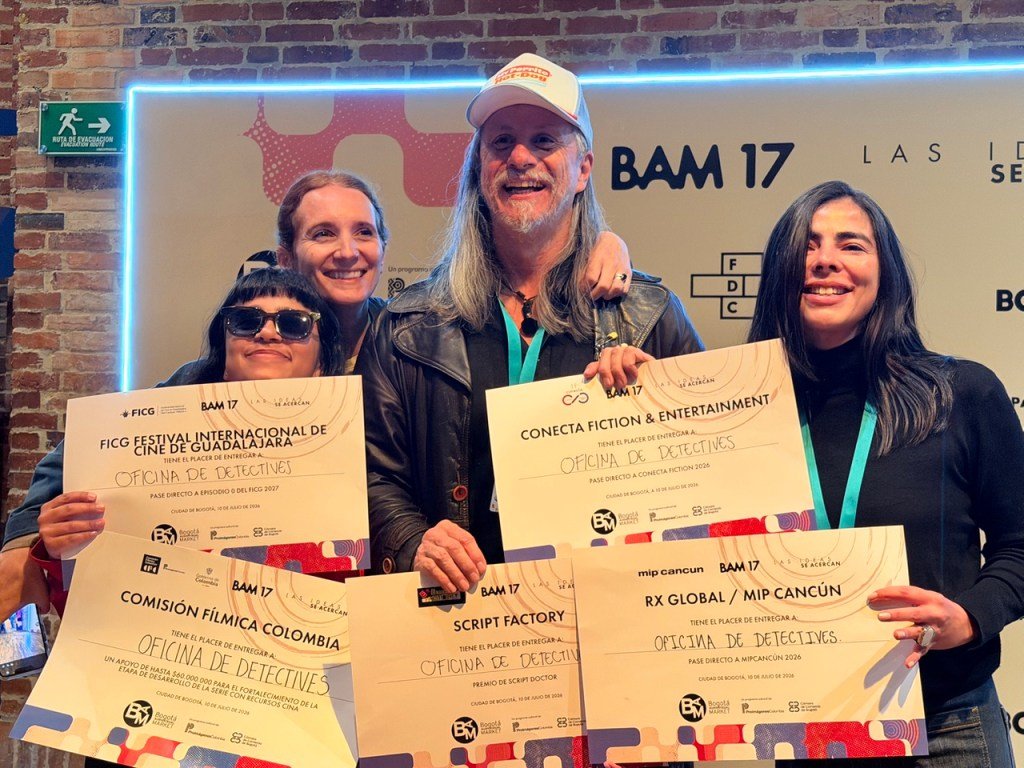
This year’s edition awarded 70 in-kind awards from national and international partners to selected projects and emerging talents in various categories, including fiction films, documentaries, series, feature films, animation, short films and Bammers. Among the big winners were José Luis Rugeles and Ana María Tarazona de Rhayuela, who took home five awards for their television series project “Rookies” (“Detective Office”).

José Luis Rugeles and Ana María Tarazona from Rhayuela won five awards for ‘Rookies’
Credit: Pablo Cataño
Among the feature-length documentaries, “La Sombra de Yolüja” by Hanz Rippe Gabriel and Fernanda Pineda and “De la Villa” by Mónica Taboada and Beto Rosero shared the awards.
For its part, “Of oranges and other demons”, by Agamenón Quintero, won the highest number of awards in the fiction feature film section.
Organized by Proimágenes Colombia and the Bogotá Chamber of Commerce, BAM continues to be a key engine driving Latin America’s audiovisual sector.
TIS Studios opens massive 18,300 square feet Stage 7, people from VFX Companies, Loma expands its clientele
BAM took place just as TIS Studios, which has been home to a host of high-profile projects, announced the opening of Stage 7, a new 18,300-square-foot soundstage, set to host large-scale international film and television productions.
Stage 7, TIS Studies
“TIS Studios brings highly trained teams, international production standards and protocols to manage large-scale projects, all backed by almost three decades of delivering premium content,” said Samuel Duque, president of TIS Studios. “Stage 7 adds to that foundation. Combined with Colombia’s production incentives, it gives producers, showrunners and production studios around the world one more reason to bring their most ambitious projects here.”
The launch of Stage 7 marks the next phase in TIS Studios’ expansion, building on nearly 30 years of production experience and a history of projects for major global platforms and networks, including Netflix, Amazon, Disney, Paramount, CBS Studios, MTV, Fox Television Studios, Nickelodeon, NBCUniversal and Telemundo.
At 18,300 square feet and 40 feet high, Stage 7 is the largest sound stage in Colombia and one of the largest in Latin America.
Meanwhile, the VFX company People Bogotadirected by Andrea Espinal, has attracted numerous international projects to its studio, attracted by its highly competitive rates.
Shows he has appeared on include Netflix’s epic “One Hundred Years of Solitude,” Taylor Sheridan’s “1883” and “Lioness” (seasons I and II), Rodrigo Prieto’s directorial debut “Pedro Páramo,” AppleTV’s “The Morning Show,” and the survival horror film “Boiúna: Legend of the Amazon,” previously titled “Titan,” which was filmed in the Colombian Amazon.
Launched in 2019 under Espinal, the Folks Bogotá studio was established to harness Colombia’s creative talent for high-end VFX productions. What started out supporting the Montreal team has grown into a full-service studio providing visual effects for major Latin American and international titles.
Another thriving visual effects company, knoll, With deep roots as a family-owned equipment rental company, it has expanded into the virtual production business. Its 2,000-square-foot virtual production studio combines custom LED volumes with real-time technologies including Unreal Engine, camera tracking, and media servers to deliver in-camera VFX and extended reality (xR) productions.
Led by COO Francisco Forero, the Bogotá-based facility supports feature films, series, commercials, live broadcasts and R&D projects, offering filmmakers a state-of-the-art environment for virtual production and next-generation visual effects workflows.
Some of the shows they have worked on include Netflix’s fact-based hijacking series “The Hijacking of Flight 601,” SPT’s “Hasta que amanecer,” and Dago Prods’ “How to Lose Everything.” as well as Vaivén by BAM, a large-scale immersive audiovisual installation created by the artist collective Proyecto Aurora.
It is not surprising that its largest client, as is the case with TIS and Folks, is Netflix, which has continued to expand its offering in Colombia and recently appointed Ana María Londoño as head of content in Bogotá.
Venezuelan filmmaker Mariana Rondón reflects on ‘All her nights without Caracas’
Taking the stage for her BAM Talk, Venezuelan filmmaker Mariana Rondón reflected on her path to film, from her award-winning “Bad Hair” to her latest feature film, “It Would Be at Night in Caracas,” produced by Edgar Ramírez.
Rondón revealed that his creative journey began with an unexpected fascination: genetics. He spent a decade developing his own “genetic laboratory” through art, creating an installation that imagined transgenic beings and produced just 12 seconds of moving images. “That process transformed my understanding of cinema: powerful stories can begin with an image, not just a script,” he said, emphasizing the emotional power of images to generate curiosity, wonder and meaning.
Later, the Venezuelan exodus changed his artistic focus. “Watching people walk from Venezuela to Chile, step by step, crossing borders on foot, felt almost biblical,” she said, describing a crisis that forced many, including herself, to rethink identity, belonging and the possibility of imagining a future.
Unable to film “It Would Be at Night in Caracas” in the Venezuelan capital, Rondón and her co-director Marité Ugas recreated Mexico City, working with hundreds of displaced Venezuelans. During the scenes recreating the protests, the border between fiction and reality collapsed. “We were asking for a ‘cut,’ but there was no way to stop it,” he recalled. Many participants relived their own experiences, leading the production to provide psychological support.
In the end, the film became an act of reconstruction: a way to reconnect with a country that many had lost and to explore identity through film. “That question of identity is at the heart of why we make movies,” he said.
The Colombian film boom has a sustainability problem
A new industry study presented at BAM confirms the historic impact of Colombia’s Film Law 814, which, through the Film Development Fund (FDC) and tax incentives, transformed the country into a thriving production center. Between 2015 and 2025, Colombia released 548 feature films (compared to about two per year before 2003), with public support and tax incentives financing more than half of them and attracting around $160 million in private investment.
But the study also reveals a major challenge: Manufacturing growth has not translated into stronger companies. Only 25% of production houses supported by FDC or tax incentives have returned for a second project, leaving 75% unable to build long-term capacity. With most companies operating with just two employees and film making up only a portion of their revenue, the report warns that Colombia is successfully financing films, but is not yet building sustainable film businesses.
The study proposes 12 strategies to strengthen the ecosystem, including expanding financing tools, improving tax incentives, supporting distribution and promotion, and recognizing the operational costs necessary to build resilient manufacturing companies.
“The study confirms the need for a more integrated approach to film policy. 26 years ago the priority was to create Colombian cinema. Today, those films exist, but their market share remains minimal and they still do not reach the public,” said producer and director Cristina Gallego (“Birds of Passage”), who led the panel.
“We need to embrace technological change and incorporate it into financing strategies, going beyond fragmented interests. Screenwriters, regional filmmakers, workers, festivals, producers, distributors and public institutions (including the ministries of culture, education, technology and commerce) have interests in the audiovisual sector, but often operate separately,” he added.
“Without a sustainable ecosystem that supports both the companies (production and distribution) and the people who drive the industry, long-term growth will remain impossible.”
New TIS Studio Stage 7
For more tech updates, stay tuned to our blog.