WASHINGTON– Senate Republicans will return to Washington on Monday with an uncertain agenda after the sudden death of prominent Republican Lindsey Graham, the committee chairman and a key player who served as a crucial ally of President Donald Trump. Graham, 71, died Saturday night after a torn aorta, according to a statement from his office
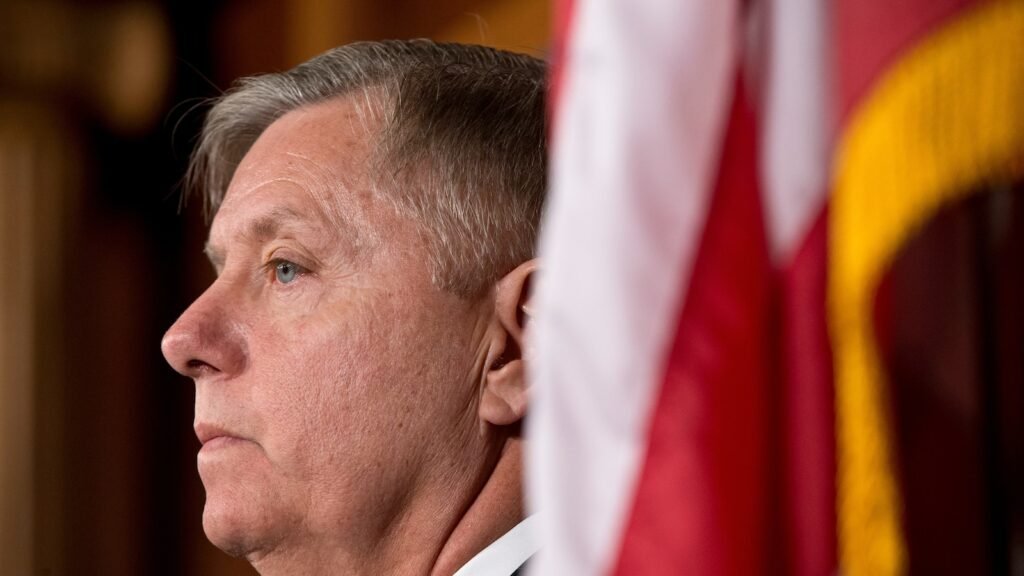
WASHINGTON– Senate Republicans will return to Washington on Monday with an uncertain agenda after the sudden death of prominent Republican Lindsey Graham, the committee chairman and a key player who served as a crucial ally of President Donald Trump.
Graham, 71, died Saturday night after a torn aorta, according to a statement from his office Sunday. The shocking news came after another prominent Republican senator, former Republican leader Mitch McConnell, was hospitalized for nearly a month. McConnell broke a weeklong silence about his health Sunday night, saying he was still recovering after suffering pneumonia and falling at home.
The continued absence of McConnell, R-Ky., and the South Carolina senator’s surprise death have rattled Republicans who were already at odds with Trump and deadlocked on several priorities upon his return from a two-week recess. And the small number of Republicans in the Senate (53-47) is sure to add confusion to what was already expected to be a chaotic and difficult few months before the November midterm elections.
Despite consolidated power in Washington, Republicans have been unable to do much as the Senate, House and White House have disagreed on legislative priorities and Trump has criticized Senate Republicans, in particular, for failing to pass his legislation to require proof of citizenship for voters. Graham, who was one of Trump’s closest friends in the Senate, often served as a crucial intermediary.
“He was great, like a gauge, a gauge of the temperature of the Senate,” Trump said of Graham on NBC’s “Meet the Press” on Sunday morning, noting that he had spoken to Graham on Saturday. “He could go in and get something passed. He would just get people on his side.”
The Senate left town two weeks ago after a difficult few weeks for Republicans. Trump blocked the Senate from confirming one of his own nominees, asked them to fund parts of his White House ballroom project despite opposition, and forced them to defend the Iran war even as they questioned the strategy and ending.
He also refused to sign a bipartisan election-year housing bill that had the support of large bipartisan majorities in both chambers, arguing that they should instead pass his bill to require proof of citizenship, the SAVE America Act. The bill became law at midnight Friday after he refused to sign it but did not veto it.
The alliance between Trump and Senate Republicans has also weakened after the president endorsed the opponents of two incumbent Republican senators who had been reliable votes, Texas Sen. John Cornyn and Louisiana Sen. Bill Cassidy. Cassidy directly challenged Trump on the Iran war in a Capitol Hill meeting between Trump and Republicans just before leaving town that did not go well.
Republicans are returning to a number of important agenda items, including the confirmation of Trump’s nominee for attorney general, Todd Blanche, and the confirmation of Jay Clayton, whom Trump selected to be director of national intelligence and then temporarily blocked.
They must also find a way around Democratic opposition and Trump’s continued anger to keep the government open and avoid a government shutdown again. Graham was a ranking member of the Senate Appropriations Committee, as was McConnell.
Graham also served on the Judiciary Committee that will consider Blanche’s nomination and is the chairman of the Senate Budget Committee, which has been under pressure from House Republicans and Trump to approve a budget package with increased defense spending for Iran.
There is also bipartisan legislation to advance a Russia sanctions package that Graham and Democratic Sen. Richard Blumenthal of Connecticut had announced Friday following an agreement with the Trump administration.
Blumenthal told The Associated Press on Sunday that Graham was “absolutely focused on this moment” when they announced the sanctions package after months of negotiations. He said he hopes Graham’s memory inspires the Senate to move forward.
“We’ve really reached this point where all the stars are aligned and we’ll be missing Lindsey’s spectacular defense,” Blumenthal said.
Senate leaders have not yet announced how they will honor Graham, who died after a tear in the inner wall of the aorta, called aortic dissection, related to hardening of Graham’s arteries, according to his office. The official cause of death will be revealed after toxicology and microscopic tests, his office said.
Graham, a prominent South Carolina Republican and former Air Force attorney who served in Congress for more than three decades, had just returned from a trip to Ukraine.
Several Republican names began circulating as possible replacements to fill out the remainder of Graham’s term, including three candidates who fell short of the party’s nomination for governor this year: Rep. Nancy Mace, Rep. Ralph Norman and Lt. Gov. Pamela Evette.
Also in the mix is Rep. Russell Fry, who was elected to the House in 2022.
McConnell’s Sunday announcement revealed for the first time that a fall led to his hospitalization, breaking the silence about his condition after weeks of growing speculation about his health.
The Kentucky Republican, who will retire in January, said in a statement that he was “briefly unconscious” when he was first taken to the hospital in June and underwent a series of tests to try to determine what caused his fall. He said he was also treated for mild pneumonia and transferred to a rehabilitation center.
“My doctors have confirmed that I did not break any bones or suffer a concussion. I did not have a heart attack or stroke. I do not have any tumors or bleeding,” McConnell said, adding that he is now “regaining my strength.”
He said he cannot return to the Senate “yet.”
McConnell explained the four-week silence about his condition by saying that “people of my generation are often hesitant to share the vulnerability that comes with aging.”
“Even in the face of public opinion, I feel the same instinct: I can’t help it,” he said.
Check back often for more exciting news!