I have studied climate tipping points.1 for more than 20 years, and I am increasingly concerned that scientists have overlooked the most dangerous aspect of these for societies. The possible collapse of important parts of the Earth system (from ice sheets to ocean circulations) will profoundly alter the planet’s warming and tilt it irreversibly toward
I have studied climate tipping points.1 for more than 20 years, and I am increasingly concerned that scientists have overlooked the most dangerous aspect of these for societies. The possible collapse of important parts of the Earth system (from ice sheets to ocean circulations) will profoundly alter the planet’s warming and tilt it irreversibly toward a different state.2. But the biggest risks may not lie at that endpoint.
Is a monstrous network of ocean currents about to collapse? The race is on to find out.
How we get there – how the turnaround unfolds – is more important, and there is an urgent need to understand the process. This is missing from current analyzes because the scales in time and space at which it occurs fall between those of climate and weather. Tipping analyzes focus on huge climate changes, often globally, over decades. Weather phenomena are fast and local. But if the interaction between the two is observed, it is clear that the transition between one climatic state and another is not smooth but extremely volatile.
Climate change will therefore manifest itself as a period of increasingly dramatic climate volatility, rather than a sharp change in average conditions. A fluctuating climate will cause swings and drops in crop yields, flash floods and erratic storms. It will stress economies by disrupting supply chains and amplifying insurance losses. Societies are unprepared because climate volatility related to tipping points is not present in risk assessments.
This problem is urgent. Earth’s subsystems, including the oceans, cryosphere, and biosphere, already appear to be destabilizing. The planet is heading towards a climate free fall.
The climate is destabilizing
By definition3Tipping points are reached when a series of interconnected changes amplify each other until the entire system becomes unstable and changes uncontrollably to a different state. The loss of sea ice at the poles, for example, reduces the amount of sunlight reflected back into space, further warming the Earth’s surface, which then accelerates ice loss. These vicious cycles of change define a tipping point at which the climate cannot return to its previous patterns.
Are we all doomed? How to cope with the overwhelming uncertainties of climate change
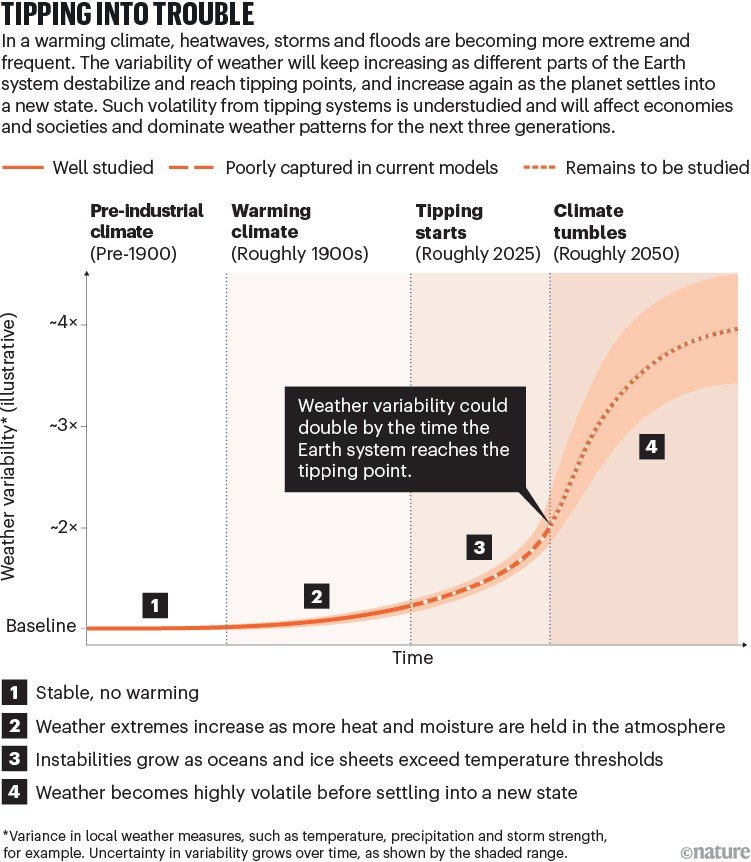
Before that point, the climate system becomes increasingly unstable. Fluctuates considerably: An increase in variability is a well-established property of these “nonlinear dynamical systems” that approach a critical threshold.4,5. So far, scientists and policymakers have not realized that society will face these fluctuations and that they will intensify during the transition.
The Earth will experience an increasingly erratic climate: increasing fluctuations in meltwater flows, ocean circulations, and sea ice extent. These changes will lead to extreme temperatures, precipitation, and more frequent and intense storms, leading not only to more heat waves and droughts, but also to more cold waves and flooding.
The magnitude of the consequences may not be obvious at first: ice sheets and ocean currents are so large that their responses to warming are relatively slow and delayed. Once a critical temperature threshold for instability is crossed, these systems are slow to collapse, but collapse is inevitable (see ‘Falling into trouble’).
Source: A. Levermann
Ice sheets in West Antarctica6 and Greenland7 They have already exceeded their tipping temperature. Arctic sea ice will do so in a few years. For the Atlantic Ocean, scientists just don’t know8. The period between passing the tipping temperature and reaching the tipping point is when fluctuations increase dramatically.
Tipping point early warning research has identified increased climate variability as a signal of reduced stability and used it to estimate the time remaining before a widespread tipping point begins. But the variability caused by instability as a mechanism of climate impact has been largely ignored.
Modern economies are adapted to relatively stable climate baselines. Agricultural productivity, infrastructure design, insurance prices, and financial risk management depend not only on expected average conditions but also on the predictability of variability.
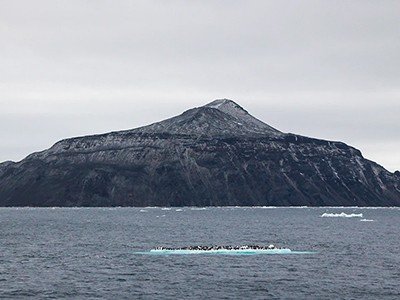
Protect Antarctica or risk accelerating planetary collapse
Farmers must take into account lost crops; architects and urban planners must take into account extremes of temperature, wind and precipitation; and financiers and insurers must consider the cost and magnitude of the damages. But once these factors are no longer predictable, all bets are off: life becomes uninsurable and the world becomes unsafe.
Communities are already feeling the effects of increasing extreme weather9. And such events could quickly escalate once climate subsystems begin to falter. For example, once the Greenland ice sheet approaches its tipping point, its surface will be even more vulnerable to melting. A more variable local climate will create more variable amounts of meltwater, which will be injected into the North Atlantic Ocean.
These injections will increase the variability of ocean convection and mixing and therefore the extent of Arctic sea ice. All of this will cause greater fluctuations in sea surface temperature in the Atlantic Ocean, which will have consequences on the stability of the jet stream and, therefore, on climate variability in Europe, North America and Asia.
The weather is different in a turbulent climate
For more tech updates, stay tuned to our blog.