
Technology companies like Google have set up important offices in London.Credit: Tim Robberts/Getty When Mythos, an artificial intelligence model from US firm Anthropic, was rolled out to a limited group of companies earlier this year, rumors quickly circulated about the system’s hacking capabilities and cybersecurity threats. True clarity about the power of the model came

Technology companies like Google have set up important offices in London.Credit: Tim Robberts/Getty
When Mythos, an artificial intelligence model from US firm Anthropic, was rolled out to a limited group of companies earlier this year, rumors quickly circulated about the system’s hacking capabilities and cybersecurity threats. True clarity about the power of the model came only once the AI Security Institute (AISI), a UK government-backed organization based in London, evaluated the model.
London, particularly its tech neighborhood in King’s Cross, is emerging as a key hub outside the United States for AI companies (see ‘King’s Cross Hub’), with Anthropic and OpenAI, both based in San Francisco, California, opening major offices there. And the city’s approach has a different flavor than its international counterparts. Instead of competing with the United States and China in generating increasingly larger and more powerful models, the United Kingdom is focusing on AI safety and understanding the risks of emerging models. AISI, which examines frontier models submitted to it voluntarily by companies, is one of several UK AI safety labs operating globally.
“The UK has been at the forefront of thinking about ethics, responsible AI and AI governance for quite some time,” says David Leslie, who researches ethics, technology and society at Queen Mary University of London.
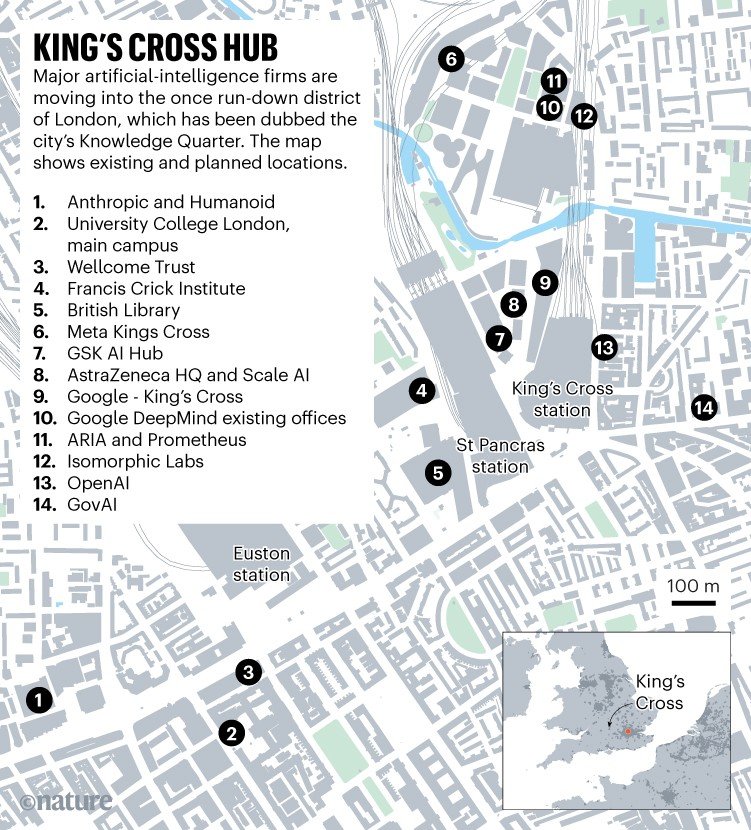
The London-based security ecosystem also includes Apollo Research, a lab that has conducted high-profile research into the potential of models to “conspire” against human users, and the nonprofit GovAI, formerly the Center for AI Governance, which has co-authored influential research, such as one that proposes using access to computing resources as a way to govern AI.
Academic bodies such as University College London, the Alan Turing Institute and the University of Oxford are also located nearby, providing AI research expertise and graduate talent.
Although focusing on AI safety is proving to be a successful niche for the UK, some researchers highlight that AISI is no substitute for a regulator. Others are also concerned that an increasingly narrow definition of AI security has focused too much on keeping models under control and safe from attack, while paying less attention to broader societal impacts, such as transparency and the consequences of widespread adoption.
London calling
London’s broader AI ecosystem has been built around DeepMind, the AI company founded in the city in 2010 and acquired by Google in 2014. Its co-founder, Demis Hassabis, ensured the company remained in London despite the sale. Several of his students have founded major startups in the city, including Ineffable Intelligence, founded by AI researcher David Silver, which raised $1.1 billion in seed funding earlier this year.
Being in the UK “gives us a little more space to think about things in a slightly different way than if you were in the wheelhouse all the time,” Hassabis said, speaking with Nature in 2025. Although “hype culture” is growing in the UK AI community, “there has always been a more measured, evidence-based approach to evaluating science,” adds Leslie.
The UK government is trying to attract foreign companies by presenting the country as more stable than the United States and more pro-innovation than the European Union. In March, after Anthropic became embroiled in a dispute with the US Department of Defense over ethics, London Mayor Sadiq Khan wrote to the company applauding its stance and inviting it to expand in London, which the company did the following month. Tech companies see the UK as more “sensitive to their interests than the EU,” which has a relatively strict EU AI Law, Leslie says.
“Big tech companies feel that not only do they have a rich environment to build on in terms of intellectual talent, but they also have a very nice regulatory environment and a very nice government environment” in London, he says.
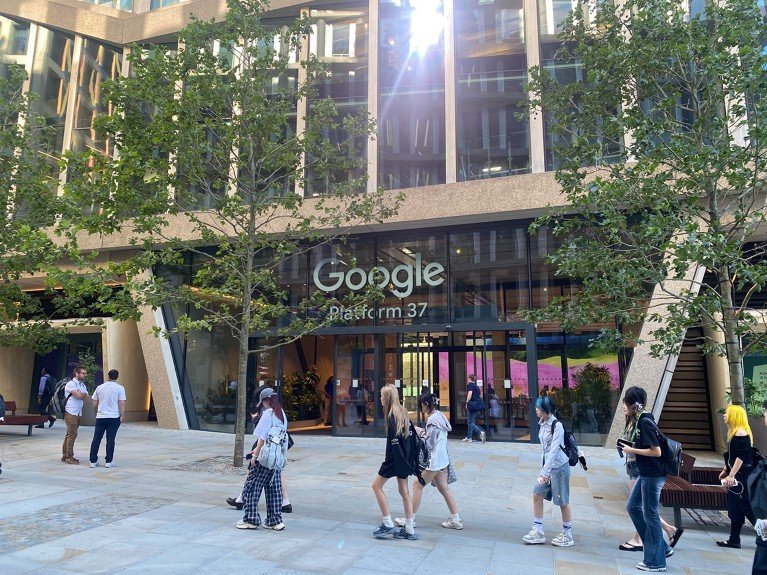
Urban planning around London’s King’s Cross station has transformed the area into Europe’s leading artificial intelligence cluster.Credit: Michael Szebor/Nature
Safety first
When it comes to efforts to map AI risks, London’s most prominent resident is the AISI. It was launched in 2023 by former Prime Minister Rishi Sunak at the first global AI safety summit, held at Bletchley Park in Milton Keynes, UK, when the country was at the forefront of an international push for AI safety.
It emerged from a “really big belief that governments need to understand what’s happening” on the AI frontier, says Jade Leung, the organization’s chief technology officer. AISI conducts industry-wide assessments, such as the reliability of models that perform as intended or are able to persuade the public. Companies such as Google DeepMind, OpenAI and Microsoft also test their models, for example to check their capabilities in creating biological weapons. AISI researchers are trying to tear down the model’s safeguards, so the company can improve them.
For more tech updates, stay tuned to our blog.