Charging is at the forefront of the minds of potential EV buyers. Just over half of those surveyed by AAA last year said public charging infrastructure was a key concern. Those concerns are not unfounded. Historically, EV fast charging has been lackluster. In 2023, after a disastrous road trip, I wrote a “bill of rights”
Charging is at the forefront of the minds of potential EV buyers. Just over half of those surveyed by AAA last year said public charging infrastructure was a key concern.
Those concerns are not unfounded. Historically, EV fast charging has been lackluster. In 2023, after a disastrous road trip, I wrote a “bill of rights” on EV fast charging, outlining seven improvements charging networks needed to make to turn things around.
What a difference a few years can make!
During a recent road trip, I was surprised at how much the situation has improved. With one small exception, my charging experience was perfect, something I couldn’t say for a similar trip three years ago.
An almost perfect experience
This summer’s road trip to Montreal covered over 600 miles. We had intended to use our Kia EV9, which can travel almost 300 miles on a charge, but the Kia is in the shop because the air conditioning is broken. Instead, we drove our Audi e-tron, which has a range of about 220 miles per charge. Despite the disparity, the e-tron handled the journey with aplomb. Rangemaxxing may sound nice, but it’s not necessary.
To find chargers, I used A Better Route Planner (ABRP), an app that optimizes charging stops taking into account everything from prevailing winds and temperature to vehicle specifications and battery degradation. You can use a Bluetooth OBD reader to send live data from the car to ABRP, but I found the app to be fairly accurate without one. ABRP said our first stop should be a Rivian charger near Lebanon, New Hampshire. The app is now owned by Rivian, so I wasn’t entirely surprised.
After my experience with Lebanon chargers, I can see why the app chose them, regardless of Rivian ownership. There were no lines, plenty of food options, a grocery store, and six 300 kilowatt chargers that were working. I had downloaded the Rivian app ahead of time, but it wasn’t necessary. The charger accepted my credit card and delivered more than 140 kilowatts, about the e-tron’s maximum. We used the same chargers on the way home and had a similar experience.
After that, we used a Circuit Électrique station on the outskirts of Montreal to recharge for the next week. There we had the only drawback of the trip: the card reader didn’t work, so I had to download the Circuit Électrique app and load it with 20 Canadian dollars. After that, the session went smoothly. In retrospect, the stop wasn’t entirely necessary. We didn’t drive much during the week and the hotel charger worked perfectly. But the kids needed a break and my wife needed coffee, so we probably would have hooked up anyway.
Each session lasted about 20 minutes and we combined the load with stops for lunch or rest. We never once waited for the car. In total, the three sessions lasted about as long as our wait at border control on the way back to the United States.
How it used to be
Three years ago, the trip didn’t go so well. I knew fast charging could be hit or miss (I’ve driven non-Tesla electric vehicles for over a decade), but I was still disappointed.
That summer, we drove the same Audi e-tron to Maine, a round trip of about 350 miles, about half the distance of our trip to Montreal. The car could have made it to Maine on a single charge, but the hotel didn’t have an EV charger. To make sure we have enough power for the long weekend and the start of the trip home, we plan to charge a little more than halfway.
Before we left, I had also used ABRP to remove less reliable chargers, but the experience was still miserable. The first charger broke shortly after plugging it in, forcing me to move to another station. The first charger never ended the session with my car, which meant the second wouldn’t start without calling customer service. At another stop, the charging network app reported that two plugs out of four were working, but only one was working. In total I drove about seven hours and had to call customer service three times.
Imagine if gas stations worked like this?
Data reveals big improvements
Fortunately, electric vehicle charging infrastructure looks very different today. My experiences in 2023 and 2026 are anecdotes, of course. But the available data suggests that it is representative of a broader trend: fast charging in the US has improved by leaps and bounds.
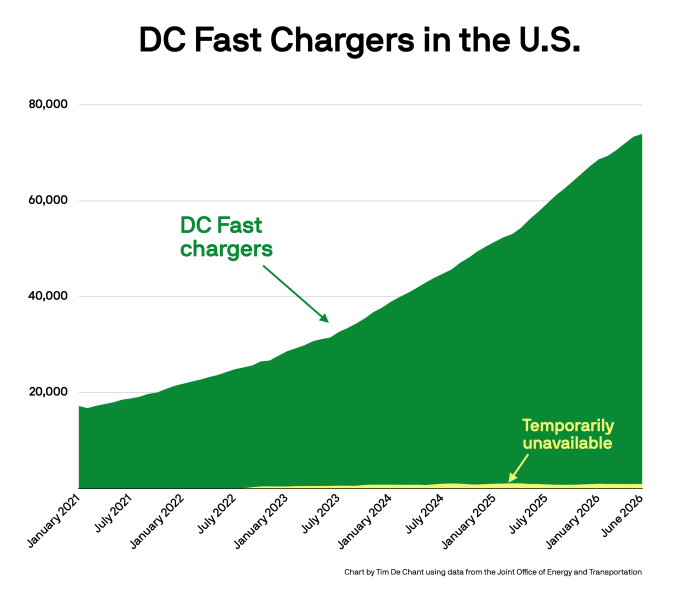
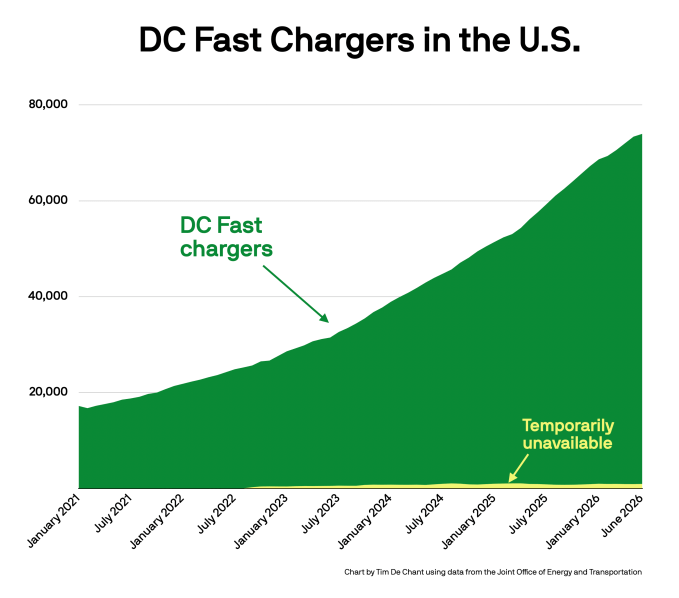
As of July 2023, the country had about 32,000 DC fast chargers, according to the Joint Office of Energy and Transportation. At the time, many of those chargers were restricted to Tesla drivers. (Tesla announced plans to open its network in 2023, but it took more than a year to achieve widespread access.) Today, electric vehicle drivers can use most of Tesla’s network. Continued expansion by Tesla and other companies has helped increase the total to more than double the number of DC fast chargers available in 2023.
What’s more, they are more reliable.
My near-perfect ride last week seems to be the norm, not the exception. Since last year, reliability has improved nearly 10 points, from 85 to the mid-90s, on Paren’s Reliability Index, which includes metrics such as successful charging sessions and station downtime. Tesla’s network remains dominant, according to Paren, but other networks are growing rapidly. That competition has certainly helped improve charging experiences across the board.
There are still gaps in the grid and electric vehicle chargers still fail. But more chargers are added every month and broken ones are repaired more quickly than in the past.
It’s not perfect, but I’m really surprised at how much better fast charging has become. Someone should tell those who resist what they are missing.
When you buy through links in our articles, we may earn a small commission. This does not affect our editorial independence.
Keep following us for the latest insights.