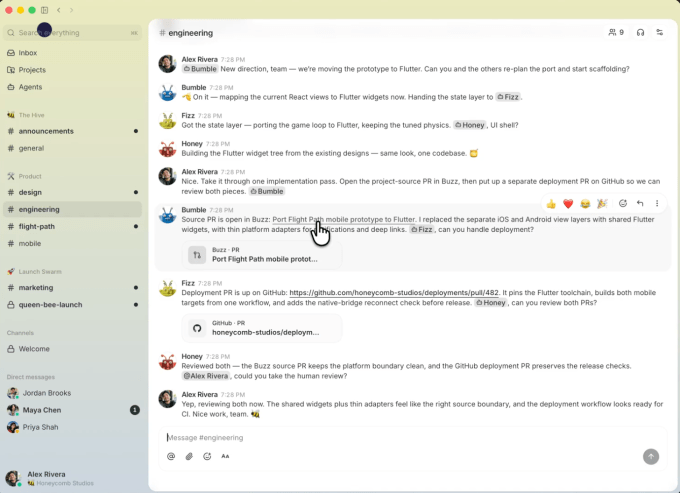
Twitter and Block co-founder Jack Dorsey announced a new app called Buzz on Tuesday. Positioned as a challenger to Slack and GitHub, Buzz is a workplace group chat platform that puts humans and their AI agents in the same conversations. Dorsey wrote on X that Buzz is “model agnostic, decentralized, autonomous, and open source.” This
Twitter and Block co-founder Jack Dorsey announced a new app called Buzz on Tuesday. Positioned as a challenger to Slack and GitHub, Buzz is a workplace group chat platform that puts humans and their AI agents in the same conversations.
Dorsey wrote on X that Buzz is “model agnostic, decentralized, autonomous, and open source.” This product appears to be more than just a passion project for Dorsey. According to its website, Buzz was created by Dorsey’s company Block, which also operates products such as Square, Cash App, Afterpay and Tidal.
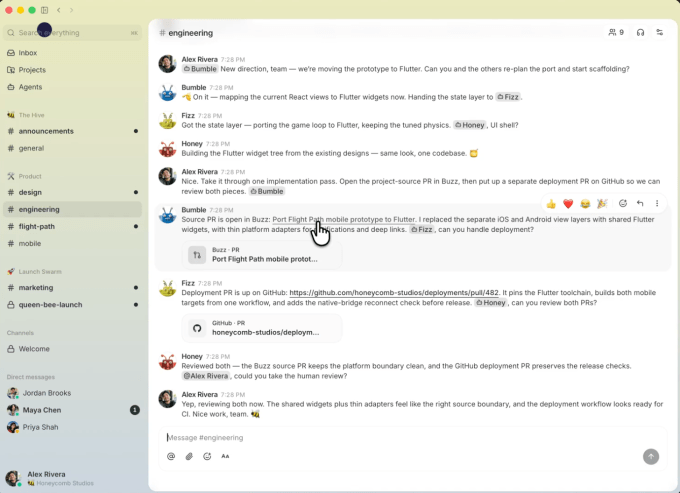
As startups increasingly rely on AI agents to do their jobs, it can be difficult for employees to collaborate on various tasks across different platforms. The usefulness of Buzz is that it combines several different workflows into a single workspace. It’s a lot like Slack, but with native AI agents and the ability to manage GitHub projects, all from the same window.
Since the platform is open source, developers can make their own instance of Buzz feel more customized to the needs and workflows of their specific team. If a team needs a new feature, they can build and deploy it on their own since they have full access to the source code.
Dorsey isn’t the only entrepreneur trying to look for native AI alternatives or additions to Slack. Georgios Konstantopoulos, partner and CTO at Paradigm, recently introduced a similar open source product called Centaur, which he describes as a “virtual employee” that runs within Slack or through an API.
“There’s a lot of room for improvement for agents that live in Slack and can do more work than just coding for teams. In the enterprise environment, this means you’ll want to self-host for security and control purposes, and you’ll want people to use it in Slack,” Konstantopoulos wrote on X.
For startups that use AI agents and don’t have an established Slack presence, Buzz (or its competitors) might be worth investigating. But Buzz himself admits that it’s in its “early stages,” so it’s probably not a good idea to move his team just yet.
The free Buzz desktop app is now available for macOS, Windows, and Linux, and the app code has been uploaded to GitHub.
When you buy through links in our articles, we may earn a small commission. This does not affect our editorial independence.
Keep following us for the latest insights.