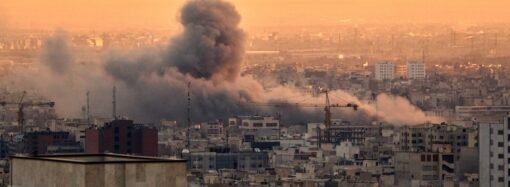
Iran's revenge: drones damage data centers for Amazon Web Services, reveal west's Achilles Heel
- Latest, Middle East
- March 3, 2026


Iran’s regime maintains an iron grip on power but still can’t ignore the impact of U.S. economic warfare, which is getting even tougher. That extends even to Supreme Leader Ayatollah Mojtaba Khamenei, who hasn’t been seen in public since the U.S.-Israeli strike on Feb. 28 that killed his father. In a written statement issued late last
READ MORE
President Donald Trump has downplayed his war on Iran as “small potatoes,” but those potatoes are getting bigger as both sides are escalating beyond their stalemate in the Strait of Hormuz. For months, Iran’s military has failed to completely close off the narrow waterway, as U.S. forces shepherd more oil tankers through, eroding Tehran’s geopolitical
READ MORE
Iranian President Masoud Pezeshkian acknowledged his country’s economic woes amid pressure from the U.S., which is strangling its trade while protecting other countries’ ships carrying oil through the Strait of Hormuz. Recent weeks have seen Tehran lose leverage over the critical energy chokepoint as traffic picks up, especially via a southern route along Oman’s coast.
READ MORE
President Donald Trump’s market-moving pronouncements are triggering almost instantaneous trading among Middle Eastern retail investors, with his statements generating more activity than Federal Reserve decisions or key U.S. economic data, according to one Dubai-based trading executive. “We see the price fluctuation immediately, and that will lead to trades,” Tarik Chebib, the Middle East CEO of
READ MORE
Facing an increasingly aggressive Iran and a slumping bond market, the Trump administration is betting that Treasury Secretary Scott Bessent can use the financial weapons in the government’s arsenal to achieve victory on both fronts. The idea is to kill two birds with one stone: getting Iran to fully reopen the Strait of Hormuz would
READ MORE
One of the hottest debates in the energy industry right now is how much oil is actually coming out of the Persian Gulf, and the answer could determine how long the Iran war lasts. Iran insists the Strait of Hormuz is closed and that it has control of the narrow waterway, which saw 20 million
READ MORE