
Sitting shoulder to shoulder on plastic chairs, hundreds of defiant San Franciscans, a notable number of them gray-haired, crowded into a gallery at the Fort Mason Center last Thursday. The reason? To protect its famous and picturesque coastal neighborhood from the development of a large new residential tower. San Francisco Chronicle reporter Laura Waxmann captured
Sitting shoulder to shoulder on plastic chairs, hundreds of defiant San Franciscans, a notable number of them gray-haired, crowded into a gallery at the Fort Mason Center last Thursday.
The reason? To protect its famous and picturesque coastal neighborhood from the development of a large new residential tower.
San Francisco Chronicle reporter Laura Waxmann captured last week’s scene in a photo she shared on X, which has since sparked backlash from social media users frustrated by the city’s housing market.
Many of the responses came from the tech industry, which some say has played a role in San Francisco’s housing crisis. They focused on the appearance of the crowd and characterized the opposition as highly organized.
Jason Calacanis, an investor, podcaster and prominent Silicon Valley voice, was among the chorus of tech workers who, in response to the photo, criticized residents who opposed the new development.
“These old guys were taking acid, dancing naked in Golden Gate Park, and living on each other’s couches 60 years ago,” he wrote on X. “Now they’re banning new housing to protect their $7 million Victorians.”
Last year, Calacanis left town for Texas, where he now owns a 33-acre ranch.
Evan Conrad, CEO of San Francisco Compute Company, a marketplace for artificial intelligence startups and others to rent and market large-scale computing power, valued at $300 million last year, blamed those holding out on building new residential buildings for the city’s lack of affordable housing.
“When the rent is $8,000 for a one-bedroom, remember that the fault lies with the people who, for 50 years, came forward to argue against almost every proposed housing unit,” he said on X in response to the photo.
Bilal Mahmood, a member of the San Francisco Board of Supervisors, said the meeting photo symbolized a generational divide.
“We have a deep affordability crisis right now, and younger generations are talking nonsense both about NIMBYs who will find any excuse to oppose housing, and about our city’s lack of action,” Mahmood wrote in an X post over the weekend, using the acronym for “not in my backyard.”
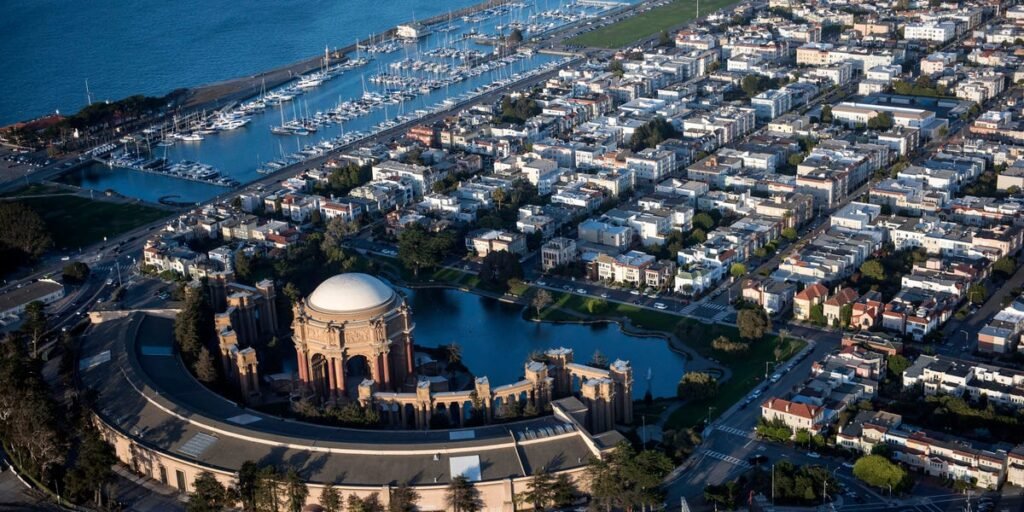
The Marina District is located on the north shore of San Francisco. It is famous for its park overlooking the Golden Gate Bridge and its Victorian and Mediterranean-style houses.
Local development company Align Real Estate has proposed demolishing the current Safeway grocery store on the boardwalk to build a new version with a housing complex on top.
The U-shaped complex would include a 20- and 18-story tower that combined would house 848 units, according to local media. Initial documents related to the project were submitted in December 2025.
A proposal to build 790 apartments on the site of a Safeway and a surface parking lot in San Francisco’s Marina District would more than double the size of the grocery store. Naturally, the mayor, the district supervisor and many area residents are opposed. pic.twitter.com/8inqnw9SHT
– Hayden (@the_transit_guy) December 8, 2025
Although the San Francisco Planning Department has not yet approved the proposal, the mixed-use development has generated fierce opposition from many residents. They worry the development will increase traffic, cause environmental problems and redefine the character of the neighborhood.
“It has become a test of how California’s state housing laws affect local planning, environmental review, and whether communities still have a meaningful voice in shaping their neighborhoods,” a flyer announcing the community meeting said.
That’s one side. On the other are younger residents in the tech industry and beyond competing for expensive apartments. They believe more residential units could benefit a city facing an extreme situation housing shortage and very high rents. Many of them also said that the division was between the old and the young.
What’s happening in the Marina District is a kind of microcosm of the housing crisis across the country. A March 2026 real estate agent report found that the housing supply gap exceeded 4 million homes last year.
Older Americans (specifically baby boomers) dominate the country’s housing market. Many of them have chosen to age in place or forgo downsizing, leaving fewer options for younger Americans hoping to enter the housing market. That’s part of what’s forcing millennials and Generation Z to cut costs by renting or moving in with their parents. Rising housing costs and mortgage rates are also barriers to entry, as is a lack of newly constructed housing.
As a result, multigenerational living, or when two or more generations of adults live together, is on the rise in California. Realtor data showed that San Francisco was high on the list with a 17.40% share of multi-generational listings.