President Donald Trump’s pledge to send every American adult a $5,000 check if Republicans hold Congress in November carries a price tag that economists say has no clear funding source — and would land on a federal balance sheet already strained by a nearly $2 trillion annual deficit. Kent Smetters, faculty director of the Penn Wharton
Investors got a reprieve on Thursday as the bond market regained its footing following a global sell-off earlier in the week. A rout in global bonds on Tuesday that sent yields spiking was partly reversed on Thursday, with investors cheering as US Treasury yields dropped from multi-year highs. The move appeared to be largely driven
The AI boom is soaking up investor cash, staving off a recession, and showing signs of faltering, David Rosenberg says. AI is “sapping the momentum out of the rest of business capital spending,” the veteran economist said during the latest episode of the “Excess Returns” podcast. Rosenberg estimated that 50% of all corporate investment is
“Is there an AI bubble?” is such a tired thought. Here’s something altogether more wired: The AI boom is paying off, but not in a way that the current equities market has accounted for. The success of the technology in one area of the economy could make the bubble real in another, more precisely. In
Last week’s attempt to boost the sagging yen wasn’t the first time the U.S. and Japan took such joint action, but the way they did it revealed weakness in the dollar’s global status, according to a top currency expert. In a Financial Times op-ed on Tuesday, University of California at Berkeley economist Barry Eichengreen pointed
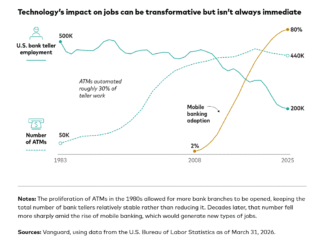
Every wave of technological change seems to arrive with a familiar prediction: This time, jobs are going away for good. The effect of automated teller machines (ATMs) on the bank teller profession reveals a more nuanced reality. When ATMs became widespread in the 1980s, many people assumed bank tellers would soon become obsolete. They were