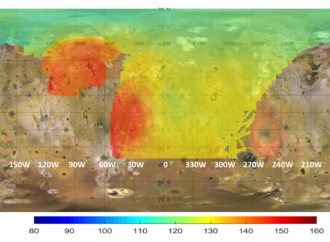
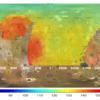
This map represents data captured by the Microwave Radiometer (MWR) aboard NASA’s Juno spacecraft, indicating the heat rising just below the surface of Jupiter’s moon Io. While infrared instruments measure the temperature of the moon’s surface, the MWR’s lower frequency microwave channels (0.6 and 1.25 gigahertz) can penetrate 6 to 20 feet (2 to 6
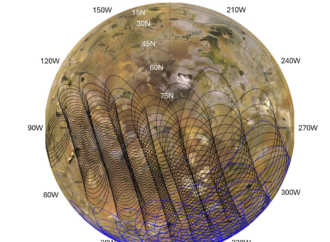
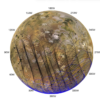
This graphic illustrates the areas of Jupiter’s moon Io sampled by the Microwave Radiometer (MWR) instrument aboard NASA’s Juno spacecraft during two close flybys. The superimposed black lines show the instrument’s footprints during Perijove 57 on December 30, 2023, when the spacecraft primarily mapped the Northern Hemisphere. The blue lines represent Perijove 58 on February
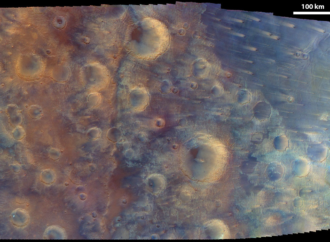
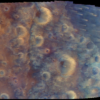
Captured by the multispectral imaging instrument on NASA’s Psyche mission, this is a color-enhanced mosaic created from four individual images acquired on May 15, 2026, during the spacecraft’s flyby of Mars. Psyche traveled from right to left (northeast to southwest on Mars) during the six minutes it took to acquire the images for this mosaic,
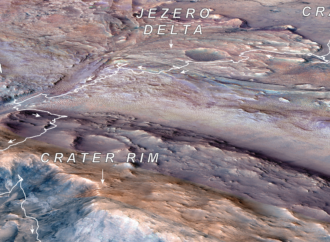
2 minute read Perseverance’s journey to ‘Broom Point’ PIA26754 Credits: NASA/JPL-Caltech/MRO/HIRISE/UA/ICL Photojournalism navigation Science Photojournalism The journey from perseverance to… Beginning of the photo report Photojournalism Search Latest content Galleries Comment RSS About Downloads Perseverance’s journey to ‘Broom Point’ PNG (16.62MB) Description This orbital map shows the path NASA’s Perseverance Mars rover took to reach
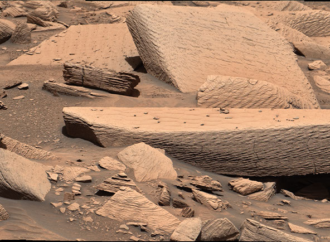
Billions of years ago, an hours-long Martian sand storm blew so intensely that waves of sand began to climb over each other as they moved across the surface. These layers of sediment eventually hardened into the multi-layered rocks seen in this image, which was taken by NASA’s Curiosity rover on December 12, 2024, the 4,391st