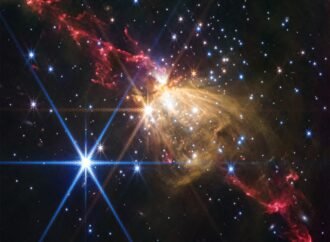
How are planets born, and how do they grow? This is an essential question in astronomy, one that researchers try to answer by observing “young planets.” That’s easier said than done. All the planets in our solar system are the same age, 4.6 billion years old. Astronomers therefore need to look elsewhere to find planets
How do scientists studying space with data from a telescope hundreds of thousands of miles away know that what they are seeing is real? A new NASA project, Artifact InSPECtor, invites you to find out – and by doing so, to help missions like Euclid and NASA’s new Nancy Grace Roman Space Telescope answer fundamental
Two mirrors, each small enough to fit in the palm of your hand, are set to change how we understand the cosmos. The launch window for NASA’s Nancy Grace Roman Space Telescope is about to open. The telescope’s primary instrument is due to inform practically every area of astrophysics, but also tucked inside the telescope
“If we consider what the James Webb Space Telescope is doing, it’s optimized towards looking at the very distant universe … but just a tiny patch of the sky,” says astrophysicist Rachel Mandelbaum of Carnegie Mellon University. “In contrast, Roman is able to look at a large area of the sky at once.” That broad
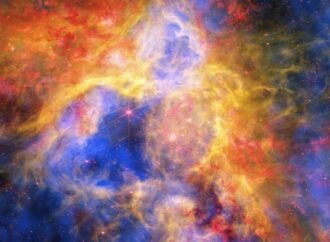
Like a collage made of layered sheets of colored cellophane, a vibrant new image layers observations of a famous star-forming nebula from NASA space telescopes. The resulting cosmic “craft” reveals new details about the star formation region known as 30 Doradus, or the Tarantula Nebula. Located in the Large Magellanic Cloud, a small neighbor galaxy
Last September, JWST took this image of a protostellar jet on the outskirts of the Milky Way. From tip to tip, the jet extends about twice the distance from the Sun to its nearest neighboring star system, α Centauri.Credit: NASA, ESA, CSA, STScI, Yu Cheng (NAOJ); Image processing: Joseph DePasquale (STScI) Of the black holes