
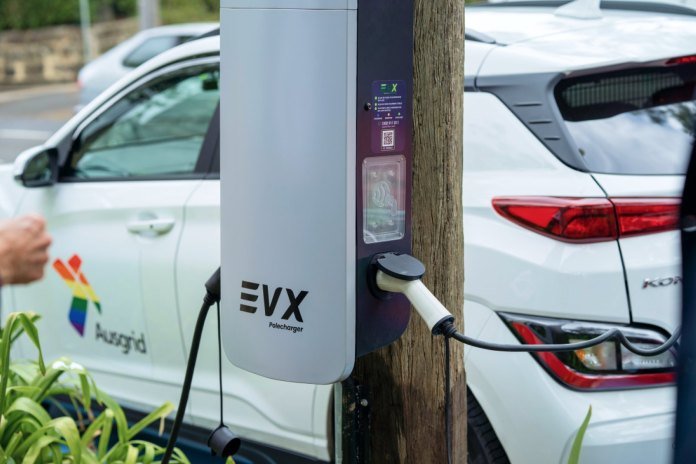
An innocent Facebook post by Federal Member for Bennelong, Jerome Laxale MP, recently sparked a fiery comment section debate that perfectly highlights a massive misunderstanding in the Australian electric vehicle community. Laxale posted a photo of a shiny new 22kW EVX pole-mounted charger over in North Ryde, celebrating the expansion of NSW Government-funded curbside charging
An innocent Facebook post by Federal Member for Bennelong, Jerome Laxale MP, recently sparked a fiery comment section debate that perfectly highlights a massive misunderstanding in the Australian electric vehicle community.
Laxale posted a photo of a shiny new 22kW EVX pole-mounted charger over in North Ryde, celebrating the expansion of NSW Government-funded curbside charging infrastructure.
Then came the classic internet comments, with one user quickly chiming in to sarcastically celebrate fossil fuel power being put to good use.
The great electron misunderstanding
The back-and-forth revealed a massive gap in how everyday Australians think the electrical grid operates.
Laxale fired back with a screenshot showing the Chargefox app proudly displaying a green leaf and declaring the site powered by 100% clean energy.
But the internet never rests, and commenters immediately questioned how a pole charger on a standard street can possibly claim to be completely green when the sun isn’t shining.
One commenter asked the ultimate question that confuses thousands of EV owners: is there a separate set of power lines hidden inside our streets carrying purely clean energy to these specific chargers?
Laxale answered beautifully with a reality check that every Australian energy consumer needs to hear:
No the grid is a mix of all forms of energy.
When a company or household claims they are powered by “100% clean energy” through the grid, they aren’t saying the specific electrons flowing into their building came directly from a solar panel or wind turbine. Instead, they are paying to ensure that enough renewable energy is added to the grid to perfectly offset the energy they take out.
So when you plug your car into an EVX pole charger, their software tracks exactly how many kilowatt-hours (kWh) of electricity you consume. EVX’s energy provider then guarantees that an equivalent amount of certified renewable energy (via Renewable Energy Certificates or LGCs) is purchased and added to the grid on your behalf.
In short: EVX pulls mixed power out of the pole to charge your car, and pays to put the exact same amount of wind or solar power back into the grid elsewhere.
– Jerome Laxale, Federal Member for Bennelong, Australian Parliament.
There are certainly instances where EV charging is powered directly by solar+battery, but more commonly, the renewable energy is achieved through the technique detailed by Laxale above.
How the offset economy keeps it honest
When an EV charging network like EVX or a residential energy plan claims to deliver 100% clean energy through the grid, it does not mean specific green electrons are magically guided to your vehicle’s charging port.
Instead, the process relies on an accounting framework that matches consumption with clean production somewhere else in the country.
When you plug your Tesla or BYD into a pole-mounted charger, the internal software tracks exactly how many kilowatt-hours of electricity flow into your battery pack.
The role of Large-scale Generation Certificates
To fulfil their green promise, EVX and their energy provider calculate the total consumption and purchase an equivalent amount of certified renewable energy.
This is done through the acquisition and voluntary surrender of Large-scale Generation Certificates, or LGCs, which act as proof that renewable energy was generated and fed into the grid.
So charging your car from a roadside charger pulls energy from the grid, which is greening, but currently still draws from whatever mixed power is available from the street pole. The charging or energy provider then pays for the exact same amount of wind or solar power back into the grid elsewhere.
Why curbside charging is the real winner here
The debate surrounding the source of the energy shouldn’t distract from how brilliant these pole-mounted chargers actually are for urban Australians.
EVX is rolling out these clever units on existing timber utility poles, completely bypassing the need to dig up footpaths, pour massive concrete plinths, or install bulky kiosks that take up valuable pedestrian space.
It is a remarkably elegant solution for the millions of Australians who live in apartments, townhouses, or rental properties without access to a private driveway or garage.
Powering up renters and apartment dwellers
The biggest barrier to widespread EV adoption in Australia has long been concerns about charging availability, particularly felt by those who don’t have access to a plug-in at home overnight.
If you cannot wake up every morning with a full battery, the economics and convenience of owning an electric vehicle take a serious hit.
Deploying hundreds of these 22kW AC units right onto the existing electricity poles outside local shopping strips and suburban streets changes the game entirely.
Understanding the speed limitations
While a 22kW charger sounds incredibly fast on paper, it is vital to understand how your specific vehicle interacts with an alternating current supply.
Most modern electric cars sold in Australia, including the incredibly popular Tesla Model 3 and Model Y, are equipped with an on-board AC charger limited to 11kW.
This means even if you plug into a beefy 22kW EVX pole, your car will only pull 11kW, meaning a full top-up will take several hours, which certainly works overnight, or to recover some % of your battery, while you shop, dine, or work.
A financial win for local drivers
Even with the slower AC charging speeds compared to ultra-rapid highway DC chargers, these curbside units are priced to be accessible and highly practical for local top-ups.
Using these neighbourhood chargers allows drivers to avoid the premium prices charged by ultra-fast highway stations, which can often climb well past A$0.80 per kilowatt-hour.
Instead, local pole charging offers a middle ground that keeps urban EV running costs significantly lower than filling up a traditional petrol vehicle.
The transparency problem in clean tech
The confusion on Jerome Laxale’s Facebook page proves that tech companies and politicians need to be far more transparent about how green marketing works.
Using simplified icons like green leaves and absolute phrases like 100% clean energy without explaining the offset mechanism triggers natural scepticism from the public.
Australians are inherently sharp and suspicious of corporate spin, so explaining the LGC accounting mechanism upfront actually builds far more trust than hiding behind marketing slogans.

The grid is transforming whether you like it or not
Every single time a provider surrenders an LGC to offset your EV charging session, it creates financial incentives for developers to build more solar and wind farms across Australia.
Even if coal and gas are still spinning to keep the lights on tonight, the financial mechanism behind your clean charging session is actively funding the retirement of those fossil fuel assets.
It is a highly effective, market-driven approach to cleaning up our electricity sector, one kilowatt-hour at a time.
According to the Australian Energy Market Operator (AEMO), over the past 12 months reveals that while fossil fuels still carry the baseline with black coal at 43%, brown coal at 15%, and gas at 5%, renewable energy has successfully established a massive 37% share of total generation, powered by wind at 19%, solar at 10%, hydro at 7%, and grid-scale batteries chipping in the remaining 1%.
Final thoughts on on-street charging
Jerome Laxale deserves plenty of credit for stepping into the comment section to clear up the confusion instead of letting misinformation fester.
As more local councils and state governments roll out pole-mounted infrastructure, we are going to see thousands more of these neat white boxes appearing across Australian suburbs.
Next time you see someone arguing that an EV is just a coal-powered car with extra steps, you can confidently explain the magic of grid balancing and renewable offsets.
For more information, head to EVX
.



















Leave a Comment
Your email address will not be published. Required fields are marked with *