Meta’s latest ad begins with a black-and-white shot of an eye, showing us what someone sees as they read countless panicked headlines about how AI will take our jobs, isolate us, and cause a global crisis. “Some people will have you believe that AI will make us feel less connected. That it will leave us
Meta’s latest ad begins with a black-and-white shot of an eye, showing us what someone sees as they read countless panicked headlines about how AI will take our jobs, isolate us, and cause a global crisis.
“Some people will have you believe that AI will make us feel less connected. That it will leave us behind,” says a voiceover. “We couldn’t disagree more.”
Suddenly, the video changes to color and shows a cycle of different people opening their eyes and smiling. Next, we see a couple dancing on a rooftop, pointing at a rainbow; a group of teenagers swimming in a lake; a child frolicking in the field; friends hugging after some time apart.
“Call us optimists. Call us dreamers. Call us whatever you want. But we’re betting on people and we like those odds,” the voiceover says. “The future is for everyone.”
It’s a nice sentiment, and a pretty convenient one for a company that’s betting hundreds of billions of dollars that AI will revolutionize humanity. But the strangest part of the announcement is not that we are seeing these happy moments through Instagram posts. The soundtrack of the ad is the David Bowie song “Five Years.”
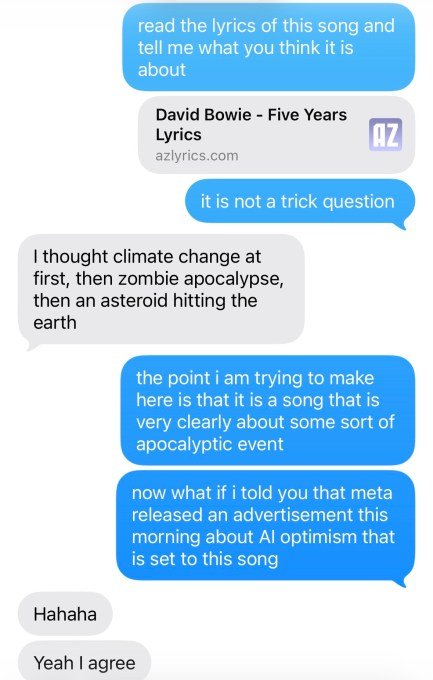
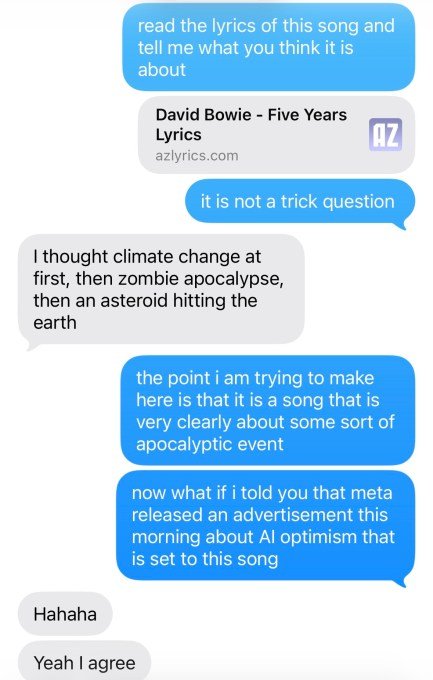
If you’re not familiar with this song, I recommend you listen to it, read the lyrics, and think about what it’s trying to say. It seems clear to me, but I studied poetry in college, so as a control for this experiment, I asked my brother, a blockchain analyst who loves Claude Code and doesn’t read for fun, if he could tell me what the song is about.
“At first I thought about climate change, then the zombie apocalypse, and then the impact of an asteroid on Earth,” he told me. He is right. It’s a song about the human race panicking after learning that they will die in a mass extinction event five years from now.
If you’re not familiar with Bowie’s music, this song may sound happy and inspiring, matching the optimistic tone of the ad. The part of the song used for the ad was probably chosen because it uses the word “people” over and over again, and without the context of the song, it’s not clear what it is about.
But if we look at the lines that directly precede this section:
news had just arrived
We had five years left to cry
The news guy cried and told us
The Earth was really dying
He cried so much that his face was wet.
Then I knew he wasn’t lying.
We “had five years left to grieve” and “the earth was really dying.” It’s pretty grim.
It’s not reassuring to convince people that AI is going to make the world better while playing a song about the end of the world, and yet this contradictory music choice seems to have gone over the heads of everyone at Meta, including CEO Mark Zuckerberg.
“Meta has always believed in giving people the power to share, connect and shape their world the way they want,” he wrote alongside the video. “As we enter this next wave of AI, we continue to believe that the future is for everyone. We are focused on giving every person the tools to reach their full potential and ensuring that the benefits of technology are distributed to all.”
On the other hand, tech leaders are not known for their literary analysis skills. Meta’s Oculus used to give new employees copies of the science fiction novel “Ready Player One,” which is set in a dystopia in which a technology company that makes virtual reality products becomes too powerful and evil. OpenAI CEO Sam Altman has been directly inspired by the movie “Her,” which warns us about what can go wrong when we use AI for emotional support. Palantir, a company that builds artificial intelligence surveillance systems for the government, is named after Palantir, a seer stone from the “Lord of the Rings” franchise that the Dark Lord uses to spy on his enemies. Currently, Elon Musk is furious about the “accuracy” of Christopher Nolan’s successful adaptation of “The Odyssey,” a story with such realistic elements as sea monsters, magic and divine intervention. These guys make a great argument about the value of studying the humanities.
Meta is not alone in its recent promotional weaknesses. Instead of competing to build AGI, the top AI companies seem to be fighting over who can make the creepiest advertising. A few weeks ago, Anthropic released its own disturbing video. As my colleague Lucas Ropek described it:
The ad begins with a video of a house on fire (not exactly a heartwarming start) before cutting to a series of still images. These images include a crowd of people being monitored using facial recognition, a homeless person sleeping on the street, rows and rows of headstones in a cemetery, and what appears to be a group of workers hard at work in a mine where raw materials for smartphones are (presumably) being unearthed.
Meanwhile, a voiceover track features different people asking questions like “Can AI be trusted?” and “Who is going to brake if necessary?”
Anthropic is trying to convince us that it understands the risks that AI poses to society and therefore this is the company that people can trust to develop AI responsibly. The message it actually conveys is closer to the tone of Bowie’s “Five Years.”
OpenAI CEO Sam Altman responded to Anthropic’s announcement: “I thought this was satire, I kept looking for the identifier to be spelled c1audeai or something.”
While these companies strive to control public perception of AI, their efforts don’t appear to be making much progress. A recent Pew survey found that only 16% of Americans think the impact of AI on society over the next 20 years will be positive, and 40% believe it will have a negative impact. Better luck next time, Meta.
When you buy through links in our articles, we may earn a small commission. This does not affect our editorial independence.
For more tech updates, stay tuned to our blog.