Microsoft on Monday launched its first specialized cybersecurity model along with a new AI cybersecurity platform at a small event in San Francisco, dealing a big blow to the major players in the space, namely Anthropic, Google and OpenAI. The company describes MAI-Cyber-1-Flash as a model created “to find challenging vulnerabilities in complex codebases.” The
Microsoft on Monday launched its first specialized cybersecurity model along with a new AI cybersecurity platform at a small event in San Francisco, dealing a big blow to the major players in the space, namely Anthropic, Google and OpenAI.
The company describes MAI-Cyber-1-Flash as a model created “to find challenging vulnerabilities in complex codebases.” The model is designed to animate MDASH, Microsoft’s harness dedicated to identifying and fixing software vulnerabilities.
The new security platform is called Perception and is designed to deploy teams of agents to assist and automate various security workflows, including identifying and correcting errors. The platform can also integrate with MDASH.
The company claims that MAI-Cyber-1-Flash is significantly more powerful (and more cost-effective) than competing models, based on its performance on an established AI cybersecurity benchmark.
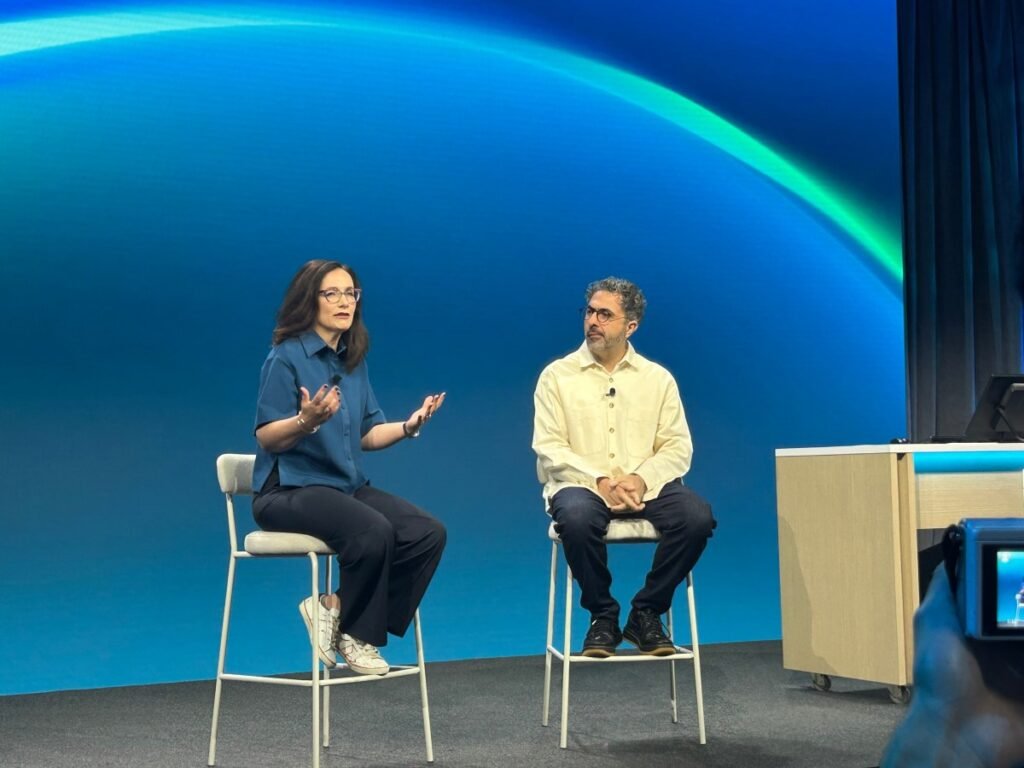
“We are very excited to announce our results,” said Mustafa Suleyman, co-founder of DeepMind and current CEO of Microsoft AI. “We have MAI-1 Cyber Flash linked [sic] with GPT 5.4 within the MDASH harness, which outperforms Gemini, GPT 5.5 Cyber, GPT 5.6 Sol and Mythos 5 in Cyber Gym, which is the main benchmark we all use. The golden benchmark.”
“We are going to send this to production immediately,” he added.
Noting that hackers are increasingly using AI in their cyberattacks, Hayete Gallot, vice president of security at Microsoft, described Perception as a way for enterprise defenders to “defend against AI with AI at the scale and speed that attackers have.”
Perception uses red teams, blue teams, and green teams. Red teams can provide detailed simulations of potential attacks, providing context on potential threat actors and the likely vulnerabilities they could exploit. Blue teams are dedicated to detecting and classifying existing errors, while green teams take “corrective action” against those errors.
Dave Weston, principal engineer at Perception, described the platform as a massive efficiency improvement for corporate defenders. “We’ve gone from taking hours and hours of manual work from various specialized people throughout the security organization (application hunters, remediation engineers, you name it) and within minutes, we have a solution for all of this. Not only do we discover the problems and prioritize them, but we also have detection, posture correction, and even a code fix.”
While AI has offered new defensive capabilities to businesses, its availability to cybercriminals has given rise to a dazzling array of potential threats.
Microsoft’s new security tools, which the company says will be available in preview on Nov. 3, will enter an increasingly populated field of AI cybersecurity solutions. Earlier this year, Anthropic launched Mythos, a security platform that was rolled out to a small group of partner organizations through a program called Glasswing. OpenAI also launched its own security solution in May through a program called Daybreak.
When you buy through links in our articles, we may earn a small commission. This does not affect our editorial independence.
Keep following us for the latest insights.