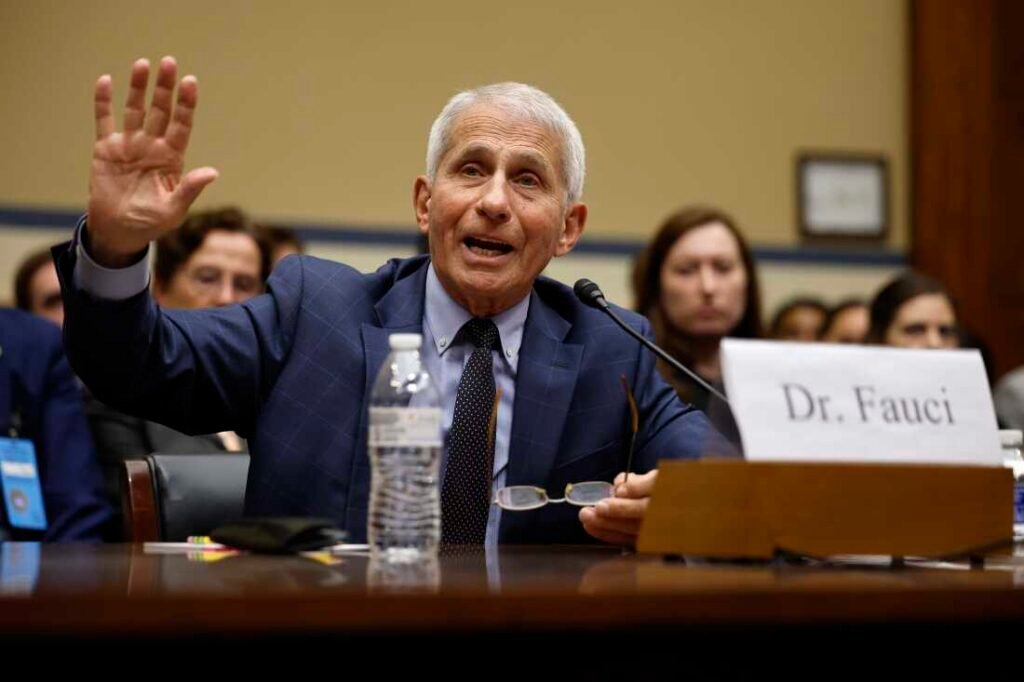
Dr. Anthony Fauci, former director of the National Institute of Allergy and Infectious Diseases, testifies before the House Oversight and Accountability Committee Select Subcommittee on the Coronavirus Pandemic on June 3, 2024 in Washington, DC. Fauci is expected to appear before the Senate Homeland Security and Governmental Affairs Committee on July 29, 2026. Chip Somodevilla/Getty
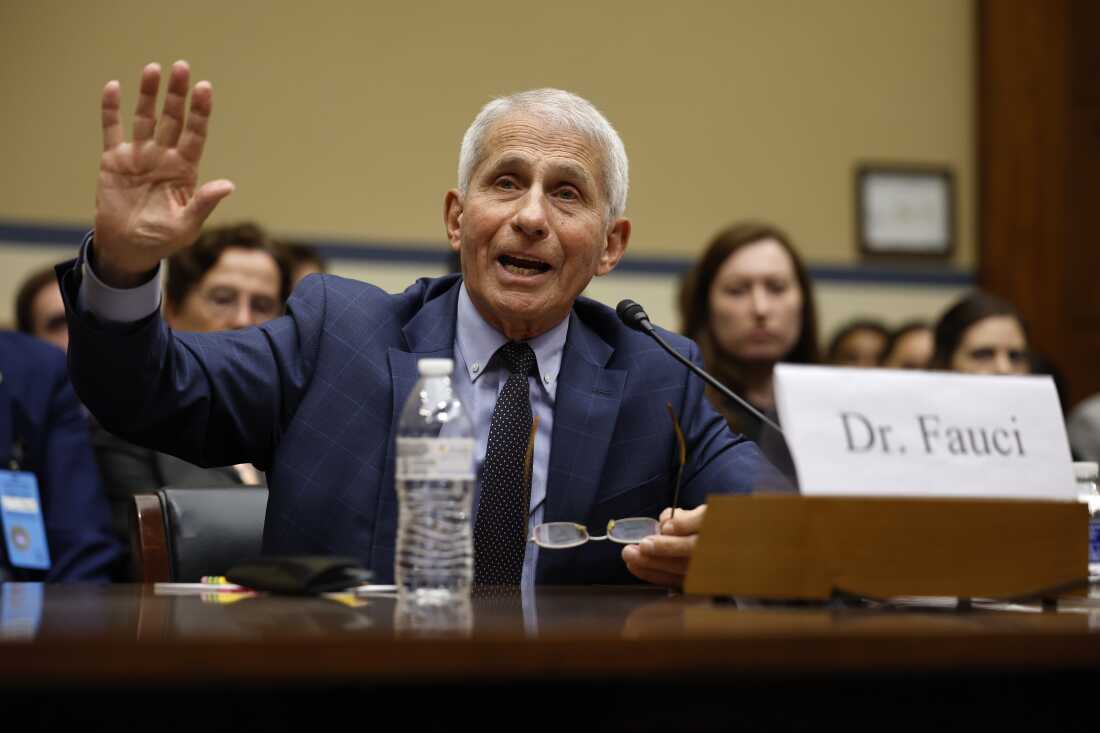
Dr. Anthony Fauci, former director of the National Institute of Allergy and Infectious Diseases, testifies before the House Oversight and Accountability Committee Select Subcommittee on the Coronavirus Pandemic on June 3, 2024 in Washington, DC. Fauci is expected to appear before the Senate Homeland Security and Governmental Affairs Committee on July 29, 2026.
Chip Somodevilla/Getty Images
hide title
toggle title
Chip Somodevilla/Getty Images
Sen. Rand Paul, R-Ky., over the weekend released a tranche of diary entries made by Dr. Anthony Fauci during the COVID-19 pandemic. The 1,141-page document, which was posted over the weekend and was no longer available on the website on Monday, came ahead of Fauci’s appearance before a Senate committee on Wednesday. The entries, and Paul’s commentary on them, highlight the disagreement between the former director of the National Institute of Allergy and Infectious Diseases (NIAID) and some politicians over the origins of the coronavirus.
Paul and Fauci, who was a key member of the White House coronavirus task force, have publicly disagreed for years over how the pandemic began. Even after Fauci resigned from his position at NIAID at the end of 2022, Paul continued to conduct “investigation into the origins of COVID-19 and risky taxpayer-funded life sciences research.”
On Saturday afternoon, as part of this ongoing investigation, Paul posted a thread about [Fauci] “He wrote privately and what he told the country are two different stories.”
Fauci and Paul did not respond to a request for comment from NPR before publication.
Felicia Goodrum, a virologist at Dartmouth College who spoke to NPR from the American Society of Virology meeting in Minneapolis, says Fauci may have been less safe in private with his colleagues as they raced to learn about the new virus than in public, where he had to reassure a population that was panicking about the rapidly emerging pandemic.
For stories of life in our changing world, subscribe here to the global health newsletter.
This thread comes ahead of a hearing scheduled for Wednesday before the Senate Homeland Security and Governmental Affairs Committee, which Paul chairs. Paul unilaterally subpoenaed Fauci to testify after saying that Fauci notified the committee that he would not appear voluntarily. Lawmakers are expected to question Fauci about what he knew and what he didn’t know as the pandemic unfolded.
What does Rand Paul expect to hear from Anthony Fauci?
For years, Paul and Fauci have disagreed about the origins of SARS-CoV-2, the virus that causes COVID-19. Fauci has stated that scientific evidence points to a spillover, whereby the virus would have reached its first human host from an animal and then spread at that point from one human to another.
Proponents of this theory point to the Wuhan wet market, where potentially infected animals were waiting to be sold. “There is very good evidence that there are two lineages [of SARS-CoV-2] that emerged,” according to Goodrum. “Both lineages were present in the market, and susceptible animals were present in the market.
Goodrum says the market was cleared before sampling was possible. However, it says the genetic data “maps all the initial cases in that market” and “none, for example, at the Wuhan Institute of Virology, where they have accused the virus of having been created or released.”
Most scientists in the virology community share this view, according to a survey published in February 2024 by the Global Catastrophic Risk Institute, a nonpartisan U.S.-based think tank that studies potentially catastrophic events.
Paul has argued for an alternative explanation. He says the possibility that the virus was designed in a laboratory should not be ruled out. Two years ago, during a full Senate committee hearing, Paul said, “Do we know for sure that it came from the lab? No, but there is a preponderance of evidence that indicates it may have come from the lab.”
In late 2024, the Republican-led Select Subcommittee on the Coronavirus Pandemic released its final report concluding that a lab leak was the most likely explanation for the origins of SARS-CoV-2. They suggested that NIH funding may have helped support research at the Wuhan Institute of Virology to create a more potent or transmissible virus. This viral improvement is called gain of function.
But Robert Garry, a virologist at Tulane University, says he questions this line of reasoning because “there’s no real evidence for it.” And it says that no one, including the Wuhan Institute of Virology, had a precursor virus similar enough to SARS-CoV-2 to create the pathogen that ultimately caused the pandemic.
Still, Paul suggests that Fauci, his colleagues and certain federal agencies may have covered up any evidence supporting the lab leak theory. In his opinion, he said in that same statement, “they withheld and continue to withhold crucial information from both Congress and the public.”
As noted, NPR contacted Fauci about Paul’s comments but did not receive a response before publication.
What does Paul say these newly published journal entries reveal?
In his posts on X, Paul highlights a few select excerpts from Fauci’s notes. For example, he points to an entry from January 26, 2020, just two months before the World Health Organization declared a global pandemic, where Fauci writes: “the first infection was in early December and was not related to the market… We now know that the market was not the source, but the amplifier.”
Paul notes in his post: “The wet market was already off the table in [Fauci’s] own private notes.”
But in that same journal entry, Fauci adds: “That said, somewhere the virus jumped from animals to humans.”
Less than a week later, in an entry written on February 1, 2020, Fauci listed the dozen researchers who participated in a conference call to discuss the origins of COVID-19. Specifically, they discussed the plausibility that a key part of the SARS-CoV-2 genome could have evolved naturally.
According to their notes, only two of the scientists supported the natural origin of SARS-CoV-2. “The rest considered that deliberate insertion was possible,” he wrote, referring to the hypothesis that the virus was engineered in a laboratory.
In response to that passage, Paul wrote in X: “This was never a 50/50 room,” suggesting that the initial scientific consensus considered a lab leak possible.
But Goodrum says this meeting took place very early, when scientists didn’t have as much data as they would have later. The virologist points out that science is iterative and takes time to develop. What some of those scientists believed at first gave way to a different consensus as more evidence emerged.
“We draw the best conclusions we have with the data we have at that time, but then we will continue working,” he says. “And then, ultimately, you’re going to revisit the original conclusions that you drew. You’re going to change your mind. That’s absolutely fundamental to the way science is done. And it’s something that Fauci really wasn’t given any latitude to do.”
Goodrum adds that Fauci may have been less safe in private with his colleagues as they raced to learn about the new virus than in public, where he had to ensure the public panicked about the rapidly emerging pandemic.
What happens next?
Fauci and Paul will clash publicly again on Wednesday when he testifies before the senator’s committee. Paul will likely ask Fauci about the content of his notes and the specific lines of concern he identified in his thread about X.
Fauci can answer the questions as he has before, describing his and his colleagues’ thought processes at different points in the pandemic.
Previously, Fauci had expressed disinterest in questions about unproven claims about the pandemic. On August 24, 2021, he wrote in his diary: “More conspiracy theories continue to arrive, such as letters from congressmen and senators trying to link us to the origin of COVID-19. This is a staggering and incredible waste of our time.”
But in his thread over the weekend, Paul argued that this wasn’t a waste at all. Rather, “it’s supervision.”
{For more tech updates, stay tuned to our blog.|Keep following us for the latest insights.|Check back often for more exciting news!}