
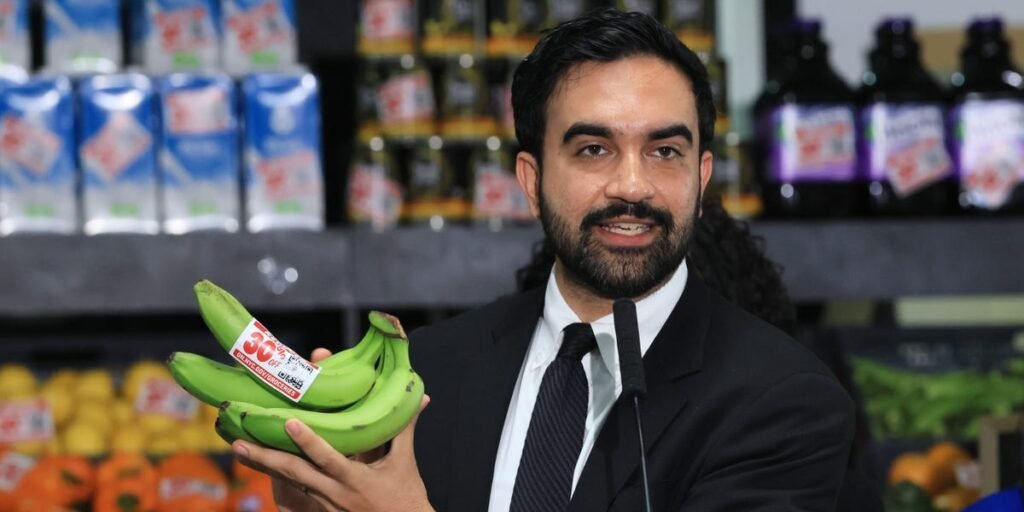
Zohran Mamdani’s city-run grocery store chain, one of his most notable campaign promises, will offer deeply discounted kitchen staples. With overwhelming overhead costs, some local businesses may struggle to compete. The mayor said stores will offer a 30% discount on the “most common and critical foods for families,” such as fresh produce, meat and dairy.
Zohran Mamdani’s city-run grocery store chain, one of his most notable campaign promises, will offer deeply discounted kitchen staples. With overwhelming overhead costs, some local businesses may struggle to compete.
The mayor said stores will offer a 30% discount on the “most common and critical foods for families,” such as fresh produce, meat and dairy. New York City has allocated $70 million in the capital budget to open the stores, which will be subsidized with city funds once they open.
From pricing to historical precedents, here are the biggest takeaways from the plan according to Business Insider.
Buyers could save
The city-run Mamdani stores, set to open in 2029, will be located in each of the five boroughs, with first priority given to the Bronx, with a planned opening in late 2027. Management said its store locations will be based on “where the need is greatest” and that it is using economic data to identify priority neighborhoods.
Food prices in American cities have risen 25% over the past five years, slightly outpacing overall inflation, and a 2024 Sienna survey found that nearly 80% of New Yorkers regularly worried about how to pay for meals.
The 30% discount announced by Mamdani, which will apply regardless of household income, will include staples such as meat, seafood, fresh produce, dairy and pantry staples. The Mayor’s Office projected that New Yorkers who could take advantage of the lower prices would save an average of 15% on their grocery bills, or about $90 a month.
Management said prices for major grocery items will be set monthly and updated periodically to reflect market conditions. And, like retailers like Trader Joe’s, the stores will launch their own private label, “NYC Groceries,” in a variety of categories.
“The savings will last the entire month,” he said. “That means no weekly fluctuations or surprises in checkout lines – neither for our seniors living on fixed incomes nor for parents who depend on a regular supply of apple slices to keep toddler tantrums at bay.”
Mamdani’s group also hopes that in addition to offering cheaper food to New Yorkers, city-run stores will provide more local job opportunities. The city will ask operators to participate in a Labor Peace Agreement to provide workers with benefits and “family-sustaining wages.”
City-run stores have been tried before
Mamdani’s plan will partner city-run supermarkets with private grocery operators. The city will set design requirements, standards and pricing, but will let these third parties manage the stores on a daily basis. The administration is using a similar public-private partnership approach for affordable housing developments.
Still, city-run stores are not a new concept. New York City already has six markets overseen by the Economic Development Corporation, a quasi-public nonprofit organization that manages city-owned properties. Because the city can offer shopkeepers cheaper rents, food in those stores is often cheaper than at private retailers.
There are examples of this all over the United States. St. Paul, a small Kansas city with just over 600 residents, has maintained a city-run store for more than a decade. However, city-owned stores in Kansas City and Baldwin, Florida, closed due to financial problems.
While not run by local governments, many military bases also have commissaries that sell discounted, tax-free groceries and household items, thanks to federal oversight.
Local businesses are skeptical
New York is more than a year away from opening its first city-run store, but some local businesses are already feeling uneasy.
Private grocery stores typically have a very low profit margin (between 1% and 3%) due to high overhead costs for food, rent, staff, equipment, and inflationary pressure.
Smaller businesses, such as bodegas, fruit stands, and convenience stores, also often struggle to make net profits. More than a dozen mobile food vendors told Business Insider this spring that the high cost of food, coupled with a shrinking customer base, makes making a living a challenge. Some Mamdani critics worry that city-run grocery stores will create unsustainable competition with these small businesses.