Shaira Berg (left) smiles during a take for her short film, Gaslight.Credit: Dik Ng Shaira Berg is building a career at the intersection of academic research and creative practice. During her PhD in psychology, which focused on behavioural neuroscience, at the University of Cambridge, UK, Berg collaborated with local video-game studio Ninja Theory. Together, they
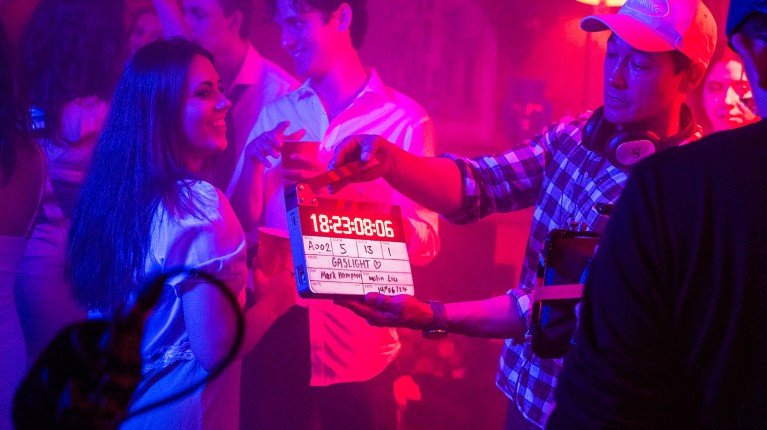
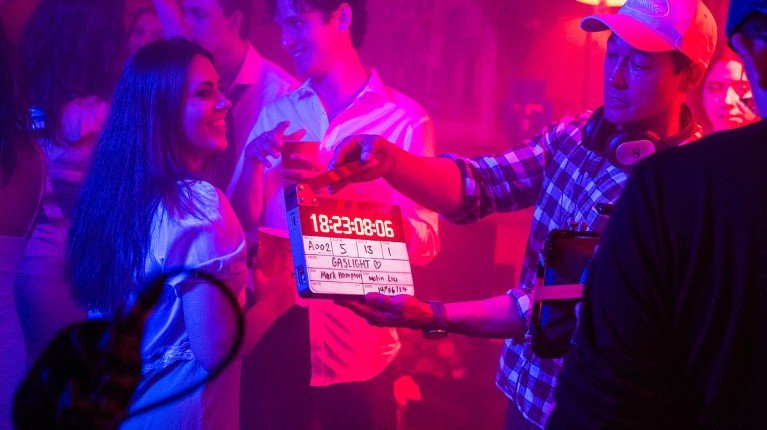
Shaira Berg (left) smiles during a take for her short film, Gaslight.Credit: Dik Ng
Shaira Berg is building a career at the intersection of academic research and creative practice. During her PhD in psychology, which focused on behavioural neuroscience, at the University of Cambridge, UK, Berg collaborated with local video-game studio Ninja Theory. Together, they conducted virtual reality (VR) studies of how threat affects goal-directed learning and maladaptive habit formation in obsessive–compulsive disorder (OCD).
Berg is open about how her scientific pathway has been shaped by personal experiences. Surviving a traumatic event during her doctoral studies altered how she thought about the limits of established research methods for studying the brain after trauma. Rather than separating that experience from her academic work, Berg began to explore how science and creative expression could inform one another.
Alongside her studies, she wrote and starred in Gaslight, a play based on her experience. The work was nominated for an award and was later adapted into a short film, which is now in development as a feature film, broadening her exploration of how creative forms can communicate psychological experience in ways that scientific data alone cannot.
Now a postdoctoral researcher at the University of Texas at Austin, Berg continues to use immersive technologies to study trauma and post-traumatic stress disorder (PTSD). Here, she tells Nature why artistic creativity has a place in science and what researchers can gain from taking unconventional paths.
You’ve worked across clinical behavioural neuroscience, VR, theatre and film. When someone asks what you do, how do you answer?
I’d say I’m a cinematic neuroscientist. My tag line is that I did a PhD in collaboration with a game studio that specializes in immersive horror, looking at maladaptive behaviour. I used a way of testing how people learn, called Pavlovian-instrumental transfer, which examines how environmental cues associated with rewards or threats can influence subsequent behaviours. For example, if someone learns that a blue symbol is associated with a reward, seeing blue while completing a different task might be associated with a ‘positive’ behaviour, such as moving faster or putting in more effort.
For my research, I used custom-built VR scenarios, which allowed us to study how these learnt cues affect behaviour in realistic virtual environments. We published the results this year in Frontiers in Behavioral Neuroscience1, showing that immersion strengthened the more habit-like version of that effect, whereas the goal-directed effect remained constant across different levels of immersion. For OCD, in which habitual responses tend to override goal-directed ones, that result is very important. My current work extends that into fear conditioning and PTSD, for which I still blend neuroscience and film through a collaboration with a film studio.
Creatively, everything I write or direct has a neuroscience grounding. For me, it’s a way of examining human behaviour honestly and portraying it honestly, too. Conditions such as PTSD and OCD are rarely depicted in a way that is both sensitive and faithful to what the conditions actually feel like. I thought I had a way to work on both fronts at once.
How did your training as a neuroscientist shape the way you processed your own trauma, and did the clinical language help or get in the way?
I think lived experience matters enormously in neuroscience: a lot of people who end up studying a condition have some personal connection to it. Neuroscience appealed to me because it felt like a way to understand my own brain better. Studying trauma in depth helped me, in part, to process my own experiences while working towards findings that might lead to treatments for others.
As for the clinical vocabulary, at the PhD level it becomes difficult to translate that into something people outside the field can relate to. That gap was part of what motivated me to write Gaslight. I wanted audiences to feel, even vicariously, what it’s like to live through trauma, using art to communicate the human experience behind the science.
Gaslight began as a play and then became a film. What could these formats do that a research paper couldn’t?
A research paper can describe a condition. A play can put an audience inside it. The overall structure isn’t that different: a paper has a beginning, a middle and an end, and so does a play. The difference is whose shoes you’re in. When I write creatively, I’m working in the mind of whoever is going through that experience. I’ve done stage and film acting since I was 12, and what always fascinated me about it was being able to feel things I hadn’t necessarily felt myself and portray that truthfully. It’s a much more human experience than when I write in a scientific context.
How much did creating Gaslight feed back into your research?
It fed back quite a lot, in the end. Throughout my PhD and my current research, I’ve had to creatively produce fictional scenes to simulate threat behaviour. This is a great way to generate experimental results, without triggering symptoms and upsetting participants. The immersive environments can elicit behaviours that are harder to study using conventional laboratory tasks. We actually found there was a more measurable response under immersive conditions1.
Keep following us for the latest insights.