
Researchers are racing to determine the impact of rising sea surface temperatures on fragile marine ecosystems.Credit: Armando Babani/Getty The world’s oceans are on the brink of setting an all-time heat record, reaching temperatures that could roil marine ecosystems and sap the ocean’s ability to take up carbon dioxide from the air. “It just spells trouble

Researchers are racing to determine the impact of rising sea surface temperatures on fragile marine ecosystems.Credit: Armando Babani/Getty
The world’s oceans are on the brink of setting an all-time heat record, reaching temperatures that could roil marine ecosystems and sap the ocean’s ability to take up carbon dioxide from the air.
“It just spells trouble for the planet,” says Kristina Dahl, a climate scientist at Climate Central, a non-profit organization in Princeton, New Jersey.
Sea surface temperatures — boosted by human-caused climate change and a powerful El Niño event gaining strength in the Pacific Ocean — have already broken monthly records for the past two months, according to the European Commission’s Copernicus Climate Change Service. In July, the average sea surface temperature outside the Arctic and Antarctic oceans was 20.96 °C, surpassing the previous July record set in 2023 by 0.07 °C, the agency reported. That followed a record hot June (see ‘Hot water’).
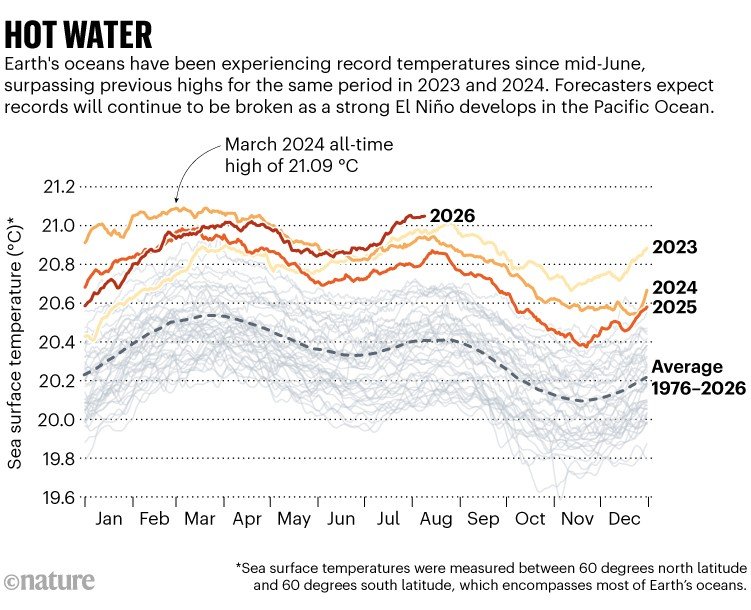
Source: Copernicus Climate Change Service/European Centre for Medium-Range Weather Forecasts
This leaves the oceans about to become hotter than they’ve been at any other point on record: average sea surface temperatures are currently hovering just a few hundredths of a degree below the current record from March 2024. Given that temperatures tend to rise for months after the emergence of an El Niño, this record will almost certainly be broken this year. “It’s just a case of when,” says Samantha Burgess, a climate scientist and Copernicus’ deputy director in Reading, UK.
Much of the anomalous heat comes from a warm band of water across the tropical Pacific that marks the El Niño climate pattern, which forecasts suggest could become the strongest on record. But El Niño isn’t the whole story. Wide areas of the northern Pacific and Atlantic, as well as much of the Mediterranean Sea, are notably hotter than the average temperature from the three decades before 2020.
An analysis tool developed by Climate Central shows that human-caused climate change made the high temperatures in many parts of the ocean dozens of times more likely. “Basically, everywhere on Earth, we’re having above-normal temperatures in the ocean,” says Dahl.
Deja Vu
The heat comes after sea surface temperatures shattered records in 2023 and 2024. That period also included an El Niño event on top of background global warming, but the size of the temperature spike stunned scientists. The event spurred a debate about whether the planet’s climate sensitivity — how much it warms in response to human emissions — is higher than anticipated by climate models. “We don’t know why the ocean has behaved differently for the last four years,” says Burgess.

This El Niño is set to be the largest on record by a ‘mind-blowing margin’
This year’s temperatures surpass records by a more modest margin, says Jens Terhaar, an ocean modeller at the University of Bern. However, the record-breaking heat is likely to fuel more discussion about climate sensitivity. “It should definitely ring some alarm bells,” he says.
The consequences of high ocean temperatures include impacts on fisheries — for instance, El Niño is associated with steep declines in anchovy populations in the waters off the Pacific coast of South America. Marine heat waves also affect people living along adjacent coasts, boosting temperatures and humidity, often overnight.
But among the most acutely vulnerable to high ocean temperatures are the planet’s coral reefs. “It’s basically a terrifying time for corals and coral-reef ecosystems,” says Amy Apprill, a marine geochemist at the Woods Hole Oceanographic Institution in Massachusetts.
For more tech updates, stay tuned to our blog.